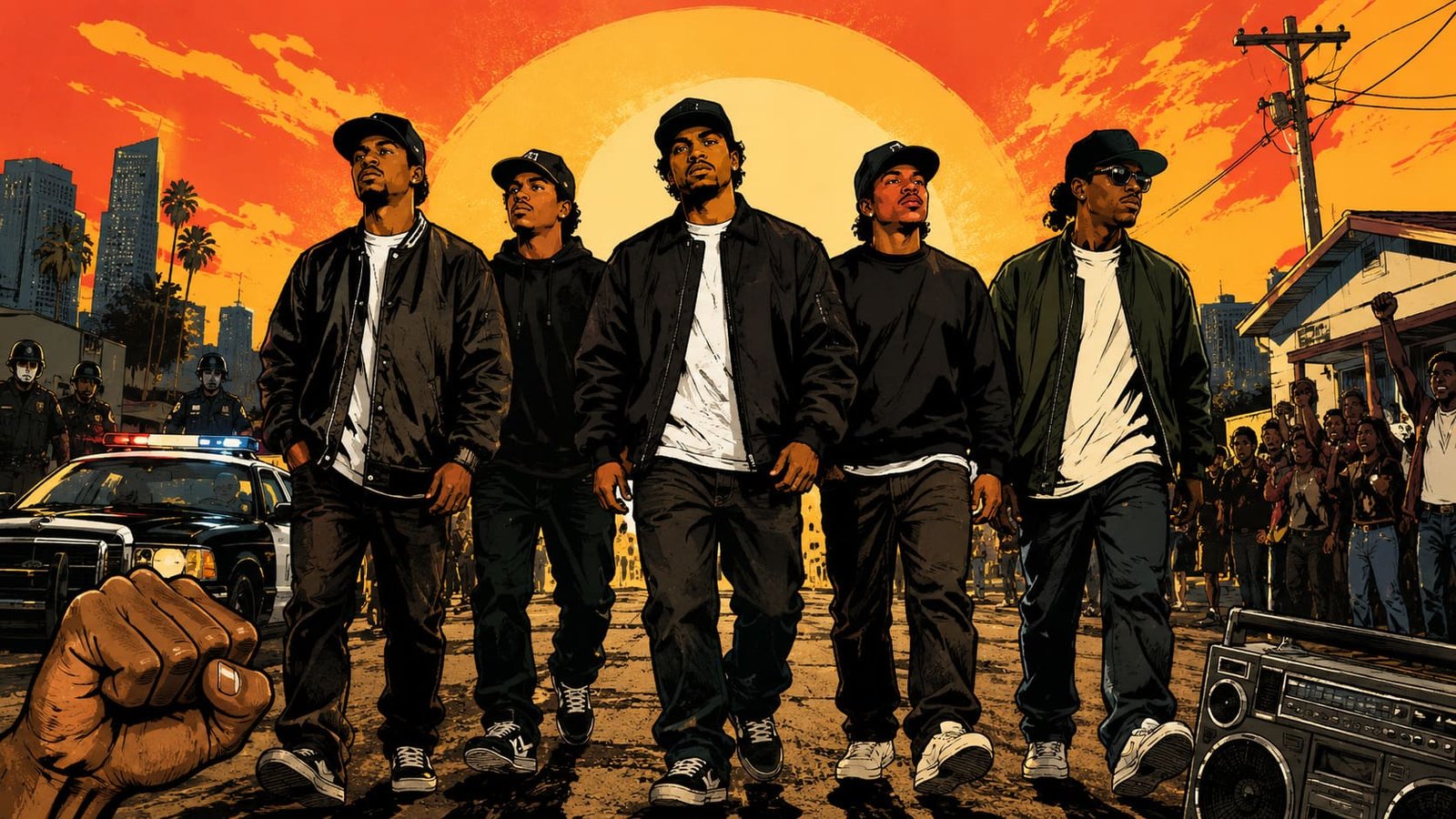
Los Angeles breathed like a city arguing with itself. Helicopters circled low over neighborhoods where sirens had become background music. Liquor store signs flickered beside murals fading under brutal sunlight. Police cruisers rolled through streets with the slow menace of sharks testing water. Teenagers leaned against chain-link fences trading jokes sharp enough to survive another afternoon. Somewhere between the bass lines rattling car windows and the smoke drifting from crowded sidewalks, a generation realized nobody powerful planned to tell their story honestly. So they grabbed microphones instead.
Straight Outta Compton arrives with the force of a public warning disguised as entertainment. Directed by F. Gary Gray, the film traces the rise of the rap group N.W.A., including Dr. Dre, Ice Cube, and Eazy-E. Most musical biopics worship fame like a glittering reward at the end of suffering. This film treats fame more like a Molotov cocktail thrown through America’s carefully polished self-image. That distinction matters because the story was never only about music. It was about power noticing voices it could no longer comfortably ignore.
The genius of N.W.A. came from understanding something corporate institutions still struggle to grasp today: authenticity terrifies systems built on controlled narratives. Their music sounded dangerous because it refused polite translation. Radio executives worried about outrage. Politicians panicked about influence. Parents feared corruption. Yet millions of listeners heard something entirely different beneath the aggression. Recognition. Rage finally articulated clearly. Modern organizations spend fortunes trying to manufacture relatability through branding campaigns and algorithmic empathy. N.W.A. achieved it through raw truth delivered without permission.
A radio producer in Johannesburg named Kelechi once described hearing “Fuck tha Police” for the first time through scratched headphones during a crowded taxi ride. The song felt illegal and strangely liberating at once. Years later, while managing commercial artists for major sponsors, Kelechi noticed executives constantly asking musicians to become “edgier” while simultaneously avoiding anything genuinely uncomfortable. One singer lost a campaign deal after criticizing housing inequality during a live interview. The company called the comments “too divisive.” Kelechi laughed bitterly afterward. “Everybody wants rebellion,” he said, “until rebellion starts naming real people.” Straight Outta Compton understands that hypocrisy perfectly.
The film also functions as a devastating study of business exploitation. Young artists enter the music industry believing talent guarantees freedom. Instead, contracts become invisible cages wrapped in expensive promises. Jerry Heller, portrayed by Paul Giamatti, does not present himself as a cartoon villain. That subtlety makes the story sharper. Exploitation rarely introduces itself honestly. It arrives smiling warmly while explaining percentages. The entertainment industry often mirrors broader capitalism with eerie precision: creativity generates wealth while intermediaries absorb control. Artists become brands. Pain becomes inventory.
There is a remarkable emotional tension running through the film between brotherhood and ambition. Success expands opportunity while quietly poisoning trust. Eazy-E wants legitimacy. Ice Cube wants ownership. Dr. Dre wants artistic freedom. Each vision collides against the machinery of fame differently. Watching those relationships fracture feels painfully familiar because every ambitious collective eventually faces the same question: what survives once individual hunger grows louder than shared struggle? Startups collapse from it. Political movements implode from it. Families rot from it. N.W.A. simply experienced the conflict under brighter lights and louder consequences.
One independent game developer from Seoul named Hana built a wildly successful online platform with three close friends from university. During the early years they slept beside laptops, surviving on instant noodles and caffeine. Once venture capital arrived, meetings changed texture completely. Lawyers entered conversations. Equity discussions replaced late-night jokes. By the second acquisition offer, two founders stopped speaking except through email threads reviewed by legal teams. Hana later admitted the strangest part was how ordinary the emotional collapse felt. “Nobody betrayed anyone dramatically,” she explained quietly. “The pressure just rearranged people.” That same emotional rearrangement pulses throughout Straight Outta Compton.
The movie becomes especially powerful when examining public fear. America often romanticizes rebellion decades after punishing it in real time. N.W.A. faced surveillance, censorship, and political condemnation precisely because they shattered the illusion that marginalized communities were invisible or passive. Their music exposed systemic violence with language too direct for comfortable audiences. That directness still feels radioactive. Entire industries now profit from sanitized versions of resistance while avoiding the discomfort of actual structural critique. The film refuses sanitization. It leaves rough edges exposed deliberately.
One scene involving a concert performance crackles with emotional electricity. Security forces hover nearby like pressure waiting to explode. Crowds roar with the hunger of people hearing themselves reflected back honestly for perhaps the first time. The moment transcends music entirely. It becomes about psychological release. Human beings can survive poverty, surveillance, humiliation, even fear for astonishing lengths of time. Silence breaks them faster. N.W.A. disrupted silence. That disruption carried consequences powerful enough to echo far beyond rap culture.
By the final moments, Los Angeles still hums beneath neon and smoke. Young artists still scribble lyrics inside cramped apartments while executives calculate marketability from polished conference rooms miles away. Somewhere another generation is discovering that systems rarely surrender dignity voluntarily. Straight Outta Compton leaves behind a realization too sharp for corporate slogans: culture changes when people stop begging for permission to describe reality honestly. And once that honesty enters the bloodstream of a society, even the loudest institutions begin sounding strangely afraid of their own silence.
Editorial Disclaimer: Whether a film is rooted in fiction or inspired by real events, the actions, decisions, and behaviors portrayed within are not intended to be encouraged, replicated, or endorsed in real-world settings. This review exists solely to analyze the storytelling, characters, themes, and business dynamics presented in the film for educational, analytical, and entertainment purposes. Any ethical or unethical conduct depicted in the film does not reflect the views, values, or endorsements of ESYRITE.
