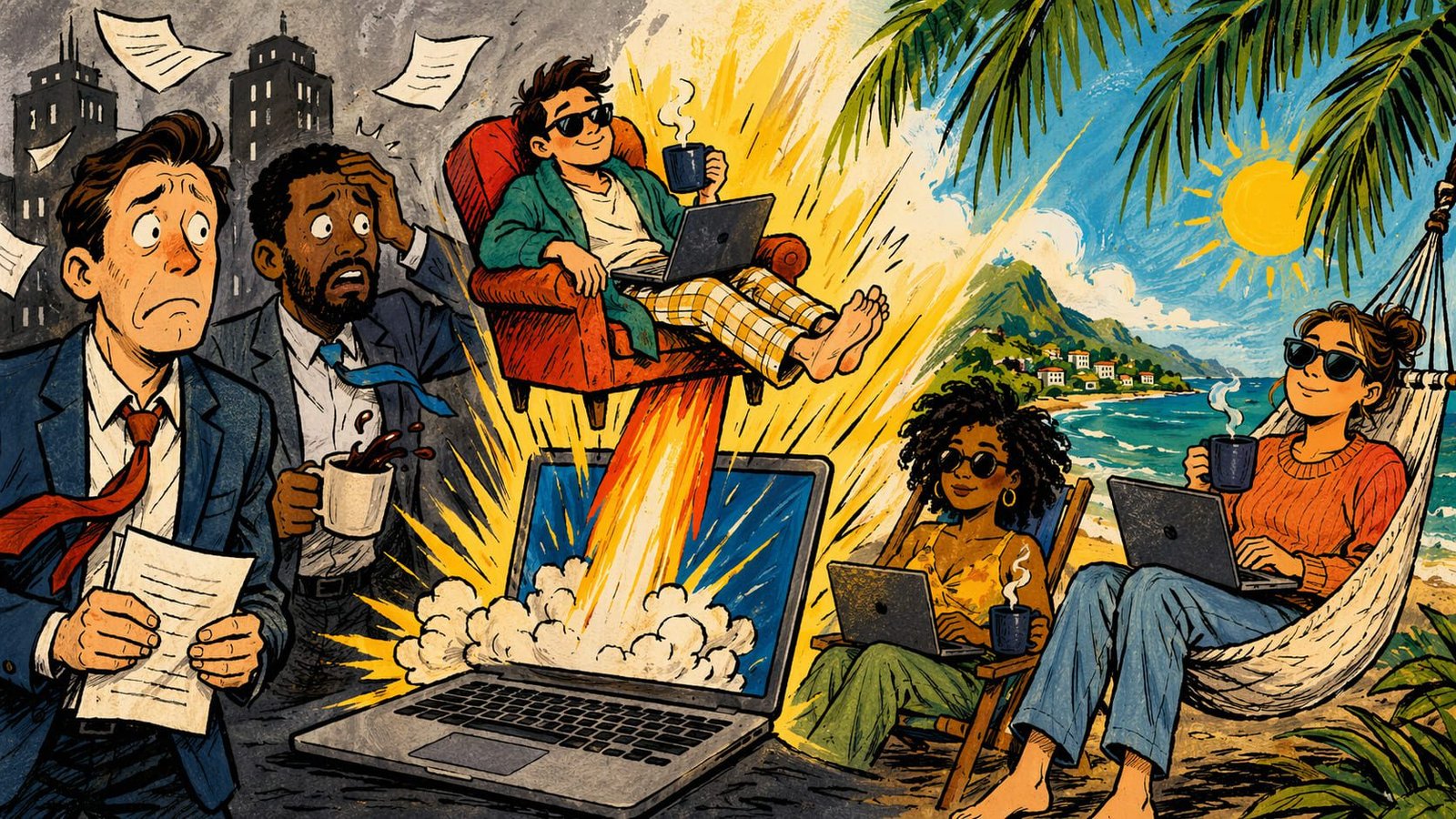
Footsteps echoed through an office built for hundreds, yet only a security guard crossed the polished floor before disappearing behind silent elevators. Rows of immaculate desks stood untouched while video calls stitched together conversations unfolding across continents. Business power had quietly changed its address. Headquarters no longer defined influence as decisively as they once did. A founder could now assemble extraordinary talent without sharing a city, a country, or even a time zone, reshaping entrepreneurship more profoundly than many executives first imagined.
Remote work is often mistaken for a workplace perk. It is better understood as a strategic redesign of how organizations create value. GitLab proved that an entirely remote company could coordinate thousands of employees across the world while documenting nearly every process with remarkable transparency. Automattic, the company behind WordPress.com, followed a similar philosophy by building culture through deliberate communication rather than physical proximity. Success came not from abandoning offices but from replacing assumptions with systems designed for distributed excellence.
A neighborhood jazz band rehearsing in separate studios sounds impossible until every musician learns to trust rhythm instead of eye contact. Remote organizations face the same challenge. Isabella launched a design agency with freelancers scattered across four countries. Early projects drifted because expectations lived inside conversations rather than written processes. She began documenting decisions, recording walkthroughs, and clarifying responsibilities before work began. Productivity rose because clarity traveled farther than charisma ever could across digital screens.
Distance exposes weak leadership with surprising speed. Managers who once relied on physical supervision often struggle when visibility disappears, while leaders focused on outcomes discover unexpected freedom. Shopify embraced remote work as a long-term strategy, encouraging teams to rethink collaboration instead of recreating office routines online. Raj experienced a similar transformation inside his consulting business. Weekly progress reports gave way to measurable outcomes, customer feedback, and shared accountability. Employees felt trusted. Clients noticed faster decisions rather than fewer meetings.
Curiously, migratory birds maintain astonishing coordination without a central commander barking instructions through the sky. Each adjusts continuously according to subtle signals from others. Healthy remote companies behave in much the same way. Elena worried that culture would vanish once employees stopped gathering around office coffee machines. Instead, intentional rituals emerged. Virtual celebrations, handwritten welcome packages, mentorship sessions, and informal digital conversations created stronger connections because relationships became purposeful instead of accidental.
Moonlight reflected from empty parking spaces outside buildings once celebrated as symbols of corporate success. Walls had not lost their usefulness, yet they no longer defined where ambition gathered or innovation flourished. Entrepreneurship entered an era where influence traveled through trust, documentation, shared purpose, and thoughtful communication rather than office addresses. Power now belongs to founders who build organizations people choose to belong to, even when nobody shares the same room.
