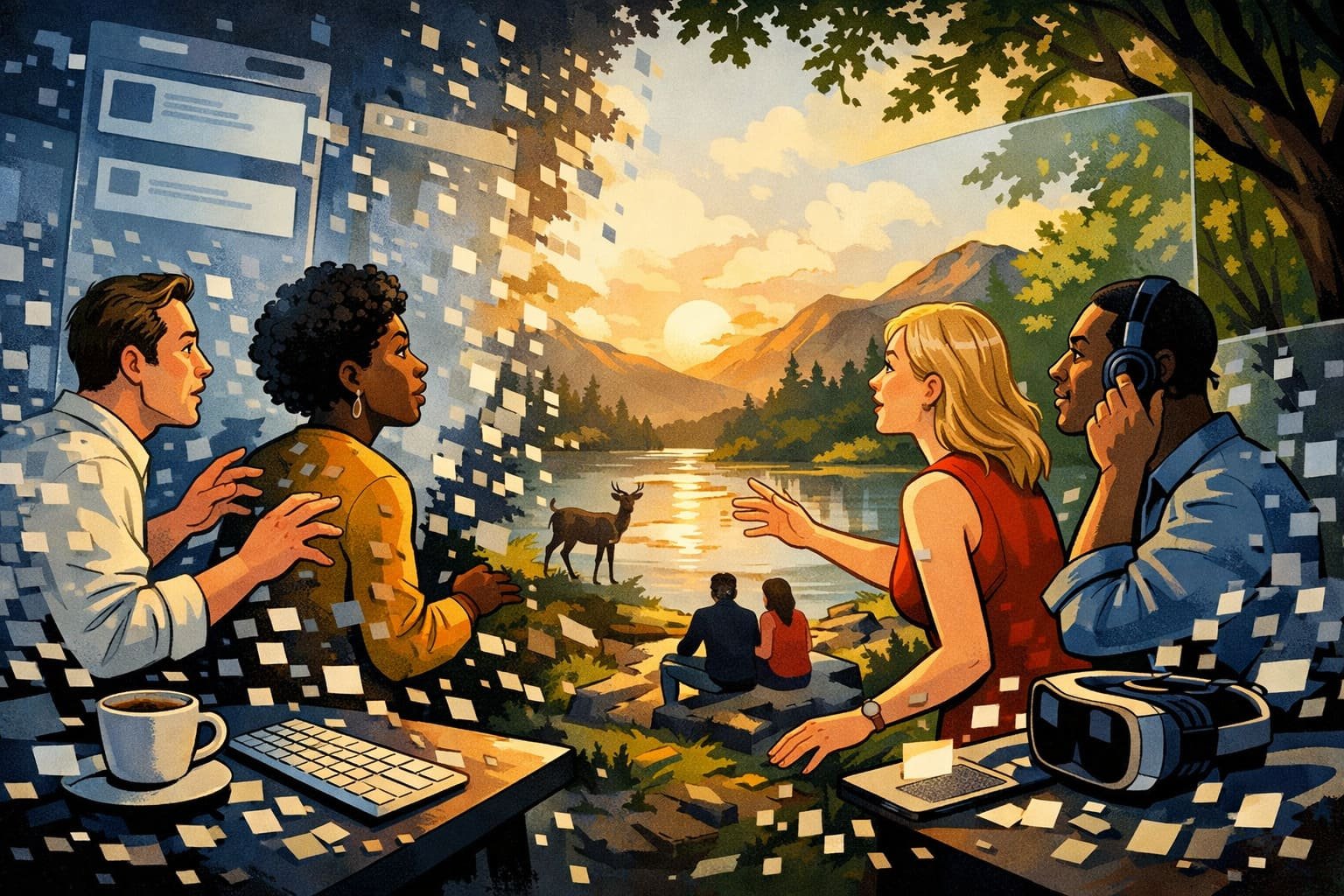
A woman stood at a crowded train station staring into empty space. No phone glowed in her hand. No laptop rested beneath her arm. No smartwatch demanded attention. Yet information flowed around her constantly. Directions appeared when needed. Messages surfaced naturally. Context followed her movement like an invisible companion. To a passerby, it looked like nothing was happening. In reality, everything was happening.
The Screen Starts Disappearing: Why Technology Is Learning To Vanish
For decades, technology demanded physical presence. Computers occupied desks. Smartphones occupied pockets. Applications occupied screens. Every digital interaction required a destination. People traveled toward technology. Technology rarely traveled toward people. That arrangement is beginning to feel outdated.
The most important innovation in modern computing may not be a device. It may be the disappearance of devices into everyday life. The future increasingly belongs to ambient computing, spatial experiences, contextual intelligence, wearable technology, and systems designed to fade into the background rather than dominate attention.
This represents a profound shift in digital transformation. Technology spent years becoming more powerful. Now it faces a stranger challenge. It must become less visible.
Attention Wars: Screens Became Too Successful
The smartphone achieved something remarkable. It compressed communication, entertainment, navigation, commerce, and social interaction into a single object. Then success created an unintended consequence.
Modern life became organized around screens. People wake up checking notifications. Meetings revolve around presentations. Relationships pass through messaging platforms. Entire afternoons disappear into endless scrolling. The screen became both portal and prison.
A product strategist named Orson once conducted a study observing commuter behavior. Nearly every passenger stared downward. Some switched between applications dozens of times within minutes. Few noticed the city moving beyond the windows. The technology worked exactly as designed. The human experience felt diminished.
This realization sparked a growing movement across the technology industry. Designers began asking a dangerous question. What if the ultimate user experience involves fewer interactions rather than more?
The answer challenges decades of digital thinking. The best interface increasingly resembles an interface that barely exists. Technology becomes valuable not when it captures attention but when it returns attention to the world.
Ambient Intelligence: The Rise Of Invisible Computing
Most technological revolutions announce themselves loudly. Ambient computing arrives almost silently. Instead of forcing users to navigate menus, applications, and dashboards, intelligent systems increasingly understand context. Devices anticipate needs. Information appears at appropriate moments. Interactions become conversational, natural, and frictionless.
A healthcare consultant named Ysella experienced this transition during a pilot project involving wearable monitoring systems. Traditional healthcare technology generated endless alerts and dashboards. New ambient systems quietly tracked meaningful signals and surfaced information only when intervention became necessary. Patients felt less monitored. Outcomes improved.
This shift resembles electricity. People rarely think about electrical systems until they fail. The technology succeeds because it becomes part of the environment rather than the center of attention.
Science fiction often imagined futuristic interfaces filled with floating holograms and dazzling visual effects. Reality appears more subtle. The most advanced systems increasingly remove complexity rather than display it. Intelligence becomes atmospheric.
The result is counterintuitive. The more sophisticated technology becomes, the less people may notice its existence.
Presence Economy: Human Attention Becomes Premium
A curious cultural reversal is unfolding. For years, technology companies competed aggressively for attention. Notifications multiplied. Content feeds expanded. Engagement metrics became obsession. Now presence itself is becoming valuable.
People increasingly seek experiences free from constant interruption. Digital wellness movements gain momentum. Minimalist technology philosophies attract followers. Consumers show growing interest in products that support focus rather than fragmentation.
A founder named Kaia launched a startup centered around intentional technology design. Investors initially questioned the premise. Conventional wisdom favored maximizing engagement. Her products prioritized calm, clarity, and cognitive space. Adoption exceeded expectations because customers were not purchasing software. They were purchasing relief.
The broader implication reaches beyond product design. Businesses increasingly compete on trust, simplicity, and emotional experience. The ability to reduce noise becomes a strategic advantage.
One of the strangest truths of the digital economy is emerging in plain sight. Attention was once treated as an unlimited resource. Reality revealed it as one of the scarcest assets on earth.
The Great Interface Paradox: Technology Wins By Leaving
Every major technological era developed around visible objects. Factories symbolized industrial power. Automobiles represented mobility. Smartphones defined the mobile age. The next era may lack a defining object altogether.
Artificial intelligence, spatial computing, voice interaction, wearable ecosystems, and contextual platforms increasingly distribute computing across environments rather than concentrating it within devices. Technology becomes woven into surroundings.
An innovation researcher named Tarian attended a technology showcase filled with prototypes. Some products featured extraordinary engineering. Others barely looked technological at all. The least noticeable solutions generated the strongest reactions. People remembered experiences rather than hardware.
This introduces a paradox that many organizations struggle to understand. Visibility no longer guarantees value. Complexity no longer signals sophistication. Presence increasingly outweighs performance theater.
The companies most likely to shape the future may not build products that demand attention. They may build systems that quietly enhance life while remaining almost invisible.
The Moment After The Screen: Where Humanity Looks Next
A child reaches toward a tree branch while an intelligent system quietly translates curiosity into knowledge. No application launches. No search bar appears. No screen interrupts the moment. Information arrives and disappears like a passing breeze.
Elsewhere, architects design environments where digital intelligence blends seamlessly into physical spaces. Healthcare providers integrate monitoring systems that support patients without overwhelming them. Educators experiment with learning experiences that feel less like software and more like discovery.
The transformation feels technological on the surface. Beneath it lies something deeply human.
For years, society adapted itself around machines. Daily habits, communication patterns, workplaces, and relationships bent toward technological limitations. A reversal has begun. Technology increasingly bends toward human behavior instead.
A glass display sits dark on a desk that no longer needs it. Dust gathers slowly across its surface. The object remains functional. Its importance has faded. Nearby, intelligence flows quietly through the environment, almost invisible, almost forgotten, and infinitely more integrated.
The future may belong not to the technologies people notice most, but to the ones that disappear so completely that life finally feels like life again.