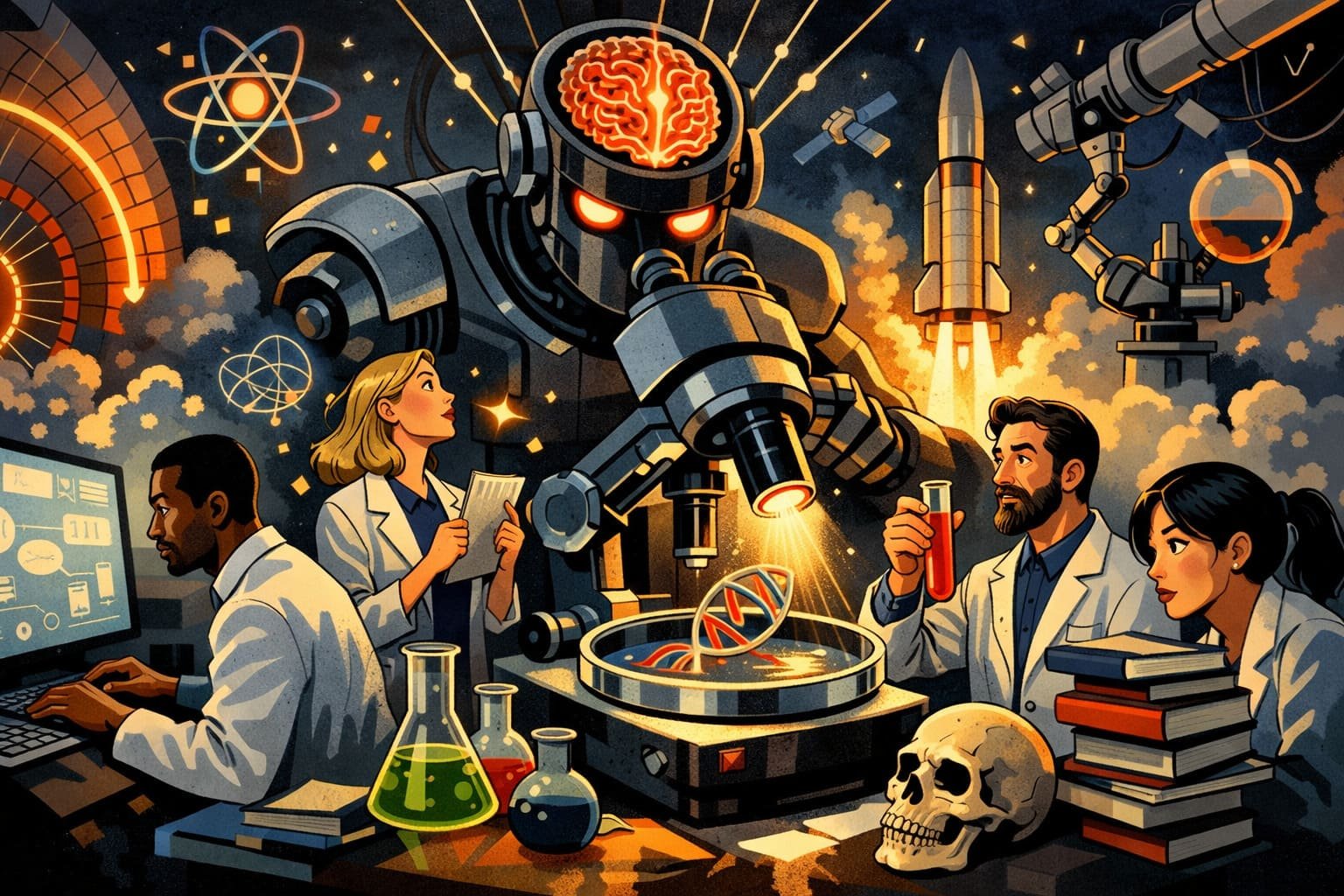
The laboratory was not asleep. Screens glowed through the darkness while automated systems sifted through oceans of information. Scientific papers multiplied faster than any human mind could absorb them. Hidden patterns drifted through datasets like constellations waiting for recognition. Somewhere inside that digital flood, discoveries were already present. The challenge was finding them before time did.
The Last Human Bottleneck: When Discovery Stops Waiting
For centuries, scientific progress moved at the speed of human attention. Researchers read papers, tested theories, debated ideas, and slowly assembled knowledge one piece at a time. The process produced remarkable achievements. It also carried a limitation that few people discussed. Human curiosity was infinite. Human bandwidth was not.
That limitation has become impossible to ignore. Every day produces new research, new findings, new experiments, and new observations. Entire fields generate more information than individual experts can reasonably consume. Knowledge itself has become an abundance problem.
Artificial intelligence entered this environment like a new species entering an old ecosystem. Instead of replacing scientists, it began hunting through complexity. It searched for patterns hidden across millions of connections. It identified relationships that might otherwise remain invisible for decades.
A strange reality is emerging. Humanity may be approaching a future where the greatest scientific discoveries are not limited by what is unknown. They are limited by what remains unnoticed.
Data Oceans: The Knowledge Explosion Nobody Can Read
The modern scientific landscape resembles a library expanding faster than anyone can walk through it. Every discipline contributes new shelves. Every breakthrough creates fresh questions. Every answer generates additional complexity.
Researchers face a challenge rarely discussed outside academic circles. Valuable insights often remain buried because no individual can connect every relevant piece of information across multiple fields. Knowledge exists. Discovery sometimes stalls because the dots remain disconnected.
A materials scientist named Vesper spent months investigating a manufacturing challenge. Progress felt painfully slow. Then an AI research tool identified a seemingly unrelated paper from a different scientific discipline. The connection proved valuable. What appeared to be separate worlds contained a hidden bridge. Years of assumptions shifted within days.
This represents one of the most important developments in scientific innovation. Artificial intelligence excels at identifying relationships across enormous volumes of information. It sees patterns unconstrained by disciplinary boundaries. Biology can inform engineering. Physics can inspire medicine. Chemistry can reshape energy research.
Popular culture often portrays intelligence as knowing more. The future may reward something different. The ability to connect distant ideas increasingly matters more than accumulating isolated facts.
Discovery Engines: The Rise Of Scientific Acceleration
Scientific progress has traditionally depended on cycles of observation, hypothesis, experimentation, and validation. Those foundations remain essential. What changes is the speed at which possibilities can be explored.
AI-powered research platforms analyze complex datasets at extraordinary scale. Drug discovery systems evaluate potential compounds more efficiently. Climate models process environmental variables with greater sophistication. Astronomical research benefits from automated pattern recognition across vast observational datasets.
A biotech founder named Soren launched a research company focused on therapeutic development. Early projects followed traditional timelines. New AI systems transformed workflows dramatically. Researchers spent less time searching and more time evaluating meaningful possibilities. The machine accelerated exploration. Human expertise guided judgment.
This distinction matters enormously. Artificial intelligence does not eliminate scientific thinking. It amplifies scientific capacity. The relationship resembles a telescope extending vision rather than replacing eyesight.
History offers useful perspective. Microscopes revealed invisible biological worlds. Telescopes expanded humanity’s understanding of the universe. Artificial intelligence may become the next great scientific instrument. It extends cognition itself.
The New Alchemists: When Machines Suggest The Impossible
Some of the most fascinating scientific breakthroughs emerge from unexpected directions. Innovation frequently begins where conventional thinking ends.
Artificial intelligence possesses a peculiar advantage. It lacks attachment to established assumptions. Human experts often inherit intellectual traditions that shape perception. Machines evaluate possibilities without career investments, academic loyalties, or institutional habits.
An oceanographer named Linara encountered this phenomenon while studying marine ecosystems. An AI model suggested an unusual relationship between environmental variables that contradicted prevailing assumptions. Initial skepticism felt justified. Subsequent investigation revealed valuable insights hidden beneath conventional frameworks. The machine had stumbled into a blind spot that experts overlooked.
This creates an uncomfortable tension. Expertise remains indispensable. Expertise can also become a filter. Knowledge occasionally protects outdated ideas long after evidence begins shifting beneath them.
Scientific revolutions often start with observations that appear absurd. The Earth orbiting the Sun sounded ridiculous. Continental drift seemed implausible. Germ theory faced resistance. AI increasingly acts as a generator of intellectual discomfort. It proposes possibilities that established thinking may initially reject.
Intelligence Against Ignorance: The New Arms Race
Civilizations have always competed through knowledge. The tools change. The principle remains constant.
Artificial intelligence is transforming research into a strategic asset. Governments invest heavily in scientific capabilities. Universities embrace advanced computational systems. Private companies race to accelerate innovation. The competition increasingly revolves around who can generate useful knowledge fastest.
A technology strategist named Zephra attended an international innovation summit where conversations repeatedly returned to one theme. Scientific advantage no longer depended solely on funding or talent. It increasingly depended on information processing capacity. The institutions capable of learning fastest gained disproportionate influence.
This shift affects more than research laboratories. Healthcare advances. Energy systems improve. Manufacturing evolves. National competitiveness increasingly depends on scientific agility. Discovery becomes infrastructure.
The most significant resource of the twenty-first century may not be oil, rare minerals, or even data itself. It may be the ability to transform information into insight before competitors recognize its value.
The Mind Beyond The Horizon: What Happens After Discovery Accelerates
Far from conference halls and research facilities, most people remain unaware of how dramatically the machinery of discovery is changing. Yet the effects will eventually touch every aspect of daily life.
A scientist reviews findings generated through collaboration with systems that never sleep. A physician benefits from treatments discovered through accelerated research. An entrepreneur builds products upon knowledge that might have required decades to uncover through traditional methods. Invisible acceleration becomes visible progress.
The old image of science featured solitary geniuses wrestling with mysteries. The emerging reality feels different. Discovery increasingly resembles a vast network where human intuition and machine intelligence operate together. Neither dominates. Both contribute strengths the other lacks.
A weathered notebook sits beside a sophisticated computational platform. One contains sketches, questions, doubts, and flashes of inspiration. The other processes patterns across unimaginable scales. Together they tell the story of modern science. Curiosity remains human. Its reach has expanded.
The defining question is no longer how much humanity can learn. The defining question is whether wisdom can evolve as quickly as knowledge now moves. And somewhere beyond the next breakthrough, that question is already waiting.