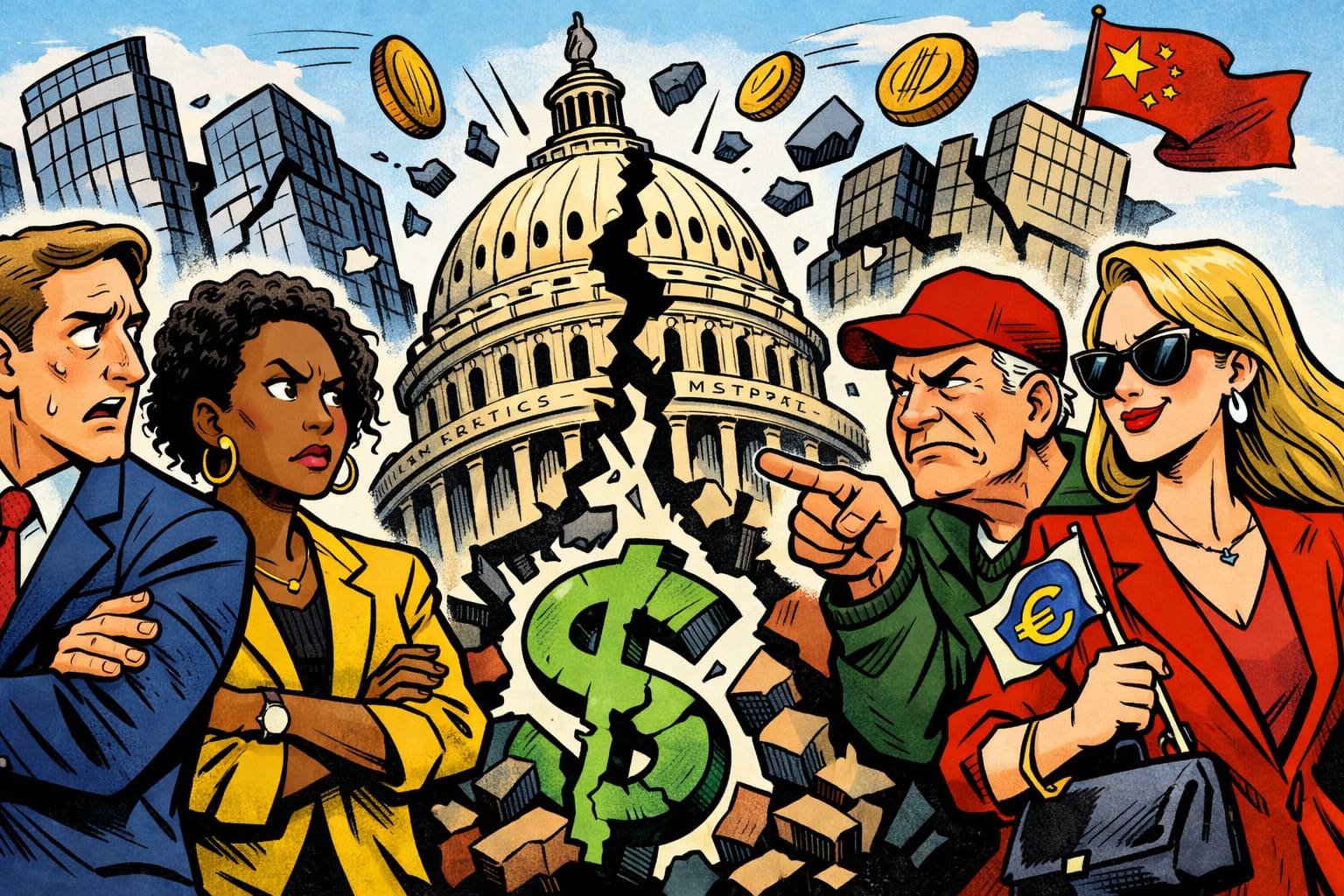
Border checkpoints usually inspect passports, not investment portfolios. Yet somewhere between parliamentary debates, sanctions announcements, election rallies, and diplomatic disputes, capital has quietly acquired a nationality. Investors once celebrated globalization as an unstoppable current carrying money wherever returns looked strongest. That certainty has weakened. Politics has stepped back into finance with remarkable force, turning supply chains, stock exchanges, semiconductor factories, and banking relationships into strategic instruments rather than merely commercial opportunities.
Financial fragmentation describes a world where geopolitical interests increasingly influence where money flows, how businesses raise capital, and which markets investors trust. Globalization has not disappeared. It has become more selective. Governments now weigh national security alongside economic efficiency when evaluating foreign investment, technology transfers, and infrastructure ownership. Those choices reshape capital allocation. Investors who once focused almost exclusively on profitability must now consider diplomatic relationships, regulatory shifts, and strategic alliances before committing long-term funding.
Recent tensions surrounding advanced semiconductor manufacturing reveal how quickly politics can reshape financial decisions. Companies such as TSMC, Intel, and Samsung now make investment choices influenced not only by customer demand but also by government incentives, export controls, and strategic industrial policies. A robotics manufacturer led by Farid discovered this firsthand after planning a factory expansion dependent upon overseas suppliers. Financing remained available, yet lenders demanded contingency plans addressing geopolitical disruption before approving long-term credit. Markets still rewarded ambition. They simply insisted upon resilience first.
Economists traditionally argued that capital naturally seeks its highest return regardless of borders. That assumption appears increasingly incomplete. Financial systems depend upon legal certainty, institutional trust, and stable international relationships, all of which politics can strengthen or weaken overnight. Diversification itself has acquired a different meaning. Companies now diversify suppliers, financing sources, production facilities, and even customer bases because concentration risk extends beyond economics into diplomacy. Balance sheets increasingly reflect geopolitical strategy as much as financial optimization.
Critics often portray financial fragmentation as a retreat from globalization, yet reality feels more complicated. Regional investment blocs continue attracting enormous capital while governments encourage domestic industries viewed as strategically essential. Renewable energy, artificial intelligence, defense manufacturing, and critical minerals increasingly receive support shaped by national priorities rather than market signals alone. Investors adapt because capital rarely stops moving. It simply redraws its preferred routes whenever political landscapes change faster than economic assumptions.
Fog drifted across a harbor where cargo ships waited for clearance beneath flags representing different nations and competing ambitions. Containers carried familiar goods, but invisible cargo traveled beside them in the form of confidence, regulation, and political calculation. Markets still reward innovation, discipline, and sound management. They also remember that every investment exists inside a larger political story. Perhaps modern finance is no longer asking where growth will appear next, but where trust will remain strong enough for capital to follow.
