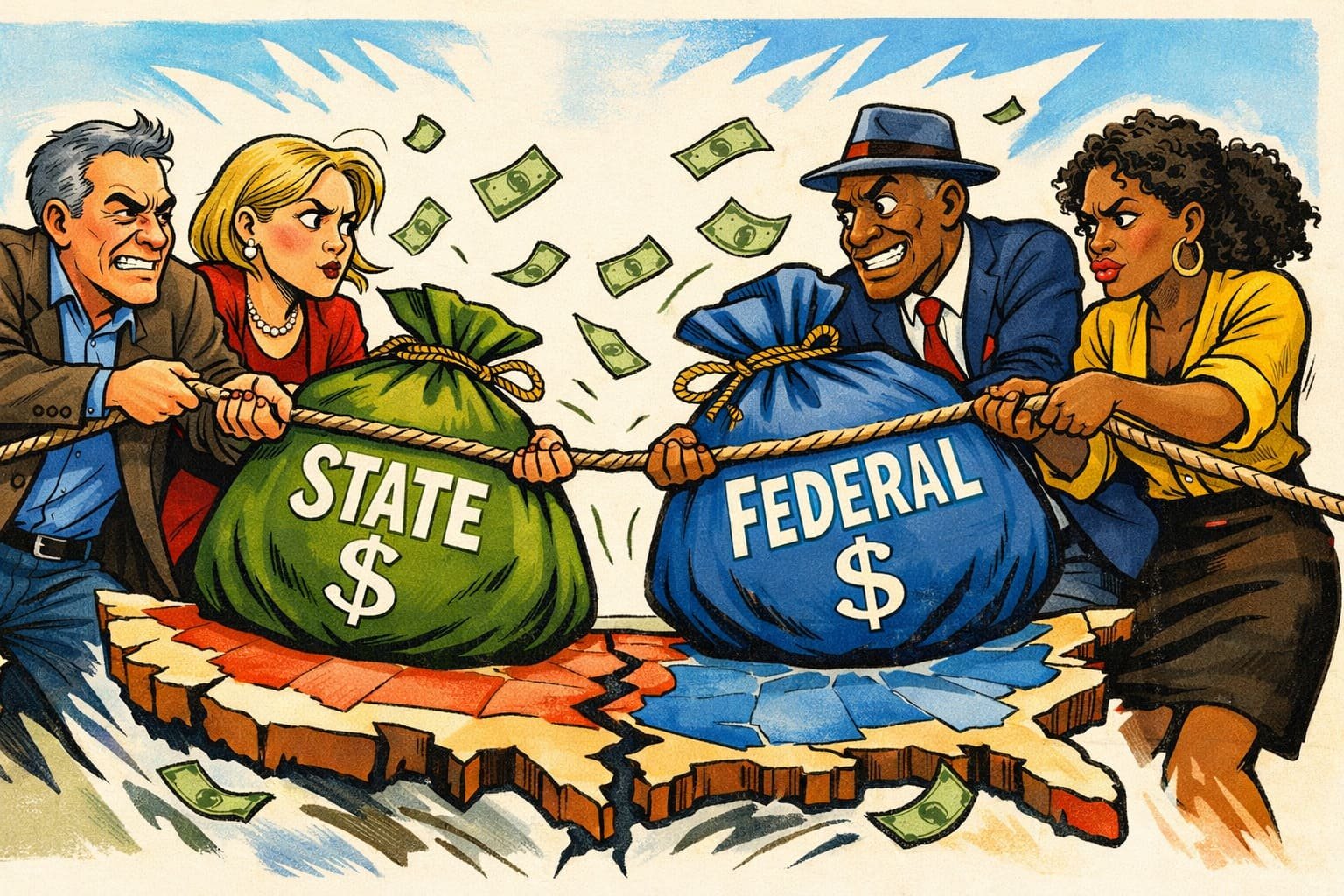
Federal systems are built on a hopeful lie. They tell citizens that power can be shared, identity can be layered, regional difference can be respected, and money can move around the map without bruising anyone’s pride. That lie is useful for a while. Then a downturn hits, or a commodity boom distorts the balance, or one region grows faster than another, and the old question returns with a sharpened edge: who is paying for whom, and for how long? Fiscal federalism sounds like constitutional architecture. In practice it is an emotional argument about fairness disguised as public finance.
Every federation must solve the same puzzle. Richer regions usually generate more revenue. Poorer regions often need more support. Central governments promise equal citizenship, which means basic services cannot depend entirely on local wealth. Transfers follow. Shared taxes follow. Conditions, formulas, bargaining, and grievance all follow. The economic logic is defensible. A nation cannot function if birthplace determines the quality of schools, roads, clinics, and water systems. Yet redistribution across regions is never experienced as a neat principle. Donor regions suspect exploitation. Recipient regions suspect abandonment. The center insists it is merely balancing the republic. Nobody feels fully thanked.
Germany’s fiscal arrangements have long reflected this tension. Wealthier states resent being permanent contributors. Weaker states argue that equal living conditions are part of the national bargain. Both claims have logic. That is what makes the fight durable. Once transfer systems are built, they shape incentives as well as outcomes. If regions expect support regardless of reform, complacency can grow. If support is too harsh or volatile, inequality hardens and resentment spreads. Fiscal federalism works best when it helps weaker places build capacity, not when it turns stronger places into resentful cash machines and weaker ones into chronic petitioners.
Canada’s equalization debates reveal how cultural identity magnifies budget disputes. Fiscal transfers there are not only about money. They brush against history, language, energy politics, and regional mythologies. A province rich in one era can feel punished in another. A province dependent on support can frame it as rightful solidarity or a humiliating necessity, depending on the political season. This is why fiscal federalism arguments rarely stay technical. Once citizens begin to see themselves as payers or dependents, the spreadsheet turns tribal. Budget design then acquires the emotional temperature of a family inheritance dispute.
The United States fights this battle through Medicaid, education funding, disaster aid, transport, and taxation, though it often avoids the grand language of equalization. States compete fiercely for jobs, investment, and political advantage while relying on federal support when crisis hits. Some denounce Washington until Washington’s money arrives. Others subsidize national strength and then complain about carrying too much weight. The contradiction is almost comic. American federalism celebrates local autonomy while depending on large federal stabilizers to prevent deeper fracture. The arguments are loud because the model itself asks regions to be proudly independent inside a structure that keeps rescuing interdependence.
Kenya’s devolution has added another powerful version of the same struggle. County governments are expected to deliver visible services and local development while remaining heavily dependent on transfers from the national level. Delayed disbursements can paralyze counties. Weak local revenue bases limit independence. Citizens, meanwhile, do not care which layer of government caused the stall. They only see projects freeze, salaries delay, and services wobble. Devolution then risks becoming a theater of blame rather than a school of accountability. Fiscal federalism becomes brittle when local authority is politically advertised more loudly than it is financially equipped.
The hardest part is not generosity. It is incentive design. Regions should not be punished for success, but neither should they hoard advantage in ways that hollow out national cohesion. Poorer regions should receive support, but support should not trap them in passive dependence. Transfers need to reward effort, improve capacity, and preserve room for local initiative. That sounds obvious. It becomes difficult when politics rewards grievance more than problem solving. A governor can win votes by denouncing the center. The center can win votes by calling local leaders wasteful. Meanwhile the fiscal architecture quietly turns into a permanent argument machine.
Resource wealth makes the fight nastier. Oil, gas, minerals, ports, and financial hubs generate revenue that regions often treat as theirs by moral instinct, even when constitutions say otherwise. Nigeria has lived with this tension for decades. Resource producing areas demand a larger share of what comes from their soil. The broader federation claims national ownership and shared destiny. Both positions carry weight. That is why fiscal federalism can feel less like a budgeting problem and more like a border dispute conducted through formulas. Money is rarely just money. It is territory translated into cash flow.
A city mayor in a fast growing region may look at national transfers and see punishment for competence. A governor in a poorer region may look at the same formula and see the minimum price of belonging to one nation instead of two economies. Each sees a truth. The failure begins when leaders pretend the other truth does not exist. Federal systems stay stable when richer regions feel respected and poorer ones feel empowered rather than managed. They become unstable when redistribution acquires the moral scent of contempt, either from the donor or the recipient side.
A sharper question would improve the whole debate. Not who pays more, but what the payment is meant to achieve. If transfers merely paper over structural weakness, the fight will recur with rising bitterness. If they finance genuine convergence in infrastructure, institutions, human capital, and local productivity, even donor regions can see the strategic value. Shared prosperity is easier to defend than endless subsidy. Federal solidarity is strongest when it has a developmental destination. A country cannot lecture provinces or states into cohesion. It must build reasons for the map to keep making economic sense.
Political honesty matters too. Regions will always compare themselves. That is normal. What destroys trust is opaque formulas, selective bailouts, and fiscal favoritism disguised as national strategy. Citizens can accept asymmetry when the rules are clear and the purpose is credible. They become cynical when transfer systems look like reward networks for political loyalty. Nothing corrodes a federation faster than the belief that taxes travel not by principle but by patronage. At that point fiscal federalism stops being a constitutional design and starts looking like an elaborate payment scheme for keeping the peace.
Across every federation, under every anthem and constitutional compromise, sits the same fragile arrangement: one part of the country sending money, another needing it, and both wondering whether the bargain still honors them. The miracle is not that these fights happen. The miracle is that the system sometimes survives them. Yet survival grows harder when economic divergence deepens and political language turns every transfer into an accusation. A federation does not break only when borders move. It can also break when shared money loses its moral story. The map remains, but the sense of common fate begins to thin.
