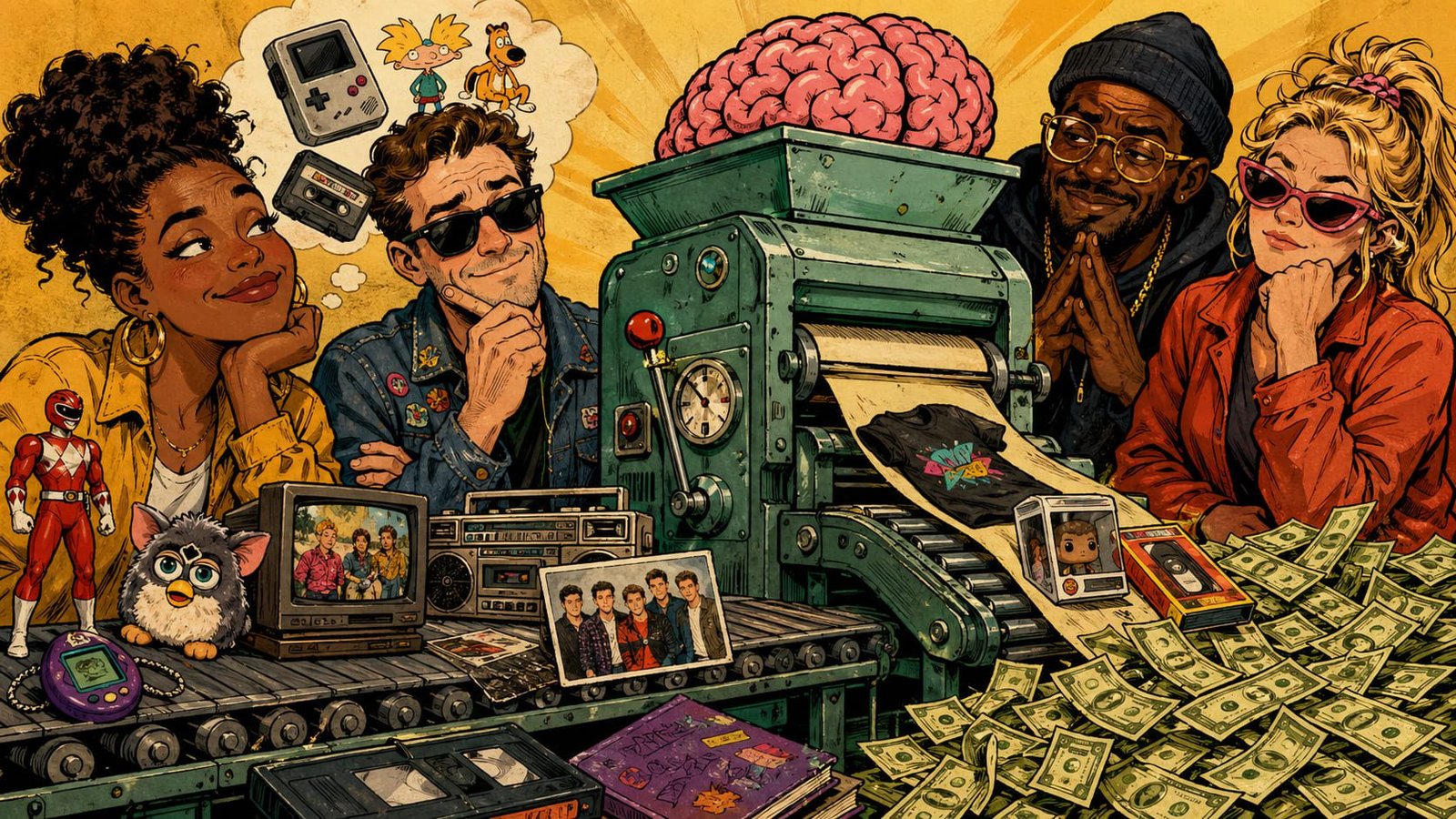
A dim storefront hums with the glow of things that feel oddly familiar. Shelves are lined with objects that seem to remember you before you remember them. Old logos return with cleaner edges. Childhood colors reappear with sharper contrast. A song from years ago plays in the background, not quite as it was, but close enough to stir something that feels like recognition. People walk in with curiosity and leave with a quiet sense of reunion. It feels personal. It feels almost intimate. Yet everything here has a price tag.
Nostalgia no longer sits quietly in the past. It has been extracted, polished, and repackaged into a system that turns memory into revenue. The genius of it lies in how it avoids resistance. People do not question what feels like home. They embrace it. Brands understand this deeply. They do not sell products. They sell time travel, carefully measured and strategically delivered. The past becomes a resource, mined not for truth but for emotional return.
There was a media executive named Farouk who once revived an old television format that had long disappeared from mainstream attention. The original show had a loyal but aging audience. Farouk’s team reintroduced it with modern production, familiar themes, and just enough novelty to feel current. It succeeded immediately. Viewers spoke less about the new version and more about how it made them feel. Conversations shifted toward childhood evenings, family routines, a sense of belonging that seemed easier to access through the screen. The content itself mattered less than the doorway it opened.
Memory, in this system, becomes selective. It highlights warmth while softening complexity. The past is edited for comfort. This is not accidental. Clean memories sell better than complicated ones. A sneaker brand reissues a design from decades ago, framing it as a return to authenticity. A streaming platform revives an old series, marketing it as a cultural moment reborn. Each move reinforces the same message. What you loved before still exists, and it can be owned again.
There is a tension here that feels almost invisible at first. Nostalgia promises connection, yet it can quietly limit imagination. When culture leans too heavily on what has already been loved, it risks narrowing what can be loved next. Innovation slows, not because creativity disappears, but because the market becomes more comfortable with certainty than with risk. A game developer named Kaito once pitched an entirely new concept to his studio. It was rejected in favor of remastering an older title. The remake sold well. Kaito’s idea never left the whiteboard.
This pattern extends beyond products into identity. People begin to anchor themselves in versions of the past that feel safer than the present. Fashion cycles return with familiar silhouettes. Music trends echo earlier decades. Even language begins to recycle phrases that carry emotional weight. It creates a sense of continuity, which can be comforting. It also creates a subtle resistance to change. The future starts to feel less defined, less compelling, compared to a past that has been carefully curated.
A small café owner named Mireille experienced this shift in a very tangible way. She redesigned her space to reflect a vintage aesthetic that reminded customers of simpler times. The response was immediate. People lingered longer, spoke more softly, shared stories that seemed to belong to another era. The business thrived. Yet Mireille noticed something unusual. Conversations rarely moved forward. They circled around memories, repeating familiar narratives. The space became a sanctuary, but also a loop.
Nostalgia works because it reduces uncertainty. It offers a known emotional outcome. In a world that often feels unpredictable, that reliability becomes valuable. Brands leverage this by creating experiences that feel pre-approved by memory. Consumers respond not just with purchases, but with trust. The transaction becomes less about evaluation and more about recognition. This is why nostalgia-driven campaigns often outperform newer concepts. They require less persuasion.
There is also a deeper psychological layer at play. Memory is tied closely to identity. Revisiting the past can feel like reconnecting with a version of oneself that has not been altered by recent pressures. This makes nostalgia particularly powerful during periods of rapid change. It provides a sense of stability. Yet it can also create a subtle dependency, where comfort is sought more often in what has been than in what could be.
The cultural impact becomes more pronounced over time. Entire industries begin to orient themselves around revival rather than invention. Film studios rely on sequels and reboots. Music labels revisit older sounds with modern production. Fashion houses cycle through archives with predictable regularity. Each decision makes sense individually. Collectively, they create an environment where the past becomes the safest investment.
There are exceptions, of course. Some creators resist the pull, choosing instead to build something that has no precedent. Their work often feels unfamiliar, sometimes even uncomfortable. It does not carry the immediate warmth of recognition. A sculptor named Anselm created pieces that deliberately avoided reference to existing forms. Early reactions were mixed. Over time, his work began to attract those seeking something they could not immediately categorize. It did not sell nostalgia. It demanded attention in the present.
The question is not whether nostalgia should be abandoned. It carries genuine value. It connects generations, preserves cultural memory, and offers moments of reflection. The challenge lies in how it is used. When nostalgia becomes the primary engine of culture, it risks turning memory into a commodity rather than a foundation. It begins to dictate direction instead of informing it.
There is a quiet shift that happens when memory is constantly revisited through commercial lenses. It starts to feel less like a personal archive and more like a shared script. Experiences that once felt unique begin to align with broader narratives shaped by market forces. The past becomes standardized, easier to package, easier to sell. Something intimate becomes collective in a way that feels both inclusive and strangely impersonal.
The storefront remains open, glowing with curated familiarity. People continue to enter, drawn by the promise of something they once knew. They leave with objects that carry echoes of earlier moments, small pieces of time wrapped in modern packaging. It feels satisfying, almost complete. Yet beneath that satisfaction, there is a faint question that lingers, not loud enough to disrupt, but persistent enough to notice.
Pause for a moment and consider: are your memories guiding what you value, or are they being reshaped into something designed for you to buy again?
