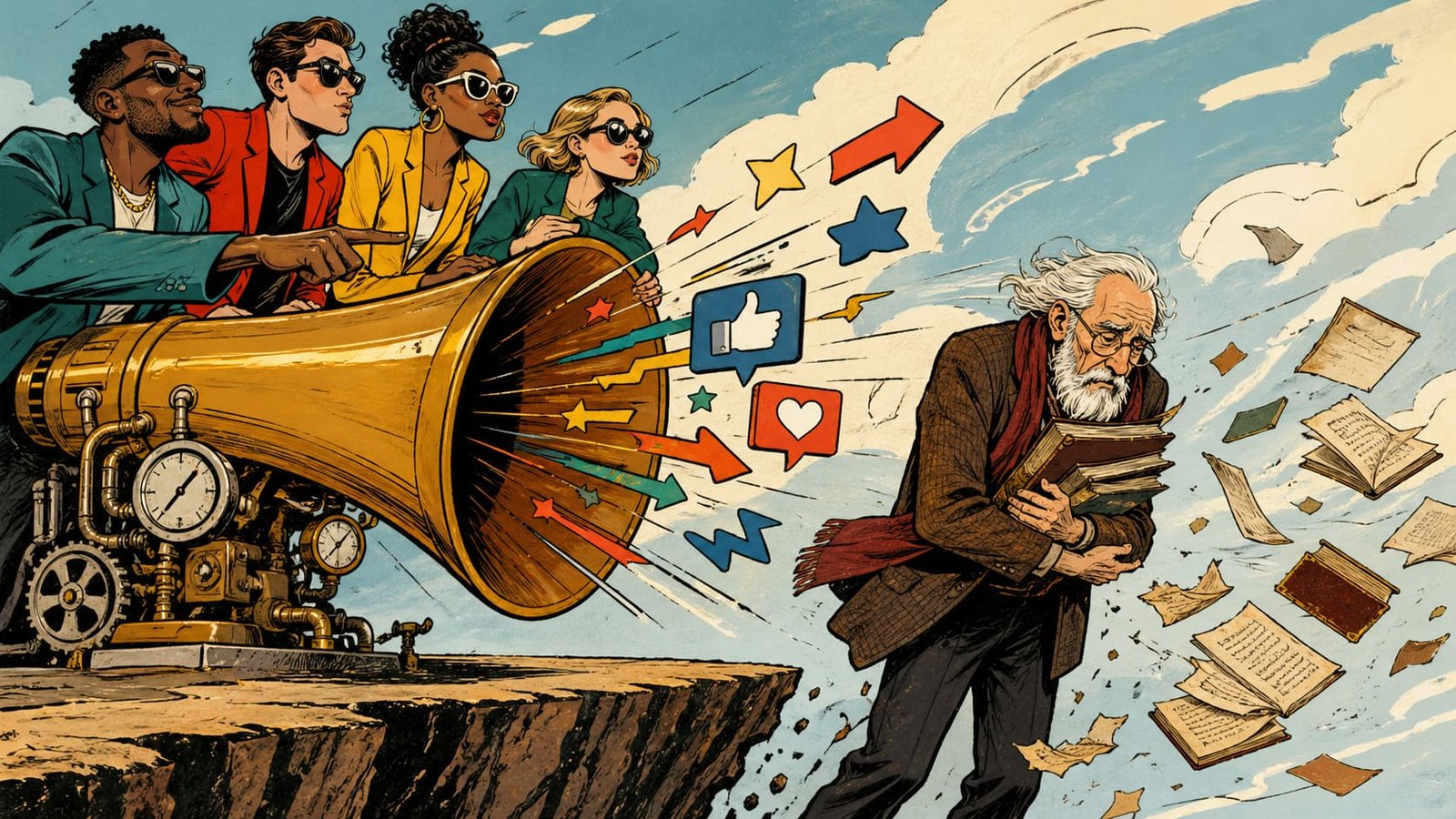
The conference hall hums with certainty. Slides glow in sharp gradients, phrases like “next frontier” and “exponential growth” land with practiced confidence, and applause rises on cue as if the future has already been approved. Everything feels inevitable, almost ordained, like history itself has been given a deadline. Outside, the city mirrors the same tempo, cranes turning slowly against the sky, glass towers rising with silent authority. It all signals advancement. It all feels like movement in the right direction. Yet somewhere in that momentum, something older and quieter begins to loosen its grip.
Progress has become a language of promise. It speaks in upgrades, in faster systems, in expanded possibilities. It carries the weight of improvement, suggesting that what comes next will be better than what came before. That belief has driven remarkable achievements, reshaping industries, extending lifespans, connecting distant worlds. The narrative is powerful because it is often true. The complication emerges when progress becomes unquestioned, when movement itself is treated as proof of value, and when the pace of change outstrips the depth of understanding.
A policy analyst named Miriam noticed this tension while working on urban development projects that prioritized innovation over continuity. Plans were bold, designs ambitious, timelines aggressive. New systems replaced old ones with little hesitation. The results were impressive on paper, efficient, modern, aligned with global trends. Yet in conversations with residents, Miriam heard a different story. Familiar spaces had disappeared, social rhythms disrupted, a sense of belonging quietly eroded. The city had progressed, but something less tangible had been displaced. The loss was not easily measured, which made it easy to overlook.
Wisdom operates differently from progress. It does not move quickly. It accumulates through experience, reflection, and often through failure. It resists simplification, preferring nuance over clarity, patience over speed. In a culture that rewards immediacy, wisdom can feel out of place, almost inconvenient. It does not fit neatly into presentations or metrics. It asks questions that slow things down, that complicate decisions, that challenge the assumption that newer is always better.
There was a product strategist named Daniel who built a reputation for delivering innovative solutions at a rapid pace. His work was celebrated, his ideas widely adopted. Over time, he began to notice a pattern. Each new solution addressed a problem created by a previous one. Systems became more complex, dependencies increased, unintended consequences multiplied. During a late evening review, surrounded by diagrams that mapped intricate workflows, Daniel paused. The question that surfaced was simple but unsettling. Were they solving problems or perpetuating them in more sophisticated forms? The realization did not stop the work, but it introduced a layer of doubt that had not been present before.
The cultural emphasis on progress often sidelines this kind of reflection. It favors action over contemplation, solutions over questions. In business, this shows up as a constant push for growth, expansion, and disruption. In technology, it appears as rapid iteration, continuous deployment, relentless optimization. These approaches generate results, often impressive ones. They also create environments where the long-term implications of decisions are not always fully considered.
A teacher named Sofia experienced this shift in education, where digital tools and new methodologies promised to transform learning. Classrooms became more interactive, content more accessible, engagement more measurable. The changes were significant and, in many ways, beneficial. Yet Sofia noticed that something in the learning process had altered. Students were quicker to find answers but less inclined to sit with questions. Depth gave way to efficiency. The ability to navigate uncertainty, to think slowly and carefully, seemed to diminish. The tools had improved the system, but they had also reshaped the habits of those within it.
Pop culture reinforces the allure of progress. Innovation is celebrated, disruption admired, the future portrayed as a place of endless possibility. Films, series, and narratives often frame advancement as a heroic journey, where obstacles are overcome through ingenuity and speed. The darker side, the unintended consequences, the erosion of slower forms of understanding, receives less attention. It does not fit the narrative of forward motion.
The tension here is not between progress and stagnation. It is between movement and meaning. It is the question of whether advancement is aligned with deeper human values or simply driven by the momentum of possibility. This tension is difficult to resolve because it requires a balance that is not easily achieved. It asks for the integration of speed and reflection, innovation and restraint, ambition and humility.
A craftsman named Hiroshi once described his approach to work in a way that contrasted sharply with the language of progress. He spoke of repetition, of doing the same task many times, not to increase output but to deepen understanding. Each iteration revealed something new, not in the object itself, but in the relationship between the maker and the material. The process was slow, deliberate, resistant to acceleration. Yet the result carried a quality that could not be replicated through speed alone. It was not just a product, but a reflection of accumulated insight.
Moments like this do not reject progress. They reframe it. They suggest that advancement without understanding is incomplete, that speed without depth can lead to outcomes that are efficient but fragile. They introduce the possibility that wisdom is not a relic of the past, but a necessary counterpart to the innovations of the present.
Somewhere within the constant hum of development, where new ideas emerge and old ones are discarded, a pause appears, brief and almost imperceptible. A decision is delayed, not out of hesitation, but out of a desire to understand more fully what is at stake. The pause disrupts the rhythm, even if only slightly. It creates space for consideration, for questions that do not have immediate answers.
In that space, a question begins to take form, steady and difficult to ignore: if progress continues to speak louder with every passing moment, who is still listening for the quieter voice that asks whether it should?
