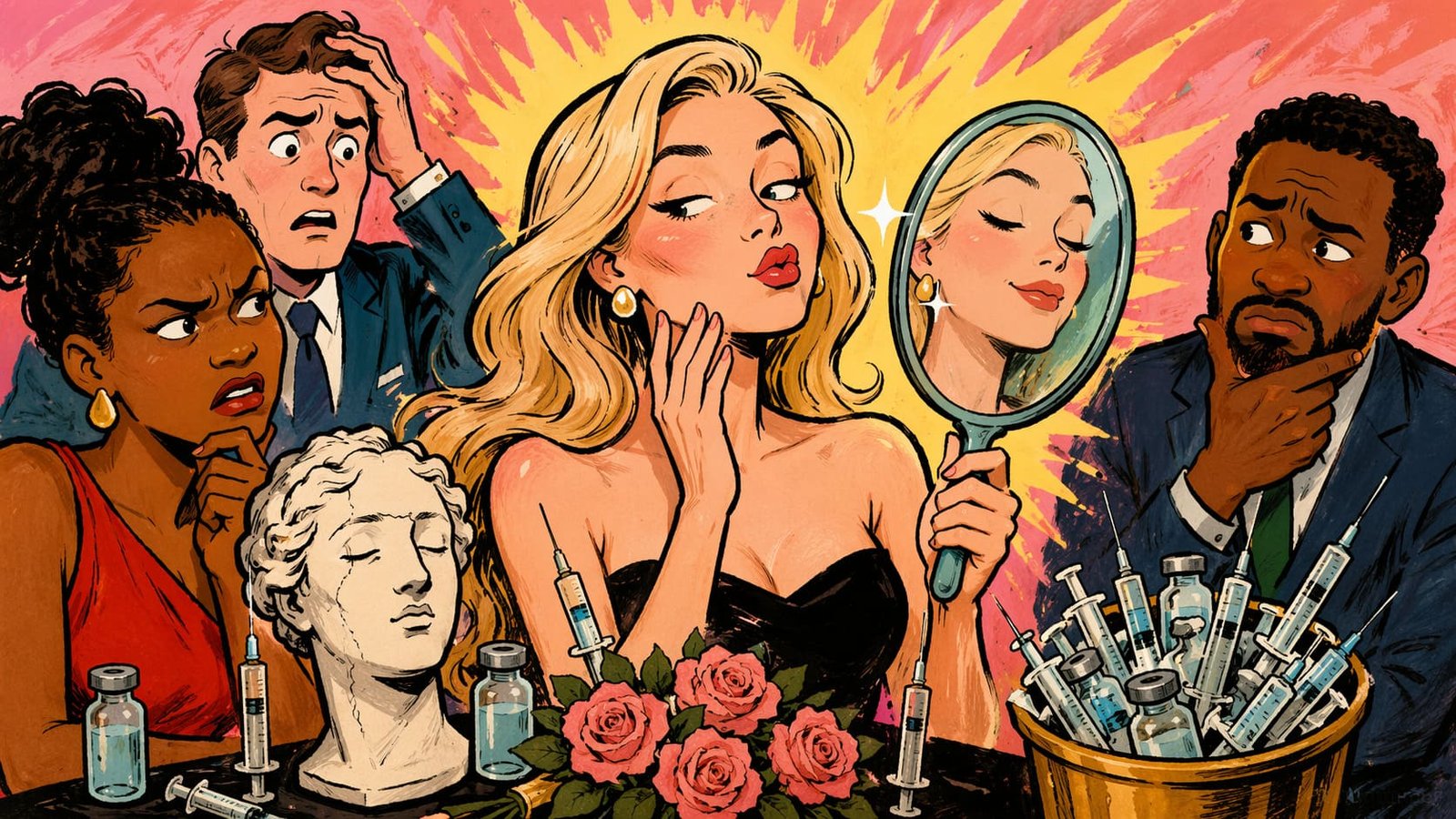
The mirror has stopped negotiating. It reflects exactly what it has been trained to show. Smoothness without interruption, stillness without resistance, a version of the face that feels composed even before emotion arrives. In a softly lit clinic, a woman studies her reflection with a quiet intensity, searching not for flaws, but for familiarity. The practitioner speaks in calm, practiced tones, describing subtle enhancements, gentle refinements. Outside, the world moves in unpredictable rhythms. Inside, everything feels controlled, almost paused.
The expansion of cosmetic procedures did not begin as deception. It began as alignment, a desire to match how one feels internally with what appears externally. That instinct carries honesty. Yet as treatments like Botox injections became widely normalized, the definition of “natural” began to shift. Looking untouched no longer meant absence of intervention. It meant the presence of carefully managed intervention, invisible but precise.
Natalie, a casting assistant in Los Angeles, noticed the change long before it became widely discussed. Actors began arriving with faces that looked technically flawless yet difficult to read. Expressions seemed delayed, reactions softened into neutrality. During one audition, an actor delivered a powerful monologue, voice trembling with emotion, while his face remained almost unchanged. Natalie sat still, unsure how to interpret what she had just seen. “It felt like the emotion was there,” she later said, closing a notebook she had barely written in, “but it couldn’t reach the surface.”
The backlash now building is not only about aesthetics. It is about communication. The human face is not simply a surface. It is a language, filled with micro-expressions that signal empathy, doubt, excitement, concern. When those signals become muted, interaction changes. Conversations feel slightly off, as if something essential is missing but difficult to name. The effect is subtle, yet it accumulates.
A corporate strategist in Paris, Julien, experienced this shift during a high-stakes meeting. He presented a proposal, expecting visible reactions to guide his adjustments. Instead, the room remained visually calm, expressions steady, responses measured but delayed. He left uncertain whether the idea had landed. Hours later, feedback arrived through email, positive yet detached. “I couldn’t read the room,” he said, sitting alone at his desk as the city outside dimmed into evening. “It felt like speaking into a space where reactions were hidden behind glass.”
Cultural figures have begun to reflect this tension publicly. Courteney Cox spoke openly about dissolving her fillers after realizing she no longer recognized her own reflection. The admission resonated widely, not because it rejected enhancement entirely, but because it reintroduced the idea of recognition. The ability to see oneself, not as perfected, but as familiar.
The industry, however, continues to evolve rather than retreat. Clinics now emphasize subtlety, personalization, maintenance. The language has shifted from transformation to refinement. A dermatologist in New York, Dr. Samuel Reyes, described the approach during a consultation that felt more like a strategy session. “We are not changing faces,” he said, adjusting the lighting slightly as his patient watched closely. “We are preserving them.” The statement carried reassurance, yet it also revealed how deeply the desire for control has embedded itself into the process.
There is a broader contradiction beneath this movement. Society celebrates individuality while quietly rewarding conformity to certain visual standards. Aging is described as natural, yet treated as something to be managed. People are encouraged to embrace themselves while being offered endless tools to modify that self. The tension does not resolve. It lingers in daily decisions, often made quickly, rarely examined deeply.
A skincare founder in Nairobi, Zuri, built her brand around a different philosophy. She focused on nourishment rather than correction, encouraging clients to see aging as a process to engage with rather than resist. Early growth was slow. Customers hesitated, accustomed to quicker, more visible results. Over time, her message found an audience seeking something less immediate but more grounded. “People don’t want to disappear from their own faces,” she said, arranging products on a shelf with quiet precision. “They want to recognize who they are becoming.”
The emotional layer of this conversation reveals something deeper than appearance. For many, cosmetic procedures offer a sense of control in a world that often feels unpredictable. Adjusting one’s face becomes a way to influence perception, to manage how one is seen. Yet when that control begins to obscure identity, the balance shifts. The face becomes less a reflection and more a construction, shaped by intention but detached from spontaneity.
The scene moves to a quiet dressing room where soft light falls unevenly across a mirror. A woman removes her makeup slowly, studying the features that remain. The lines, the stillness, the subtle tension between them. She leans closer, not searching for flaws, but for signs of something familiar, something that feels like her.
And beneath that quiet moment, a realization begins to form. Perfection, when pursued too precisely, can flatten the very details that make a face human. Movement carries meaning. Imperfection carries memory. Expression carries connection.
So the question lingers, soft but persistent: when beauty becomes something carefully maintained through stillness, what happens to the parts of you that were meant to move freely, to change, and to be seen exactly as they are?
