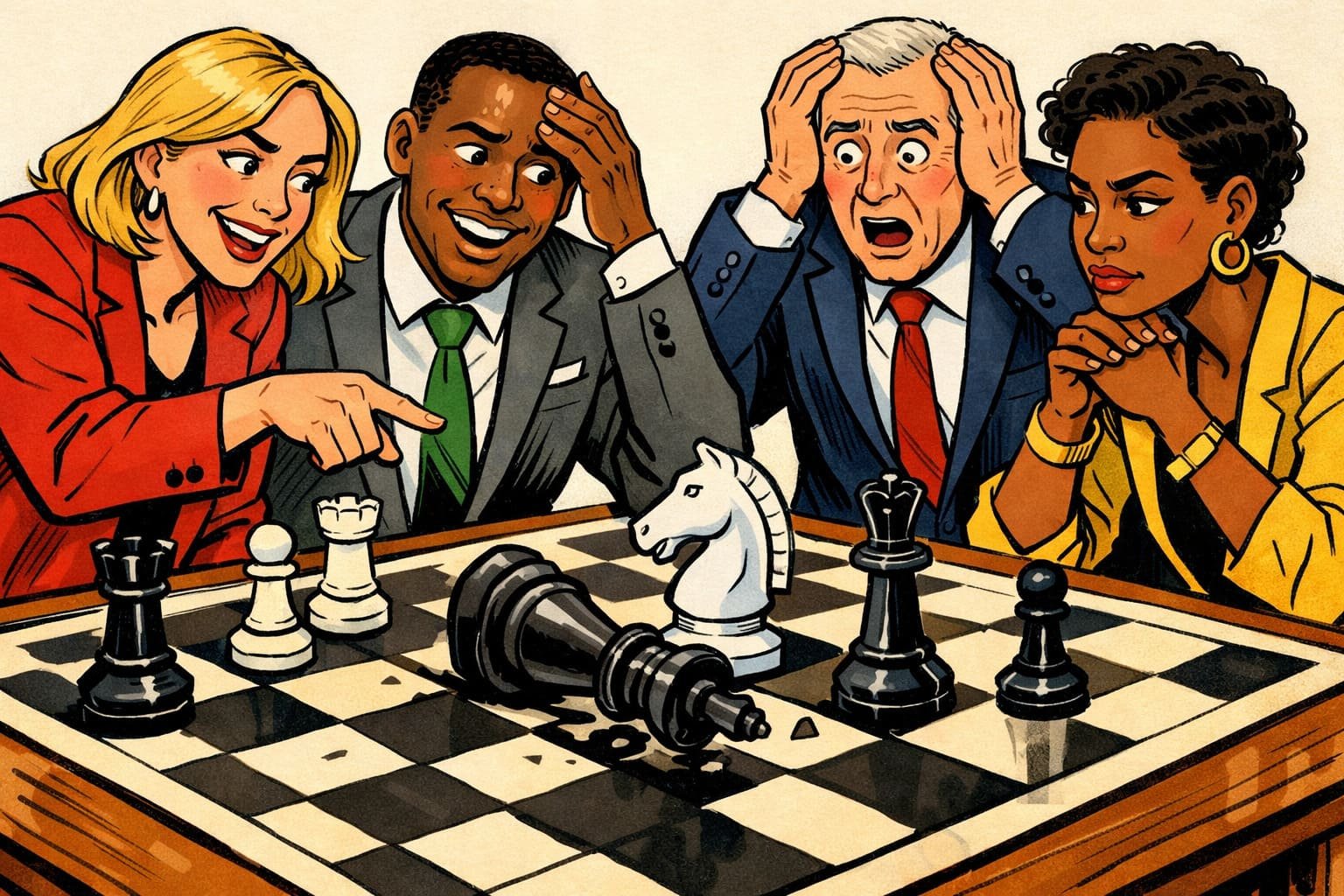
Corporate collapse rarely arrives with cinematic elegance. It comes through strange accounting language, exhausted hallway whispers, lawyers suddenly appearing in calendars, and the peculiar silence that settles when ambitious people begin updating résumés during lunch. A business near failure does not always look dramatic from the outside. Sometimes it still serves coffee in branded mugs while internally negotiating with mortality. Strategic collapse often looks offensively ordinary until the obituary becomes undeniable.
Terminal Noise: The Week Everyone Thought It Was Over
A turnaround executive named Gabriel once entered a headquarters where the receptionist still answered calls with cheerful professionalism while accounts payable had quietly entered triage. In a conference room upstairs, someone had printed a liquidity projection so catastrophic the final month simply read UNSUSTAINABLE in block capitals, as though typography itself had begun panicking. One finance manager stared at the page, removed his wedding ring absentmindedly, rolled it across the table, and asked nobody in particular, “So what exactly survives?” That question was more strategically honest than most leadership messaging. Near-collapse has a way of stripping decorative intelligence from the room.
Business culture romanticizes victory so aggressively that it often misunderstands comeback psychology. Turnarounds are not inspirational slogans wearing expensive consultants. They are brutal exercises in subtraction, honesty, and emotional metabolism. Something usually has to die, an illusion, a division, a leadership doctrine, an ego architecture, before the organization itself gets another chance. Resurrection is rarely sentimental. It is operational surgery performed under reputational anesthesia.
There is also humiliation involved, which management literature discusses less enthusiastically. Companies nearing strategic checkmate must often confront truths they previously paid handsomely to avoid. Pride becomes unaffordable. Narrative control evaporates. Markets stop caring about executive eloquence. The organization is forced into a deeply clarifying emotional state where survival outranks image. Desperation can be grotesque. It can also be intellectually purifying.
This is why some companies recover magnificently while others collapse theatrically. Crisis does not automatically create wisdom. Sometimes it merely accelerates dysfunction. But in rare organizations, existential pressure destroys enough institutional vanity for disciplined adaptation to become possible. Near-death experiences do not make businesses smarter. Honest interpretation of them sometimes does.
Controlled Panic: The Strategy of Surviving Tuesday
Turnaround strategy is often misunderstood as visionary heroism. It is frequently much less glamorous. Before grand reinvention comes cash discipline, operational triage, brutal prioritization, and a sequence of unpleasant decisions that nobody will celebrate at innovation conferences. Survival has administrative paperwork. The mythology usually skips that part.
A retail restructuring leader named Naomi once inherited a business so close to collapse that daily cash reviews had replaced long-term planning conversations entirely. Morning meetings resembled emergency medicine more than strategy. Which suppliers must be paid. Which inventory moves fastest. Which commitments can survive another forty-eight hours. Someone taped a handwritten sign above the finance war room reading, “Stay boring. Boring keeps us alive.” It may be the most strategically mature sentence ever written on printer paper.
This is the phase outsiders consistently underestimate. Comebacks are not born from inspiration first. They begin with containment. Leaders who cannot distinguish ambition from hemorrhaging become dangerous during crisis because excitement can masquerade as courage. The strongest turnaround operators understand that disciplined dullness often precedes meaningful recovery. You stabilize the patient before discussing marathon training.
The resurrection of Apple is often narrated through innovation mythology, which makes for better storytelling but incomplete strategy. Before triumph, there was ruthless focus. Product simplification. Resource discipline. Strategic narrowing. Turnarounds often require subtractive intelligence before additive brilliance. Businesses drowning rarely need more complexity.
Controlled panic is an underrated leadership skill. The room needs urgency without emotional contagion. Too little pressure breeds denial. Too much panic destroys decision quality. The leaders who navigate near-checkmate effectively behave like surgeons during internal bleeding, emotionally precise, strategically unsentimental, weirdly calm while everyone else imagines funerals.
Strategic Humiliation: What Failure Teaches Expensive People
Failure has a unique way of reorganizing hierarchy. The executive who once dominated rooms through confidence may suddenly sound ornamental when liquidity disappears. Consultants become quieter. PowerPoint optimism begins resembling historical fiction. Crisis has a brutal egalitarianism because arithmetic does not respect seniority. Numbers are magnificently unimpressed by ego.
A logistics chairman named Henrik spent years dismissing operational warnings with aristocratic impatience until one collapse scenario finally arrived exactly as predicted. During a restructuring meeting, a warehouse supervisor, someone Henrik had never previously addressed directly, explained more about business survival in eight unsentimental minutes than senior leadership had managed in three quarters. Afterwards, Henrik reportedly said, “We have been listening upward for years.” That sentence should haunt governance programs globally.
Humiliation becomes strategically useful when it produces epistemic humility rather than defensive theatre. Some organizations collapse inward, protecting ego instead of extracting lessons. Others become startlingly teachable. That distinction matters enormously. Crisis is not inherently educational. Plenty of failing businesses remain emotionally committed to their own myths right until liquidation. Pain alone teaches very little. Interpretation teaches everything.
The comeback stories people admire often involve leadership capable of metabolizing embarrassment without becoming paralyzed by it. That psychological trait is rarer than competence. Public failure threatens identity in ways strategic textbooks underestimate. Recovery requires executives who can survive the emotional violence of being wrong without converting that discomfort into denial. Pride kills slowly, then suddenly.
This is why comeback leadership often feels emotionally different from ordinary leadership. It is less performative, less ornamental, less addicted to appearing in control. The strongest recovery leaders understand something humiliating but liberating: reality was never obligated to validate their self-image. Once that truth settles, strategic clarity becomes easier.
Resurrection Logic: The Discipline of Choosing What Lives
Comebacks are ultimately editorial acts. Something gets cut. Products. Divisions. Narratives. Habits. Sacred cows. Entire strategic identities. Recovery requires ruthless clarity about what deserves oxygen and what merely consumes it. Businesses do not return from near-checkmate by preserving every historical attachment. Resurrection is curation under duress.
A turnaround strategist named Eliska once inherited a sprawling services business whose leadership had become emotionally incapable of killing underperforming units because each division had an internal political patron. She described the portfolio with surgical contempt: “We are feeding sentimentality with payroll.” Three months later, she cut aggressively, not because cruelty impressed her, but because arithmetic had already become the least emotional person in the building. Survival often demands emotional separation from legacy affection.
The transformation of Marvel Entertainment from financial distress into strategic resurgence involved sharper capital discipline and intellectual property focus than the simplified mythology often remembers. Successful comebacks usually look narratively inevitable in hindsight. Inside the crisis, they feel messier, lonelier, and far less cinematic. Recovery strategy is clearer in memoirs than in conference rooms.
Resurrection logic also requires choosing what cultural behaviors survive. A company can recover financially while preserving the internal habits that nearly killed it. That is not comeback strategy. That is temporary respiration. Sustainable recovery requires behavioral redesign alongside operational repair. Otherwise the institution is simply rehearsing future collapse with fresher branding.
The emotional discipline here is severe. Leaders must distinguish nostalgia from value, familiarity from utility, and hope from arithmetic. Weak operators preserve comforting complexity. Strong operators simplify brutally enough for survival to become structurally plausible. The future is rarely generous to businesses trying to save everything.
What Do You Do When the Story Should Be Over?
A night security guard named Tomas once walked past a strategy room at 2:13 a.m. and found a chief executive asleep in a chair, suit jacket folded beneath his head, beside a whiteboard containing three phrases: SELL WHAT WE CAN, SAVE WHAT WE MUST, DESERVE TOMORROW. Tomas said the room looked less like leadership than aftermath. That may be the most honest visual description of turnaround strategy available. Comebacks are not motivational posters. They are disciplined acts of institutional triage.
The businesses that survive near-checkmate understand something psychologically unsentimental. Hope is not strategy. Denial is not optimism. Confidence is not liquidity. Recovery begins when organizations stop performing health and start confronting condition. That transition is emotionally brutal because narrative death often precedes operational recovery. Some companies recover only after abandoning the version of themselves they were publicly defending.
There is also something strangely human about strategic comeback stories that keeps them culturally irresistible. We admire disciplined resurrection because it flatters our own private fantasies about second chances. Businesses are institutions, yes, but they are also human systems, full of pride, denial, courage, fear, reinvention, and exhausted people trying to make tomorrow exist. That psychological truth gives turnaround stories unusual narrative voltage.
But survival alone is not victory. Plenty of organizations avoid death only to become permanently diminished versions of themselves. True comeback strategy is not about extending corporate respiration. It is about redesigning the institution into something reality can respect again. Survival buys time. Strategy decides whether time becomes meaningful.
So here is the question waiting in every crisis room where revenue collapses, lenders hesitate, talented people leave, and expensive optimism begins sounding unserious: when the story should already be over, do you still have the discipline to build a better ending, or are you merely negotiating with inevitability?