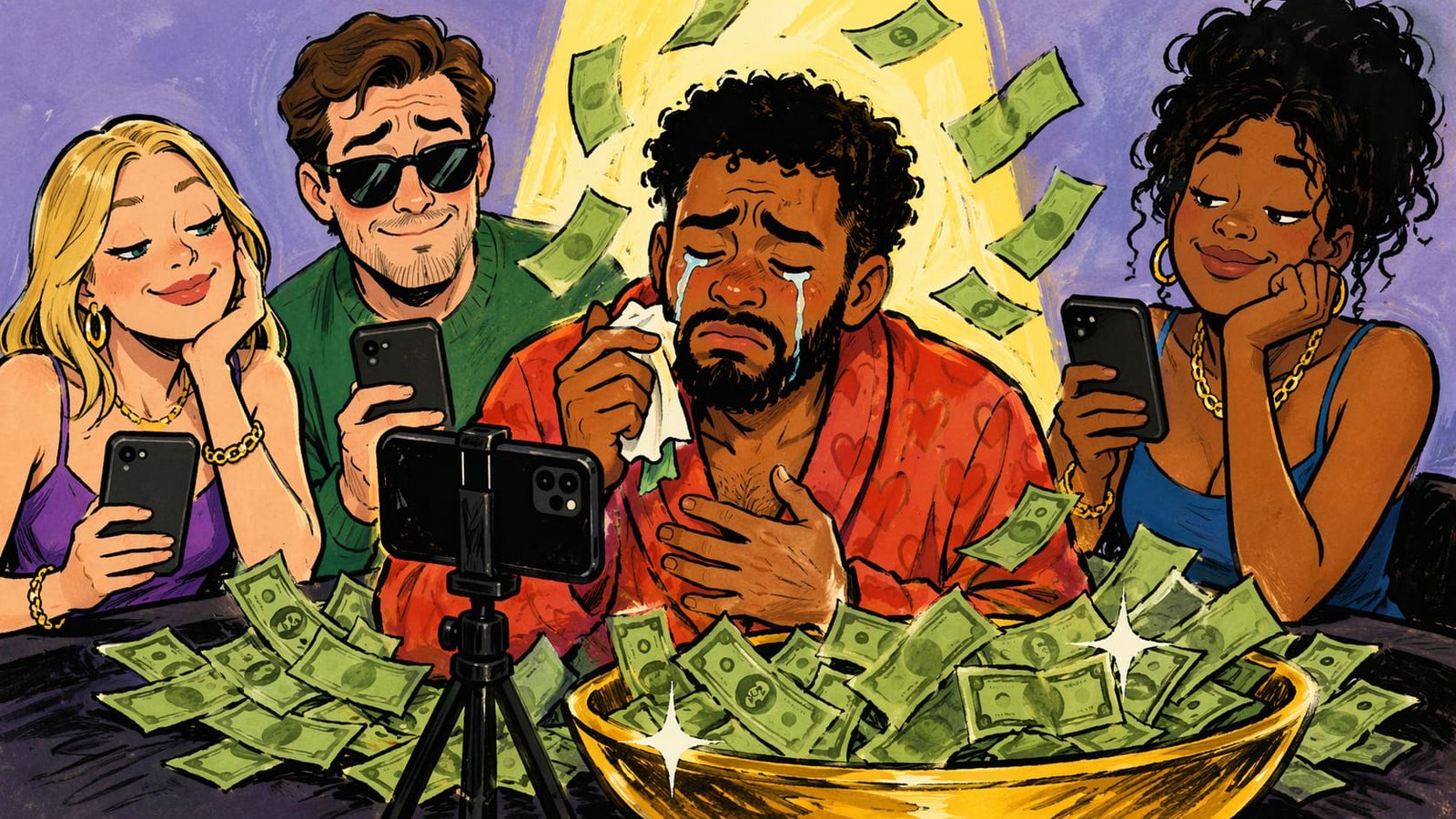
A ring light flickers to life in a quiet bedroom, illuminating a face that looks both fragile and prepared. The camera begins recording before the first tear falls, as if emotion itself has a schedule. Somewhere across the world, a stranger pauses mid-scroll, drawn in by the rawness of a moment that feels too intimate to be public and yet too polished to be accidental. The internet has learned a new language, and it speaks in confession.
There was a time when vulnerability belonged to private spaces. A friend’s couch, a late-night call, a quiet corner where words could land without consequence. Now it travels through platforms designed for amplification, where emotional exposure becomes content and content becomes currency. Apps like TikTok and Instagram reward intensity, and nothing travels faster than a visible crack in composure. Sadness, once hidden, now circulates with precision.
The shift did not happen overnight. Early creators shared struggles in scattered ways, often without clear intention. Over time, patterns emerged. Videos that captured tears, admissions, or moments of breaking down received more engagement. Comments poured in, not just with sympathy but with attention. The algorithm noticed. What began as expression quietly evolved into strategy. Emotion became a signal that could be optimized.
A content creator named Nia experienced this transformation in real time. She started posting lighthearted videos, small glimpses of daily life. Growth was slow, steady, unremarkable. One evening, after a difficult conversation with her partner, she recorded a short clip, voice trembling, eyes wet, words unfiltered. She hesitated before posting, then pressed publish. The response was immediate. Views surged, messages flooded in, followers multiplied. Nia later admitted something that stayed with her. “I felt seen, but I also felt watched.”
This duality sits at the center of the phenomenon. On one hand, sharing vulnerability can create connection. Viewers recognize parts of themselves in someone else’s experience. They feel less alone. On the other hand, the structure of the platform turns that connection into measurable output. Likes, shares, comments. The emotional moment becomes data. The creator learns, consciously or not, what kind of expression performs best.
Psychologists have long discussed the concept of emotional labor, the effort required to manage and present feelings in social contexts. Online, that labor takes on a new dimension. A creator may revisit painful experiences not just for processing, but for engagement. The line between healing and performance becomes difficult to trace. Dr. Brené Brown, often cited in conversations about vulnerability, speaks about the difference between sharing with intention and oversharing without boundaries. The digital environment complicates that distinction.
A manager named Luis worked with several mid-level creators navigating rapid growth. He noticed a pattern that concerned him. Content that leaned into personal struggle consistently outperformed neutral or joyful posts. When creators attempted to shift away from that tone, engagement dropped. Luis described it bluntly. “The audience learns what they want from you, and the platform reinforces it.” Over time, creators felt pressure to remain within that emotional register, even when it no longer reflected their current state.
The audience plays a complex role here. Viewers often approach these moments with genuine empathy. Comments offer support, advice, shared experiences. Yet the act of watching itself becomes part of the system. A vulnerable video is consumed, reacted to, then replaced by the next piece of content. The cycle continues. Empathy exists, but it is distributed across a feed that moves quickly. The depth of connection can feel real in the moment, then dissolve just as quickly.
A young viewer named Amina once described her daily routine. She followed several creators who spoke openly about anxiety, heartbreak, and personal setbacks. Their honesty comforted her. It gave language to feelings she struggled to express. At the same time, she noticed a subtle shift in her own perception. “It started to feel like everyone was always breaking,” she said. The constant exposure to curated vulnerability created an atmosphere where distress seemed more prevalent than it actually was.
This atmosphere influences how people interpret their own emotions. Ordinary sadness may feel less significant compared to the intense expressions seen online. Or, in some cases, individuals may feel compelled to frame their experiences in ways that align with what receives attention. The internal narrative adjusts to external feedback. The self becomes slightly performative, even in private moments.
There are creators who resist this pattern, who choose to share selectively, who set boundaries around what remains offline. Their approach often grows more slowly, but it carries a different kind of sustainability. They treat vulnerability as context rather than content. These choices rarely trend, yet they offer a quieter model of presence that does not rely on constant exposure.
A therapist named Jordan once shared a story about a client who built a large following through deeply personal videos. Over time, the client felt trapped. Moments of genuine happiness felt difficult to share because they did not align with audience expectations. When life improved, engagement declined. The client described feeling as though they had become a character in their own narrative, one that required ongoing struggle to remain relevant.
The business side of platforms reinforces this tension. Engagement drives visibility, visibility drives monetization. A video that captures strong emotional response is more likely to be promoted, recommended, amplified. The system does not distinguish between vulnerability shared for connection and vulnerability shaped for performance. It responds to reaction. The more intense the reaction, the stronger the signal.
A small scene captures the contradiction. A creator finishes recording a video where they speak about a difficult moment, voice soft, eyes reflecting something real. The recording ends. They pause, review the clip, adjust the lighting slightly, choose a thumbnail that conveys the right level of emotion. The content is posted. Within minutes, notifications begin to appear. The moment becomes public, measurable, repeatable.
In another room, a viewer watches that same video, feeling a sense of recognition, perhaps even relief. The connection is genuine, even if the medium is mediated. Two experiences intersect briefly, each shaped by a system that rewards visibility. The interaction feels human, yet it exists within a structure designed for scale.
As the feed continues to scroll, the emotional intensity rises and falls in waves. Laughter follows tears, inspiration follows confession, and the cycle repeats. The boundaries between authenticity and performance blur not because one replaces the other, but because they begin to coexist in the same space.
Late at night, when the notifications slow and the screens dim, a quieter awareness surfaces. The stories shared throughout the day linger differently depending on how they were received. Some feel grounding, others feel heavy, a few feel strangely distant despite their intimacy.
In a room lit only by the faint glow of a phone screen, a final thought settles without urgency, almost like a question that does not demand an answer but refuses to disappear:
If your most vulnerable moments are the ones that travel the furthest, what part of you is being shaped by the distance they must travel to be seen?
