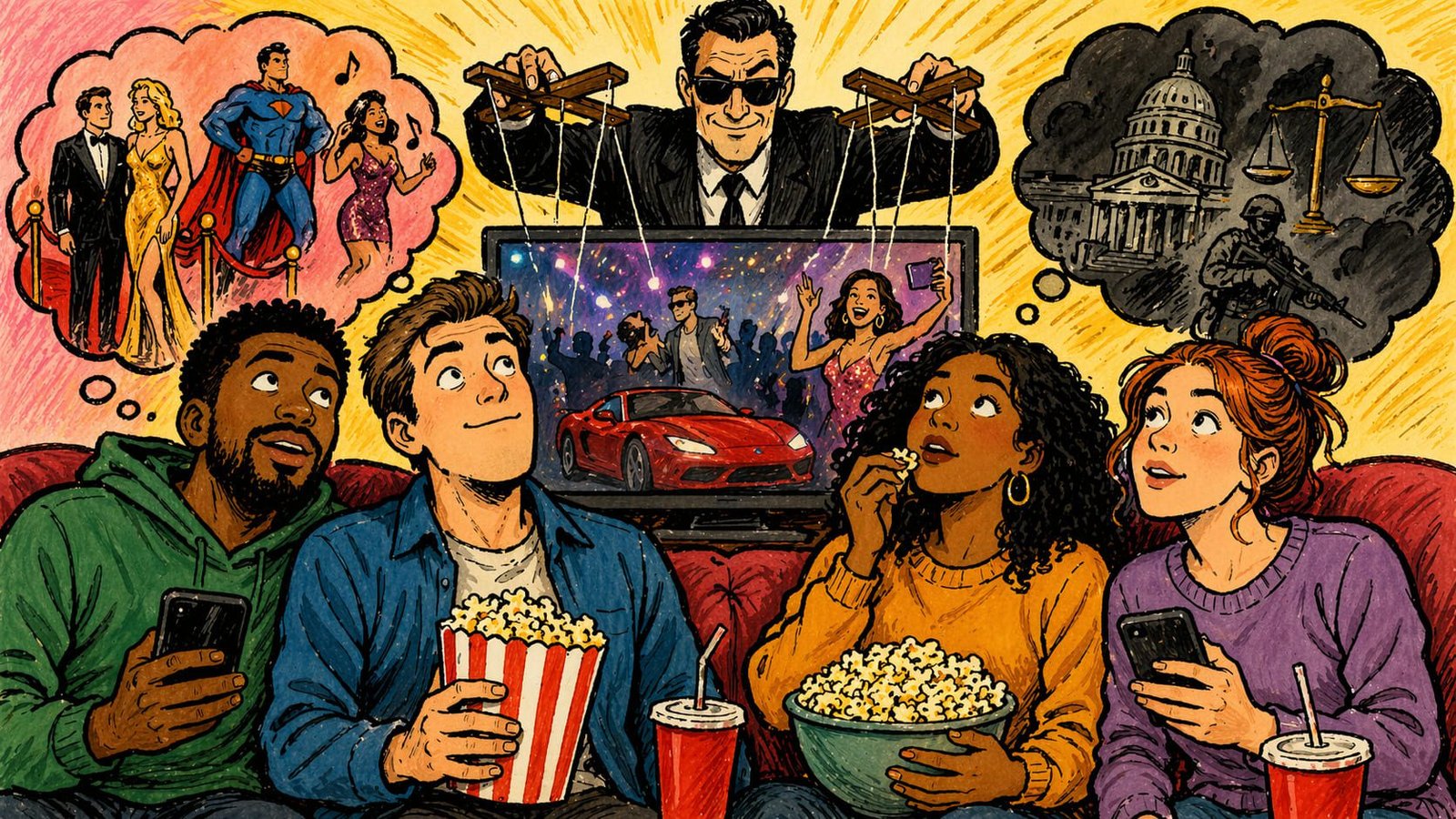
A screen flickers in a darkened room, and what looks like escape begins to behave like instruction. Laughter rolls easily, tension dissolves, and for a moment it feels like nothing serious is happening. Yet beneath the surface, something steadier moves, almost invisible. Stories slide into the mind not as arguments, but as experiences. They do not ask for permission. They do not announce their intentions. They simply stay. By the time the credits roll, the audience has not just been entertained. It has been gently rearranged.
Modern entertainment rarely declares its values outright. It prefers seduction over instruction. A joke lands, a character wins, a conflict resolves in a way that feels satisfying, and somewhere in that satisfaction, a message settles. The brilliance lies in the disguise. When ideas arrive wrapped in pleasure, resistance drops. The mind does not brace itself. It leans in. This is how narratives travel deeper than lectures ever could. They bypass skepticism and settle into instinct.
You can trace this through small, everyday moments. A product designer named Kareem once noticed his team referencing a popular streaming series during brainstorming sessions. The show celebrated risk-taking at all costs, framing caution as weakness. Slowly, the team began favoring bold, high-visibility ideas over thoughtful, sustainable ones. The shift felt natural, almost inevitable. No one had declared a new philosophy. They had simply absorbed one. Weeks later, a project failed not because of lack of talent, but because caution had quietly been rebranded as cowardice.
Entertainment has always carried moral frameworks, but today the delivery system has become sharper. Stories are shorter, more frequent, more immersive. They travel through algorithms that reward emotional intensity, ensuring that the most provocative narratives rise fastest. This creates a feedback loop. Content that reinforces strong reactions spreads wider, shaping norms at scale. What feels like personal taste often reflects collective conditioning. The line between preference and programming becomes difficult to locate.
A small film studio once discovered this by accident. Lina, a producer known for subtle storytelling, released a quiet drama about patience and long-term commitment. It received modest attention. Months later, she worked on a project filled with high-stakes conflict and immediate gratification. The second film exploded in popularity. Audiences praised its energy, its urgency, its sense of momentum. Lina realized something uncomfortable. The market was not just rewarding entertainment. It was rewarding a specific moral tempo, one that favored speed over depth.
This pattern extends beyond film and television. Music, advertising, even short-form video content carry embedded values. A catchy hook about independence can subtly reshape ideas about relationships. A viral clip celebrating hustle can redefine rest as failure. These messages accumulate. They do not feel heavy in isolation, but together they form a worldview. Over time, they begin to guide decisions in ways that feel personal, even though their origins are shared.
Cultural theorists have long argued that media acts as a kind of informal education system. Not through textbooks or exams, but through repetition and emotion. When a certain behavior is consistently rewarded in stories, it begins to feel normal. When another is consistently punished or ignored, it fades from consideration. This is not manipulation in the obvious sense. It is something quieter. It is orientation. A gradual shaping of what feels possible, acceptable, desirable.
A marketing executive named Sofia once described this effect during a late-night strategy session. She admitted that campaigns rarely try to change minds directly. Instead, they aim to shift what feels familiar. If an idea can be made to feel ordinary, resistance disappears. Entertainment operates on the same principle, but at a broader scale. It normalizes before it persuades. By the time a belief is consciously examined, it often already feels like common sense.
The tension becomes clear when you consider how rarely these embedded messages are questioned. People critique plots, performances, production quality. They debate endings, argue about characters, share recommendations. What they rarely do is interrogate the underlying moral architecture. It feels unnecessary, even excessive. After all, it was just a show. Just a song. Just a moment of distraction. That assumption is precisely what allows the deeper influence to operate without friction.
There is a quiet irony here. The more entertainment claims to be neutral, the more power it holds. When something presents itself as pure enjoyment, it lowers the guard of critical thinking. It becomes a trusted space. That trust allows ideas to settle more deeply than overt arguments ever could. It is not that entertainment hides politics. It dissolves the boundaries that would normally make those politics visible.
A small anecdote from a university classroom captures this shift. A professor asked students to analyze the values in a popular series. At first, the room resisted. They insisted it was just storytelling. As the discussion unfolded, patterns emerged. Success was tied to dominance. Vulnerability was framed as risk. Loyalty was conditional. The students grew quiet. They had not noticed these patterns while watching. Yet once named, they felt obvious. The realization lingered longer than the series itself.
This is where the deeper question begins to press. If entertainment shapes perception so effectively, what responsibility does it carry? And perhaps more importantly, what responsibility does the audience carry? The relationship is not one-sided. Creators respond to demand. Audiences reward certain narratives. Together, they co-create the moral landscape. It is a dynamic system, constantly adjusting, constantly evolving.
Somewhere, in a crowded production studio filled with glowing monitors and half-finished scripts, a scene is being rewritten. A character is being adjusted, a line softened, a conflict sharpened. These decisions feel technical, creative, even trivial. Yet each one carries weight. Each one contributes to the larger pattern of what stories say about how life should be lived. The accumulation of these choices becomes culture.
The realization does not arrive loudly. It settles in slowly, like a quiet shift in lighting that changes how everything else is seen. Entertainment is not separate from reality. It is one of the ways reality is negotiated. It offers scripts, not just for characters, but for audiences. It suggests how to respond, how to value, how to interpret. The more immersive it becomes, the more persuasive it grows.
Somewhere in the glow of another screen, another story begins, carrying with it a set of values that feel effortless, almost invisible. The audience leans in again, ready to feel, to laugh, to escape. Yet beneath that surface, the same quiet process continues, shaping not just what is watched, but what is believed.
So when the next story pulls you in and feels harmless, ask yourself something that rarely gets asked: are you enjoying the narrative, or quietly inheriting its rules?
