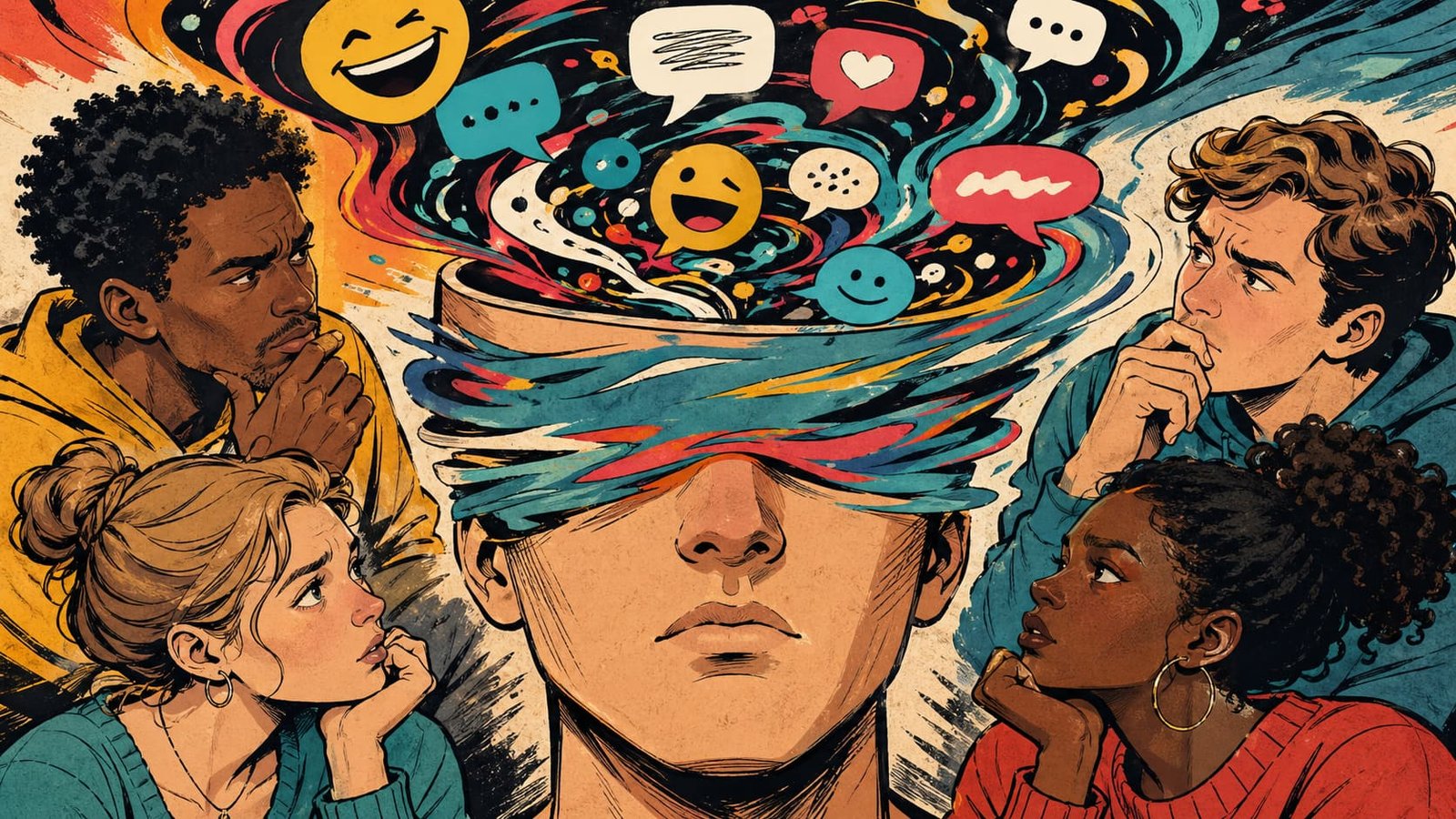
A sentence appears on a glowing screen, stripped down to fragments, stitched together with symbols, abbreviations, and an inside joke that only half the audience fully understands. It lands instantly. No one asks for clarification. The meaning is felt before it is explained. Somewhere else, the same sentence would sound incomplete, even incoherent. Here, it feels precise. Language has not broken. It has evolved into something faster, sharper, more compressed, and in that compression, something deeper begins to shift.
Words used to stretch. They carried context, tone, history. Conversations unfolded slowly, allowing meaning to develop in layers. The internet introduced a different rhythm. Speed became essential. Brevity turned into a skill. Entire ideas are now conveyed through a handful of characters, a reaction image, or a phrase that carries cultural weight far beyond its literal definition. Language has become a form of code, shared among those who understand it and opaque to those who do not.
A communications lecturer named Esther noticed this shift while reviewing student essays. The arguments were thoughtful, but the phrasing often reflected patterns from online discourse. Phrases that originated as jokes or memes appeared in academic contexts, carrying an implied meaning that was difficult to translate into formal language. Esther did not see it as a decline. She saw it as a transformation. Students were not losing language. They were adapting it to fit a new environment.
This adaptation is not neutral. It shapes how ideas are formed and expressed. When language becomes more compressed, nuance can be harder to maintain. A complex issue may be reduced to a phrase that captures attention but loses depth. At the same time, the efficiency allows ideas to travel quickly, reaching audiences that might never engage with longer forms. The trade-off is subtle but significant. Clarity increases in some ways, while complexity decreases in others.
A startup founder named Malik experienced this while pitching his company online. His initial explanations were detailed, grounded in careful reasoning. They struggled to gain traction. When he reframed his message into shorter, more striking phrases, engagement increased dramatically. The audience responded to the clarity, the immediacy. Yet Malik found himself simplifying concepts that required more explanation. The language worked, but it also reshaped the idea itself.
Internet language also carries a strong sense of identity. Certain phrases signal belonging to specific communities, whether they are rooted in gaming culture, finance, activism, or entertainment. Using the right words in the right context can establish credibility instantly. Misusing them can have the opposite effect. This creates a dynamic where language becomes both a tool for communication and a marker of cultural alignment.
A journalist named Sofia observed this during a live discussion on social media. Participants used shorthand phrases that conveyed entire arguments in a few words. Those familiar with the language engaged quickly, building on each other’s points. Others struggled to follow, feeling excluded from the conversation. The discussion was efficient for some and inaccessible for others. Language had created both connection and division at the same time.
Pop culture amplifies these patterns. Phrases that originate in niche communities often spread into mainstream usage, sometimes losing their original meaning in the process. What begins as a specific expression tied to a particular context can become a generalized term, applied broadly and sometimes inaccurately. This evolution reflects the speed at which language now moves, adapting to new environments while leaving traces of its origins behind.
There is also a creative dimension that deserves attention. Internet language encourages experimentation. New words, new structures, new ways of expressing tone and emotion emerge constantly. A writer named Tunde described it as “language in motion,” a space where rules are flexible and meaning is negotiated in real time. This fluidity can be liberating, allowing for expressions that feel more immediate and personal. It can also create ambiguity, where meaning depends heavily on shared context.
The business world has embraced this shift, integrating internet language into marketing and communication strategies. Brands adopt informal tones, incorporate popular phrases, and engage with audiences in ways that feel conversational rather than corporate. This approach can make companies appear more relatable, but it also requires careful navigation. Language that feels authentic in one context may feel forced in another.
A teacher named Neema once asked her class to translate a series of online phrases into formal language. The exercise revealed how much meaning was embedded in context rather than words alone. Students debated interpretations, drawing on shared cultural knowledge to explain nuances that were not explicitly stated. The process highlighted both the richness and the limitations of this evolving language.
In a world where communication moves at unprecedented speed, language continues to adapt, reflecting the environments in which it is used. It becomes more efficient, more expressive in certain ways, while also carrying new challenges related to clarity and inclusivity. The transformation is ongoing, shaped by millions of interactions that occur every moment.
Somewhere in a quiet corner of a library, a reader encounters a phrase that feels familiar yet slightly altered, a reflection of how language has shifted over time. The words carry meaning, but they also carry the imprint of the systems and cultures that shaped them. That imprint lingers, subtle but persistent.
And in that subtle shift, a realization begins to form. Language does not just describe reality. It helps create it, shaping how people think, connect, and understand the world around them.
You read, you write, you adapt, and somewhere in that constant exchange, you must decide whether language is serving your understanding or quietly rewriting it.
