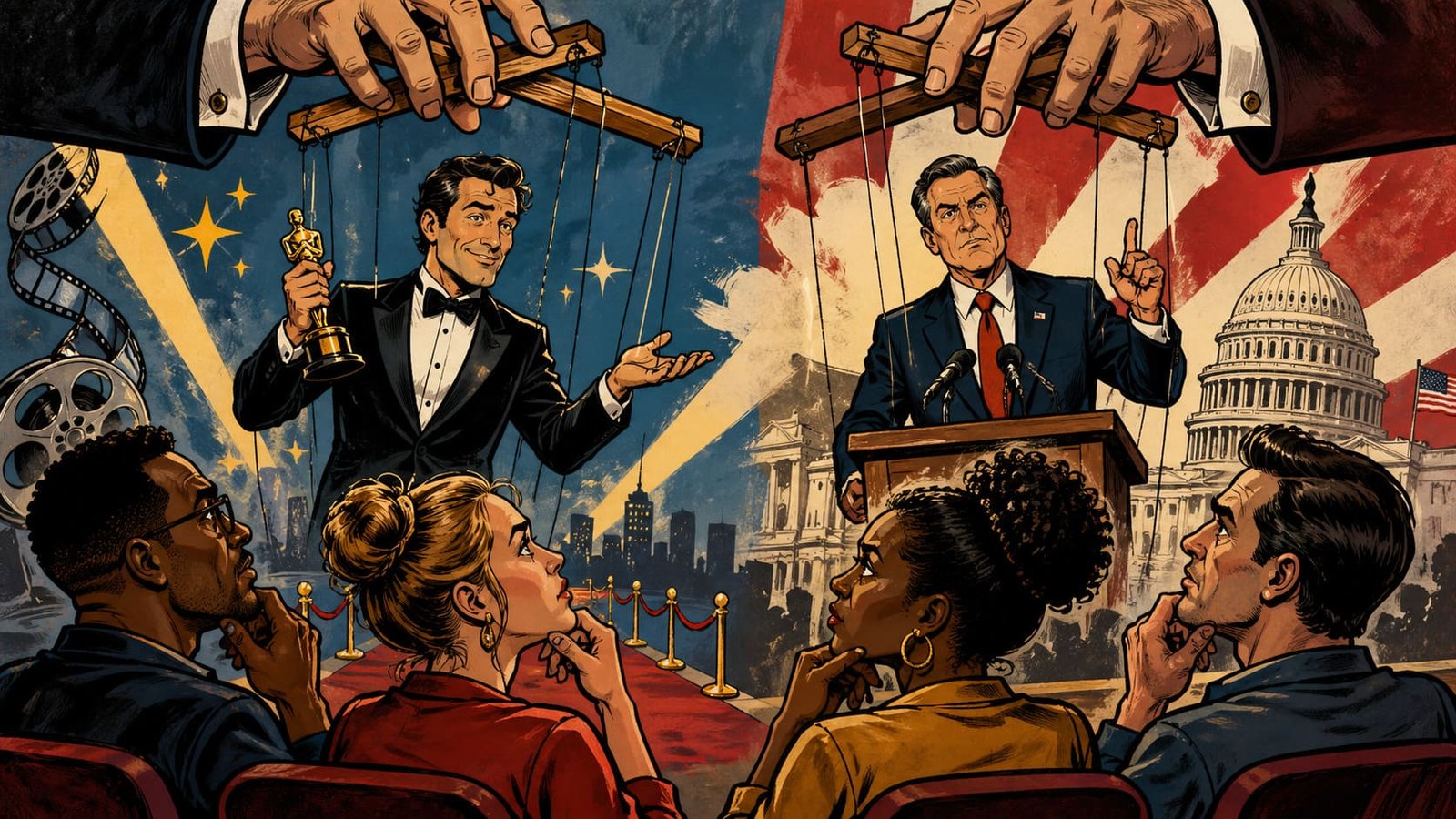
A glowing screen flickers in a quiet living room, and a character delivers a speech that feels too sharp to be accidental. The camera lingers, the music swells, the line lands. Somewhere beyond the scene, a different kind of rehearsal takes place. Not in studios or on sets, but in the minds of viewers who carry those rhythms into the way they interpret leaders, crises, and power itself. The boundary between entertainment and governance does not break. It dissolves.
The influence begins subtly, almost playfully. Stories simplify chaos into arcs that can be followed. Heroes emerge, villains take shape, conflicts resolve with timing that feels deliberate. The theorist Neil Postman once warned that public discourse can shift toward the logic of entertainment, where style overtakes substance and performance shapes perception. That shift no longer feels hypothetical. It feels ambient, woven into how authority is recognized and judged.
Patterns repeat until they feel natural. A campaign strategist named Mateo once admitted, during a late-night debrief in a dim office that smelled faintly of printer ink and stale coffee, that speeches are often tested for narrative impact before policy clarity. Lines are crafted to echo familiar story beats, not just to inform but to resonate. When a leader frames a decision as a turning point or a battle, it taps into a structure audiences already understand. The content matters, but the arc carries it further.
This is where instinct begins to change shape. A law student named Yara noticed it while watching a series known for its portrayal of political maneuvering. The show’s characters navigated power with precision, blending charisma, calculation, and spectacle. Later, during a public debate, Yara caught herself evaluating real politicians through the same lens. Who delivered the stronger line, who controlled the room, who felt decisive. The assessment felt intuitive. It also felt borrowed. The criteria had been trained, not chosen.
Inside institutions, this dynamic becomes more strategic than accidental. A communications advisor named Henrik described it during a strategy session held in a glass-walled conference room overlooking a restless city. He explained that modern political messaging often borrows from narrative design used in entertainment. Tension is introduced, stakes are raised, resolution is promised. The structure is familiar because it has been rehearsed through countless stories. When Barack Obama spoke with measured cadence and narrative clarity, it resonated not only because of content, but because it aligned with patterns audiences had learned to recognize as leadership.
A small civic initiative in Manila once attempted to counter this by presenting policy discussions without narrative framing. The organizer, Lian, believed that stripping away dramatic elements would allow substance to stand on its own. The sessions were detailed, informative, and precise. Attendance, however, remained limited. Participants who did attend often described the experience as valuable but demanding. Without a narrative arc, engagement required more effort. Lian faced a quiet dilemma. Should truth adapt to the language of story, or risk being overlooked?
Pop culture continues to reinforce these instincts with relentless consistency. Films and series depict leaders who are either visionary saviors or deeply flawed antiheroes, rarely occupying the quieter middle ground where most real decisions occur. These portrayals create expectations that bleed into public life. A leader who does not fit the archetype can feel less compelling, regardless of competence. The performance of power begins to matter as much as its execution.
The deeper consequence is not simply misjudgment. It is a shift in what feels legitimate. A policy proposal framed without narrative may appear weak, even if it is sound. A dramatic stance may feel strong, even if it lacks substance. A political analyst named Sofiane once observed during a panel discussion that audiences often remember the moment of delivery more vividly than the details of the policy itself. The spectacle lingers. The specifics fade. The script outlives the substance.
There is a quiet recognition that emerges when this pattern becomes visible. It does not dismiss storytelling. It questions its dominance. It asks whether the structures borrowed from fiction are serving understanding or replacing it. This recognition feels almost like stepping out of a familiar rhythm, noticing the choreography that once felt natural. It introduces a pause, a hesitation that allows for a different kind of evaluation.
In a small screening room after the credits have rolled, a viewer remains seated, the glow of the screen fading into darkness. The story has resolved cleanly, conflicts tied together with satisfying precision. Outside, the world continues, unresolved, layered, resistant to neat endings. The contrast feels sharp, almost unsettling. The patterns that felt so convincing within the story begin to look less certain when applied beyond it.
As the next speech, debate, or decision unfolds with a familiar cadence, a question lingers, quiet and persistent: if the instincts used to judge power were shaped in rooms built for fiction, how much of what feels convincing is simply well-rehearsed, and what might change if the script no longer guided the gaze?
