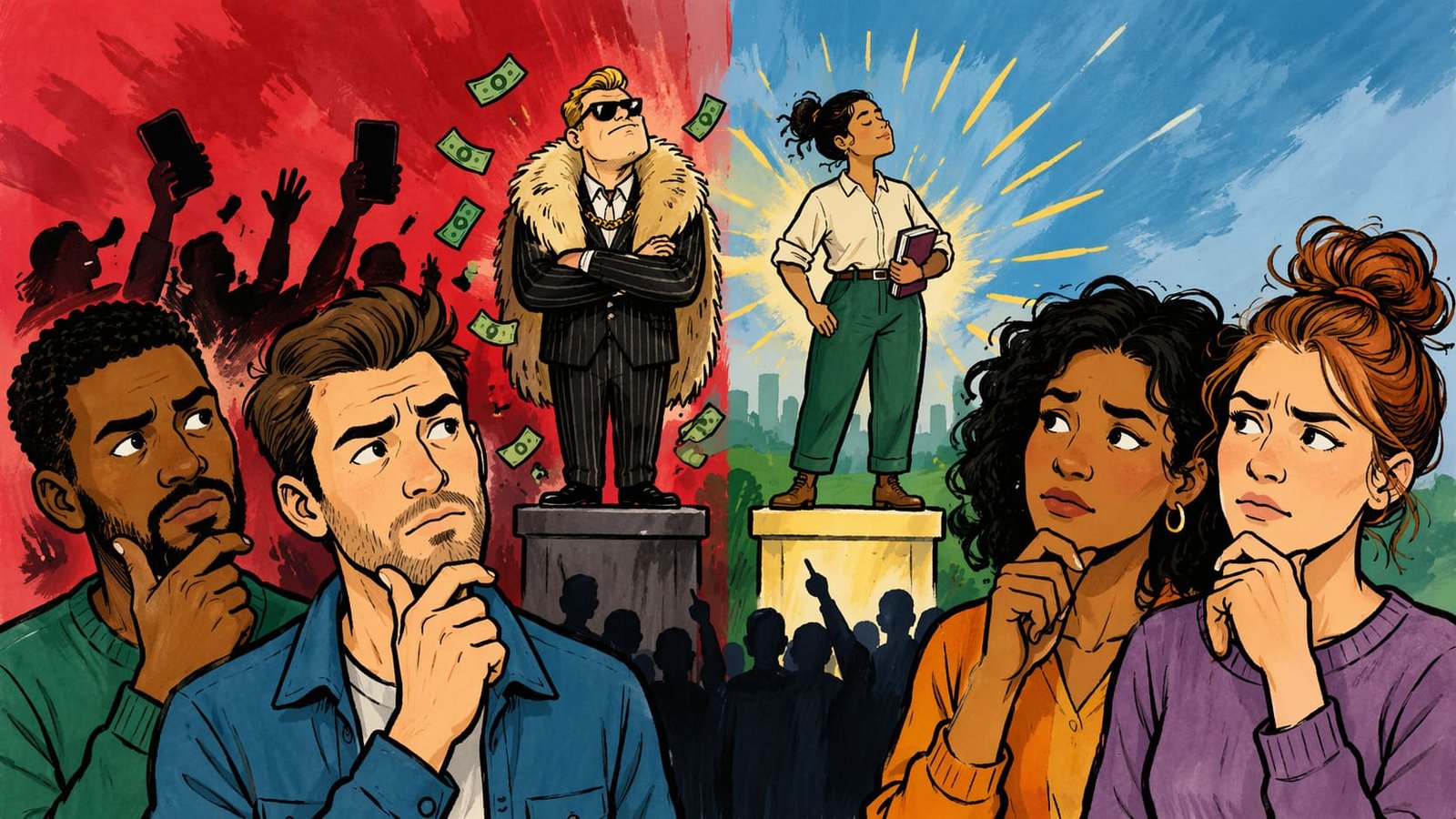
A city glows under artificial light, not the soft warmth of belonging but the cold brilliance of screens reflecting faces that never quite rest. Somewhere between a trending clip and a breaking headline, a name rises. A hero is chosen. Not elected, not earned in any classical sense, but assembled in fragments. A gesture here, a quote there, a carefully cropped image that feels honest enough to trust. The crowd leans in, not out of devotion, but out of hunger. It is not the hero they are watching. It is themselves, refracted through someone else’s story.
History never runs out of heroes, yet each era curates its own with unsettling precision. You can almost feel the invisible hand selecting traits that mirror collective anxieties. During moments of uncertainty, bold figures appear. In times of exhaustion, softer icons rise. The pattern repeats with eerie consistency, like a cultural algorithm refining itself. Consider how public figures once admired for restraint now compete in a theater of visibility, where silence reads as absence and restraint feels like weakness. The shift did not happen overnight. It happened because audiences changed their appetite.
You can see it in small, human moments. A young consultant named Amina once paused mid-presentation because her team kept quoting a charismatic founder known for blunt, viral statements. She noticed something strange. They admired not his strategy, but his tone. Sharpness had become a signal of intelligence. Weeks later, her firm adopted a more aggressive communication style, believing it aligned with strength. The results were mixed. Deals closed faster, but relationships frayed. The hero they had chosen quietly rewired how they behaved, long before they understood the cost.
Heroes do not simply inspire. They authorize. That is the quiet contract. When a culture elevates a certain kind of figure, it is granting permission to act in similar ways. Think of how entertainment has shifted over time. Antiheroes dominate narratives now, not because morality disappeared, but because complexity feels more honest. A character who bends rules resonates in a world where rules often feel negotiable. The popularity of morally ambiguous figures signals something deeper than taste. It reveals a collective negotiation with ethics, one that feels both liberating and unsettling.
There is a pattern beneath this. Sociologists often point to the idea that culture reflects collective psychology. Heroes become emotional shortcuts, a way for societies to process internal conflict without naming it directly. A society grappling with inequality may elevate disruptors. A society anxious about stability may lean toward protectors. These are not random choices. They are mirrors disguised as idols. When people say, “That person represents something,” they are usually right. They just rarely finish the sentence with “about us.”
A story from a small creative agency captures this tension perfectly. Daniel, a brand strategist known for thoughtful campaigns, once lost a major client to a louder competitor who built his reputation on relentless self-promotion. Months later, Daniel noticed his own tone changing. He spoke faster, interrupted more, leaned into spectacle. It worked. His visibility grew. But something subtle shifted in his work. It became louder, less precise. He had not just adapted. He had internalized a new definition of success, one borrowed from a hero he did not consciously choose.
Pop culture accelerates this process. It packages heroes into digestible formats, then distributes them at scale. A viral speech becomes a philosophy. A bold decision becomes a template. The speed is breathtaking. It compresses nuance into symbols that travel easily. A founder becomes “the visionary.” An artist becomes “the rebel.” These labels feel clean, but they flatten complexity. The danger is not that heroes are imperfect. It is that their imperfections are often edited out, leaving behind a version that feels easier to imitate but harder to question.
This is where the tension sharpens. Every era wants heroes who feel larger than life, yet deeply relatable. It wants figures who seem exceptional but also accessible. That contradiction drives much of modern admiration. People do not just want to watch greatness. They want to feel adjacent to it. That proximity creates a strange loop. The closer a hero feels, the more influence they carry. The more influence they carry, the more they shape behavior. Over time, the line between inspiration and imitation blurs until it disappears entirely.
A late-night conversation in a quiet office once revealed this more clearly than any theory. A senior executive named Victor admitted something he had never said out loud. He did not know if he believed in the principles he often quoted. He believed in the people who said them. The distinction unsettled him. It meant his decisions were not anchored in ideas, but in personalities. He paused, then added that he was not alone. Most of his peers operated the same way, even if they would never admit it in public.
The truth sits there, quietly uncomfortable. Heroes are not accidents. They are selections. Each era builds them from its own contradictions, its own desires, its own fears. The process feels organic, but it is deeply revealing. It shows what a society rewards, what it tolerates, what it secretly admires. It also shows what it is willing to ignore. When certain flaws are overlooked, it is rarely because they are invisible. It is because they are inconvenient to the story people want to believe.
The deeper question lingers beneath all of this. What happens when a culture outgrows the heroes it once needed? The transition is rarely smooth. Old icons begin to feel outdated. New ones emerge, carrying different values, different signals. The shift can feel disorienting, even threatening. It is not just about replacing figures. It is about redefining what is admirable. That process often reveals fractures, as different groups compete to define the next standard.
In the end, the hero is never just the individual standing in the spotlight. The hero is the reflection of the crowd that placed them there. Every applause, every share, every quiet moment of admiration adds another layer to that reflection. It becomes a collective portrait, one that tells a story about who people are becoming, not just who they admire.
Somewhere, in a room filled with low light and restless ambition, another name is beginning to rise. The signals are already there, subtle but unmistakable. A phrase catching on. A style being copied. A presence gaining gravity. The next hero is forming, shaped not by destiny, but by the quiet preferences of millions who may never realize they are part of the selection process.
As that figure steps into focus, one question hangs in the air, sharper than it first appears: are you choosing your heroes, or are they choosing who you become?
