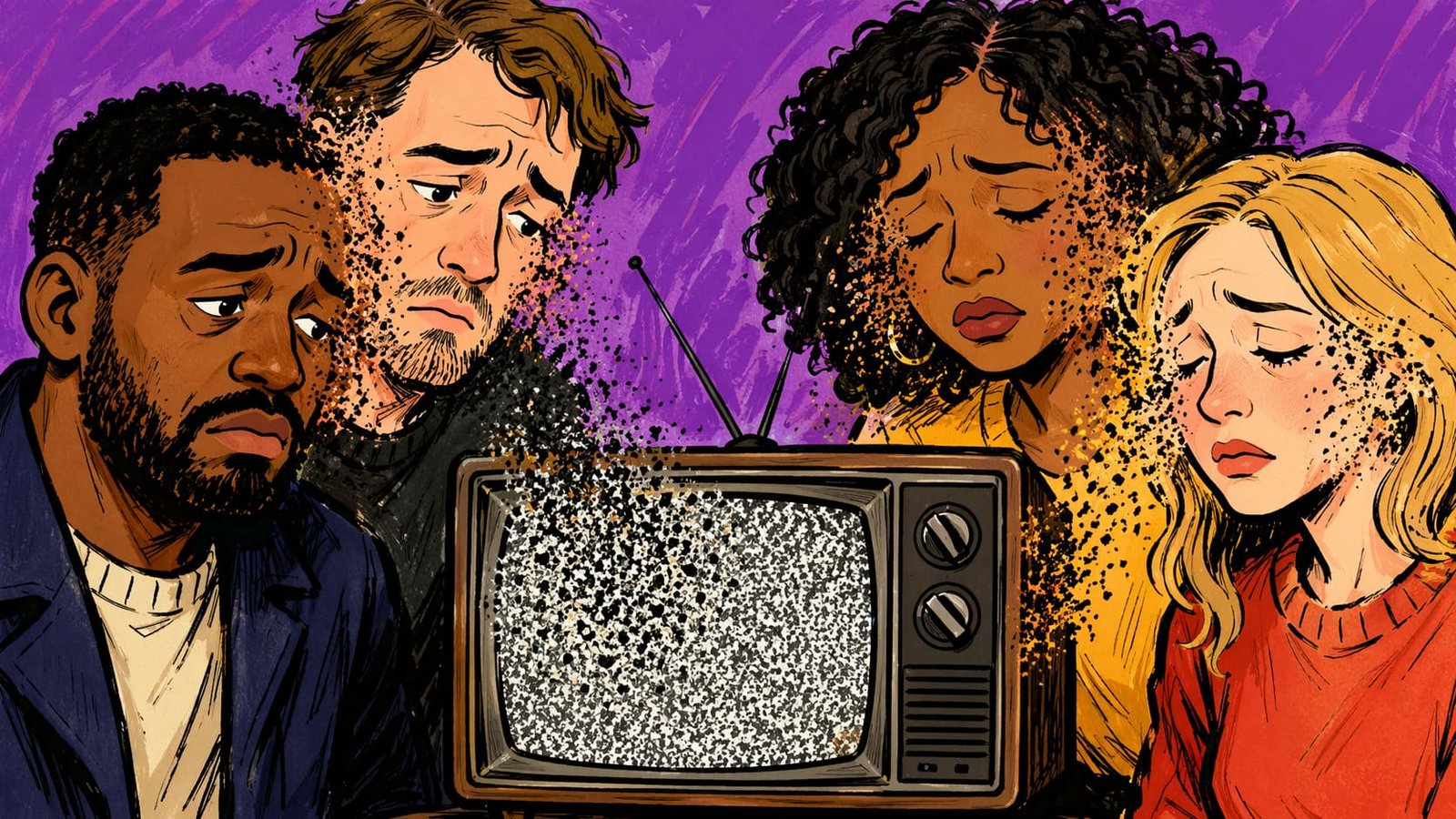
The screen flickers, but no one owns it anymore. A figure walks into frame, speaks, exits, and leaves no trace behind, as if the story itself has forgotten to remember them. Once, television revolved around gravity. A central character pulled every scene inward, a sun around which everything else orbited. Now the center does not hold. Narratives drift. Attention fractures. The hero dissolves into a chorus, and the chorus sounds strangely like noise. Something fundamental has shifted, not in the technology of television, but in its imagination. The age of the main character is slipping out of focus.
It did not happen overnight. The erosion began quietly, disguised as innovation. Ensemble casts grew larger, plotlines multiplied, timelines splintered. Prestige television prided itself on complexity, on weaving narratives so intricate they felt like puzzles rather than stories. Viewers were told this was sophistication, a sign of narrative maturity. And for a while, it was. Shows like Game of Thrones made fragmentation feel thrilling. No single character was safe, no perspective permanent. The story belonged to everyone and therefore to no one. It was exhilarating until it became exhausting.
You can feel the difference in how people talk about television now. Ask someone about a classic series, and they will name a character instantly. Tony Soprano. Walter White. Olivia Pope. These figures carried narratives with a kind of emotional gravity that anchored the viewer. Ask the same question about many recent shows, and the answer becomes less certain. People describe plots, aesthetics, even vibes, but struggle to point to a singular presence that defines the experience. The story becomes ambient. It exists, but it does not attach.
A producer named Elena once pitched a drama built around a deeply flawed protagonist, a woman whose contradictions were meant to drive every episode. The network feedback was polite but clear. “Expand the world,” they said. “Give more characters equal weight.” The concern was not artistic. It was strategic. In a fragmented attention economy, more characters mean more entry points, more clips, more moments that can circulate online. Elena adjusted the script. The protagonist remained, but she was no longer the center. When the show aired, it performed well. Viewers debated scenes, shared highlights, moved quickly to the next release. Months later, few could recall the main character’s name.
This is not just about storytelling. It reflects a deeper cultural shift. The idea of a “main character” implies hierarchy, focus, a sense that one perspective matters more than others. That idea feels increasingly out of step with a world shaped by feeds and algorithms, where everything competes on equal footing for attention. Social media has trained audiences to process stories as streams rather than arcs. You scroll, you sample, you move on. Television has adapted to that rhythm. Instead of asking viewers to commit to a single journey, it offers multiple threads, each one partial, each one replaceable.
There is also a subtle fear at play. Strong protagonists demand patience. They evolve slowly, often uncomfortably. They ask the audience to sit with ambiguity, to invest in a person who may not be immediately likable or easy to understand. That kind of engagement is harder to sustain in an environment built on instant reaction. Fragmented storytelling feels safer. It distributes emotional risk. If one character fails to resonate, another might. The narrative hedges its bets, and in doing so, it weakens its own core.
A showrunner in Los Angeles once described the pressure in a way that lingered. “Every scene has to be a doorway,” he said. “You never know where the audience will enter.” It sounds practical, even smart. Yet something is lost when every moment is designed to function independently. Stories become modular. Characters become interchangeable. The sense of progression, of watching someone transform over time, begins to fade. What remains is a sequence of moments, polished and shareable, but rarely cumulative.
There are exceptions, of course, and they stand out precisely because they resist the trend. Series like Succession still orbit around powerful central figures, even as they explore a wider ensemble. The Roy family dominates not because they are evenly distributed, but because their conflicts carry weight. Each character feels consequential, not because they share equal screen time, but because they are tied to a clear emotional axis. The difference is subtle but important. The story knows where its center is, even when it chooses to wander.
What is unfolding is not the death of storytelling, but a redefinition of its priorities. Television is becoming less about following a single life and more about mapping a landscape of interactions. The viewer becomes less of a witness to transformation and more of a navigator, moving between threads, assembling meaning from fragments. It can be engaging in its own way, a kind of narrative collage. Yet it raises a quiet question. When no one carries the story, who carries the meaning?
In a darkened living room, the credits roll on a show that no one will remember in a year. Not because it was poorly made, but because it left no imprint, no central figure to hold onto. The screen goes black, and for a brief moment, there is an absence that feels almost unfamiliar. No cliffhanger, no lingering attachment, just a clean break. It is efficient. It is forgettable. It is the logical end of a system that values constant novelty over lasting connection.
Somewhere, a character stands at the edge of a story that refuses to choose them, waiting for a narrative brave enough to make them matter, and the silence that follows feels less like an ending and more like a quiet dare: will you keep consuming stories that forget themselves, or will you start demanding ones that remember who they are really about?
