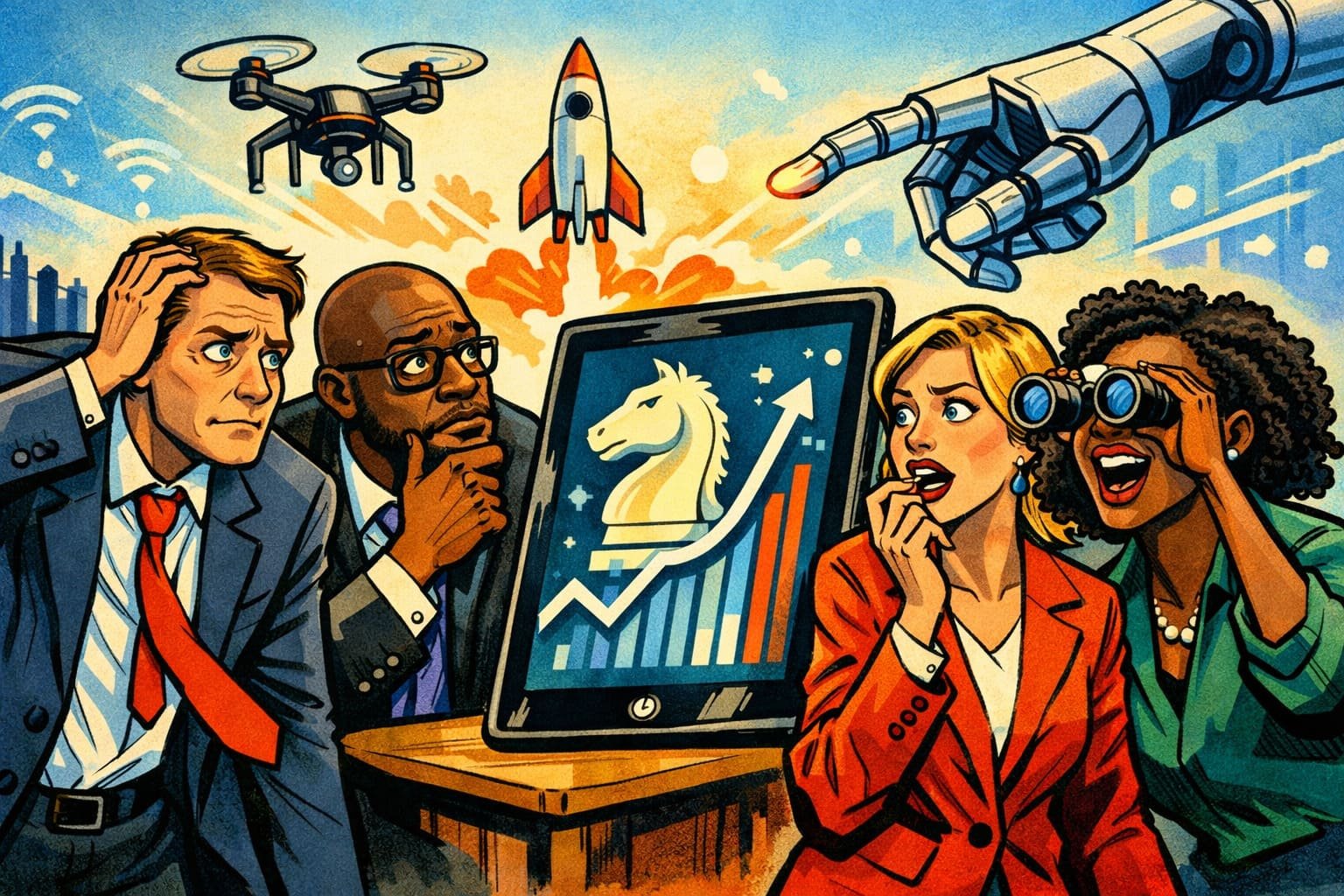
The most dangerous room in modern business is not the one filled with conflict. It is the one filled with polished agreement around concepts nobody fully understands. In one London boardroom, an executive vice president named Dorian nodded through an artificial intelligence strategy presentation while secretly googling terminology beneath the conference table like a teenager cheating through finals. Nobody noticed because everyone else was performing the same species of executive theatre, elegant posture disguising strategic illiteracy. Technology rarely humiliates companies because the tools arrive too quickly, it humiliates them because leadership vanity slows honesty.
Polished Ignorance: The Meeting Where Everyone Nodded
The mythology of leadership still flatters experience in ways reality no longer respects. There was a time when accumulated industry wisdom behaved like strategic currency that appreciated with age. That contract has become unstable. Today, entire business models can be mugged by software written by people too young to remember fax machines. Experience still matters, certainly, but only if it remains intellectually porous. Fossilized expertise is just nostalgia wearing cufflinks.
A chief marketing officer named Ruxandra once insisted her consumer brand did not need to rethink digital behavior because “human psychology never changes.” That sentence sounded sophisticated until a direct-to-consumer competitor weaponized algorithmic personalization so effectively that her team began studying their own collapse through quarterly reporting decks. She was partially right, which made the error more dangerous. Human psychology does remain remarkably stable. Technology simply learns to manipulate those constants faster than institutions adapt.
This explains why leaders often become emotionally defensive around technological disruption. New tools do not merely threaten workflows. They threaten identity. If you built a career being the smartest person in the room, emerging technology introduces a uniquely humiliating possibility, that your expertise may suddenly resemble aristocratic handwriting in an age of keyboards. Strategic adaptation becomes psychologically expensive when reinvention feels like self-erasure.
Clayton Christensen’s work on disruption remains useful because it captured something brutally human about institutional blindness. Organizations rarely ignore technological shifts because data is unavailable. They ignore them because existing incentives reward continuity, confidence, and protecting profitable assumptions. Technology does not ask permission before changing strategic terrain. Markets are deeply inconsiderate that way. Leaders who confuse historical competence with future relevance eventually become case studies.
Expensive Theatre: Innovation Performances for Nervous Adults
Corporate innovation often resembles ceremonial religion more than disciplined strategy. Executives attend summits, collect fashionable vocabulary, fund symbolic pilot projects, and announce transformation initiatives with all the emotional sincerity of aristocrats donating publicly while preserving private inheritance. Technology becomes theatre when leaders crave the optics of adaptation more than the discomfort of actual change. That pattern is expensive, though it photographs beautifully. Few things look more modern than institutional denial with excellent branding.
A telecom executive named Faraj once launched what internal teams privately called the innovation aquarium. It was a glass-walled experimentation lab positioned where visitors could admire developers working like curated intellectual wildlife. Tours loved it. Investors applauded it. Employees quietly joked that the lab’s primary function was decorative reassurance because the actual operating business remained culturally hostile to change. Nothing kills transformation faster than innovation that exists primarily for guided tours.
You can see versions of this everywhere. Legacy retailers launching apps nobody meaningfully supports. Financial institutions discussing blockchain with the hushed reverence of people discussing distant astronomy. Media executives describing digital transformation while protecting advertising assumptions already rotting beneath them. Innovation theatre is comforting because performance feels cleaner than disruption. Real adaptation requires status sacrifice.
BlackBerry remains one of the more elegant cautionary tales. The company was not run by fools. It simply interpreted technological change through the emotional logic of prior success. Keyboard loyalty became cultural identity. Existing customer assumptions became strategic religion. By the time reality became undeniable, adaptation no longer felt like innovation. It felt like surrender.
Technology punishes symbolic adaptation with unusual cruelty. Markets do not reward transformation vocabulary. Customers do not care about executive enthusiasm panels. Software does not become less disruptive because senior leadership attended a conference in Davos. Strategic adaptation requires behavior change, incentive redesign, talent redistribution, and ego demolition. The future is strangely unimpressed by theatre.
Machine Anxiety: When Leaders Fear Their Own Replacement
Artificial intelligence has introduced a specific psychological tension corporate history has rarely seen at this scale. Earlier technologies disrupted labor, distribution, communication, logistics, and consumer behavior. AI carries a more intimate insult. It threatens white-collar identity, the professional classes who long assumed cognitive work occupied safer strategic territory. Watching executives discuss AI often feels like observing aristocrats discover industrial machinery has entered the library.
A legal operations director named Mireya described her first encounter with advanced language models in oddly personal terms. “It felt rude,” she admitted. That sentence deserves preservation. Not because the software was emotional, but because disruption had become psychologically intimate. AI did not merely threaten workflows. It threatened self-concept, accumulated expertise, and the invisible hierarchy separating “thinking professions” from automatable labor.
This emotional dimension matters strategically because fear distorts judgment. Some leaders aggressively overinvest because panic masquerades as vision. Others dismiss capability because contempt feels emotionally safer than curiosity. Neither response reflects disciplined strategic thinking. Technology anxiety produces strategic overcorrection as reliably as technological arrogance produces paralysis. Emotional regulation has become an executive competency.
Nokia’s collapse illustrated a related truth, though under different technological conditions. Organizational fear distorted decision quality internally. Teams understood competitive threats more clearly than leadership behavior suggested, yet cultural dynamics suppressed urgency. Strategic blindness often looks informational from the outside. Internally, it can feel painfully emotional, like institutional denial dressed in business casual. Technology rarely defeats honest organizations as quickly as it defeats frightened ones.
The cruel joke is that leadership prestige historically depended on projecting certainty. Technology now punishes certainty when certainty becomes performative ignorance. The strongest modern leaders increasingly sound less omniscient and more intellectually agile. “We do not know yet” may become one of the most strategically sophisticated sentences available. Vanity hates that sentence. Markets reward it more often than executives admit.
Obsolescence Fever: The Professionals Watching Time Accelerate
There is a particular kind of fatigue emerging across executive culture. It is not burnout in the classic sense. It is obsolescence anxiety, the unnerving suspicion that professional half-life is shortening while expectations keep accelerating. Senior leaders once had time to metabolize change between industry waves. Now disruption behaves like weather in coastal storm season. Strategic adaptation is no longer episodic. It is atmospheric.
A manufacturing strategist named Eliska printed an article about AI supply chain optimization, highlighted half of it, then left it unread on her desk for eleven days because understanding it felt emotionally exhausting after managing three unrelated crises. That detail matters because adaptation failure is not always arrogance. Sometimes it is overload. The future keeps arriving during already full calendars. Strategic neglect occasionally begins as ordinary human fatigue.
Younger professionals misread this dynamic when they assume resistance always equals incompetence. Sometimes the resistance is grief. Technological transitions do not merely introduce tools. They quietly retire forms of mastery people spent decades building. Imagine becoming excellent at an intellectual craft only to watch interfaces flatten the prestige around it. Adaptation requires not just learning, but mourning.
Hollywood accidentally captured this emotional architecture in films about aging professionals confronting cultural displacement, though boardrooms rarely admit the resemblance. The executive who once dominated an industry can become psychologically fragile when technological literacy redistributes status toward younger operators. Strategic adaptation becomes emotionally tangled because hierarchy is never purely rational. Technology does not simply change systems. It rearranges dignity.
This is why leadership development needs reinvention. Teaching decision frameworks without emotional adaptability is increasingly malpractice. Strategic competence now includes curiosity under uncertainty, ego elasticity, technological literacy, and tolerance for partial understanding. The modern leader must metabolize ambiguity without performing false confidence. That is a harsher job description than many inherited.
Who Still Deserves to Lead?
A cleaning contractor named Sabine once passed a conference room after midnight where a smart display still glowed with the phrase AI Transformation Roadmap in immaculate corporate typography. Around the table sat abandoned sparkling water bottles, artisanal biscuit wrappers, and a forgotten leather notebook containing a handwritten line that simply read, “Ask what GPT actually does.” The honesty of that note felt more strategic than the entire presentation. Institutions do not collapse because people lack intelligence. They collapse because status makes honest ignorance socially expensive.
The leaders who survive this era will not be the ones who memorize the most technology jargon. They will be the ones psychologically capable of remaining beginners without becoming defensive. That distinction matters enormously. The future does not belong to the loudest futurists. It belongs to executives with enough ego discipline to learn publicly without mistaking humility for weakness.
Technology strategy is no longer a specialist conversation delegated politely to technical departments. It is leadership literacy. Not because every executive must become an engineer, but because strategic interpretation increasingly depends on understanding how technological capability reshapes markets, labor, attention, and customer expectation. Delegated ignorance is becoming commercially unaffordable. Pretending comprehension may be even costlier.
History will likely judge this era less by technological breakthroughs than by leadership responses to them. Some organizations will adapt with curiosity, discipline, and courage. Others will fund decorative transformation while privately protecting fragile hierarchies. The difference will not be intelligence alone. It will be emotional maturity under strategic pressure.
So here is the question hiding beneath every innovation summit, transformation workshop, and glossy digital strategy deck: when the next technological wave strips away the prestige of what you already know, will you become the kind of leader who learns fast enough to matter, or the kind who keeps nodding while secretly searching definitions under the table?