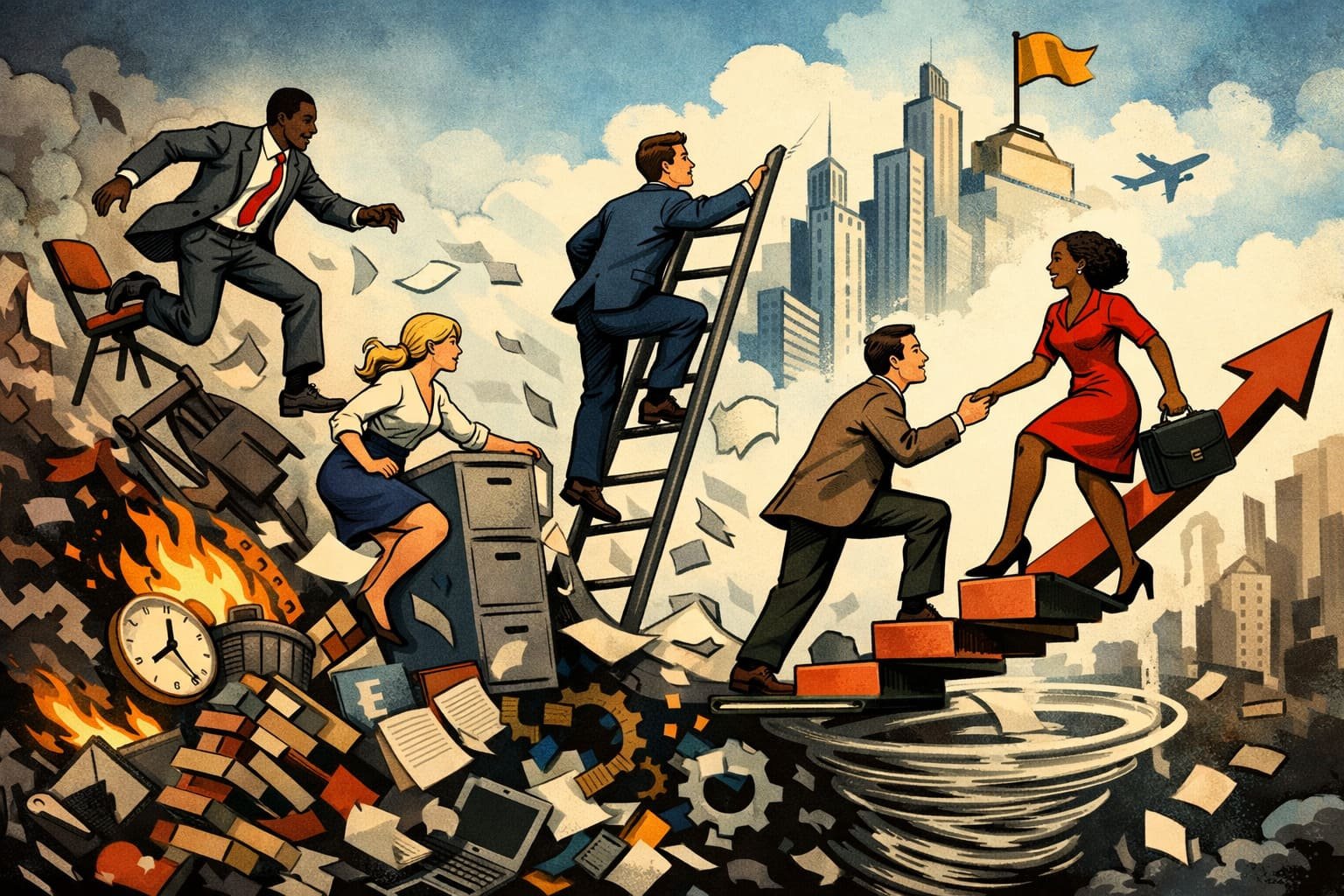
In the half-light of a restless economy, growth can look almost obscene. Screens glow with bad news, cautious memos move from inbox to inbox like folded warnings, managers speak in careful tones, and the smell of burnt coffee hangs over conference tables where people use the word “stability” as if it were a prayer. Then one company does something unsettling. It expands. It hires. It launches. It invests. It behaves as though disorder is not a reason to hide, but a reason to move faster. That is when the room changes.
Most people think growth belongs to easy seasons. They imagine expansion as a reward for calm markets, supportive customers, friendly capital, and a sky without thunder. Business history keeps humiliating that fantasy. Some of the strongest companies did not scale because conditions were safe. They scaled because they understood that fear makes competitors late, timid, distracted, and predictable. Growth, in the right hands, becomes less a celebration and more an ambush.
That logic feels uncomfortable because fear sounds prudent. Fear tells you to conserve energy, delay bets, protect what remains, and wait for better visibility. That instinct can save foolish companies from dying quickly. It can also keep promising businesses from becoming formidable. Growth is rarely comfortable, and scaling through disorder feels especially rude because it asks you to move while everyone else is still negotiating with their anxiety. The brave part is not speed alone. The brave part is disciplined motion while the crowd clutches the railing.
You can see flashes of this in companies that refused to treat chaos as a permanent stop sign. Netflix expanded aggressively into streaming while others still treated digital consumption like a side plot. Amazon kept deepening infrastructure and logistics while many retailers were still admiring store footprints that would soon feel heavier than they looked. Airbnb grew inside skepticism and turbulence by reading behavior faster than established hospitality players read themselves. None of these stories were clean. That is what makes them instructive. Growth does not need perfect weather. It needs conviction, pattern recognition, and the stomach to look unreasonable before looking right.
This article is about that harder truth. You are about to see why fear often creates the very openings growth companies exploit, why scaling is more psychological than most leaders admit, why smart expansion is not recklessness in nicer clothes, and why the businesses that win during disorder are often the ones willing to build while others are still hiding behind caution. Growth does not merely survive fear. In the right company, it feeds on it.
Quick Notes
1. Fear makes markets softer in strange places. Competitors delay decisions, customers rethink habits, and talent starts listening for a better future. That is when growth-minded companies move.
2. Scaling through disorder is not about blind optimism. It is about seeing that chaos often lowers resistance for the players willing to act with discipline.
3. Businesses stall when they confuse caution with wisdom. Care matters. Paralysis only looks intelligent from a safe distance.
4. Real growth during turbulent periods comes from sharper priorities, stronger systems, and a clearer offer, not from noisy bravado.
5. The companies that expand when others freeze do something almost predatory. They treat fear in the market like fresh snow, a clean surface that reveals where everyone else stopped walking.
Fear Makes Competitors Slow, and Slowness Is an Opening
You have probably seen what fear does inside a company. Meetings get longer. Words get softer. Plans become conditional. Leaders begin speaking like people trying not to wake a sleeping animal. Nobody wants to be blamed for a bold move that lands badly, so the organization starts developing an unhealthy relationship with delay. That is where growth-minded rivals find oxygen.
Fear rarely announces itself as cowardice. It arrives dressed as prudence, process, alignment, and the need for “one more review.” By the time those phrases take over a company’s language, momentum is already leaking out of the floorboards. A nervous business usually does not stop all at once. It slows in little ways that feel respectable. A launch gets pushed. A hiring decision drifts. A product improvement waits for more data. A market entry gets studied until the market loses interest in being entered. Meanwhile someone else is already packing boxes.
This is why chaos can become a competitive gift. It reveals which companies know how to think under pressure and which ones know only how to perform concern. During messy stretches in the market, the field stops being ruled by whoever had the slickest slide deck last year. It starts favoring whoever can move cleanly while others are tangled in their own caution. That shift is brutal and wonderfully democratic.
A founder named Elena ran a B2B workflow company that served operations teams no one on social media ever celebrates. Her larger competitors entered a tense economic period by freezing recruitment, delaying new features, and quietly retreating into account protection mode. Elena saw something else. Customers were still frustrated, still underserved, and suddenly more willing to switch if the payoff was clear and fast. She accelerated implementation support, hired two experienced account leads others had just let go, and launched a stripped-down offer built for anxious budgets. The bigger players called it risky. Her customers called it relief.
That is the first hard truth about growth in disorder. It is often less about charging into danger and more about recognizing that fear has made your competition clumsy. Their caution creates gaps. Their hesitancy softens their edges. Their endless internal reassurance becomes your runway. When a market is nervous, speed feels louder. Precision feels bolder. Even modest movement can look like a breakout when everyone else is standing still.
Growth Is Not Recklessness, It Is Organized Appetite
A lot of people hear the word “growth” and picture a founder yelling at a whiteboard, burning cash, expanding into five markets at once, and calling chaos a strategy. That performance has broken enough companies to deserve its own cautionary genre. Serious growth is nothing like that. Serious growth is appetite with structure.
The distinction matters because disorder punishes sloppiness fast. If you scale without systems, you magnify confusion. If you expand without a sharp offer, you spread vagueness over a wider area. If you chase volume without operational discipline, growth becomes an expensive way to advertise your weaknesses. That is why disciplined expansion feels almost boring from the inside. It is built on sequencing, capacity, customer truth, and a willingness to say no to shiny distractions that flatter the ego but confuse the model.
Amazon’s long arc demonstrates this better than most companies can stomach. People love to talk about the scale and spectacle, but the real force came from infrastructure, sequencing, and a relentless willingness to build capability before the payoff was obvious. Warehouses, logistics, cloud infrastructure, platform discipline, category expansion, these were not random lunges at size. They were organized appetite. That is why the growth lasted instead of merely trending.
Jasper, who ran a specialty food distribution firm, hit this lesson the ugly way. A burst of demand convinced him he was sitting on a rocket. He added new geographies too quickly, signed more clients than the team could serve well, and treated spreadsheets like protective charms rather than warning signs. The result was not growth. It was stretched service, angry partners, tired drivers, and a finance lead who looked ten years older by autumn. Jasper pulled back, rebuilt routes, clarified customer tiers, tightened cash discipline, and then resumed expansion with less swagger and more control. The second growth phase looked calmer. It was also real.
This is what thoughtful scaling requires. Hunger, yes, but hunger held inside a shape. Disorder does not reward the loudest expansion. It rewards the most coherent one. You do not want growth that makes the company feel larger and weaker at the same time. You want growth that deepens the machine even as it widens the map. The point is not to move wildly. The point is to move in a way that leaves behind stronger structure, not prettier damage.
Customers Change Faster in Uncertain Times, and Growth Belongs to Whoever Notices First
When the world gets shaky, customers rarely stay the same. Their budgets shift, their priorities reorganize, their tolerance changes, and their emotional needs become easier to miss if you keep selling like it is still last year. Some companies respond by clinging tighter to the old script. Others realize that uncertainty speeds up customer evolution, and that realization becomes a growth engine.
This is where many businesses get blindsided. They assume demand has vanished when it has really changed shape. They treat slower buying as disinterest when it may actually be scrutiny. They complain that customers are harder to reach when the real issue is that the offer no longer speaks to the new mood. A turbulent market does not only reduce appetite. It rearranges it.
Netflix understood this when entertainment habits changed under the pressure of convenience, bandwidth, and shifting consumer rhythm. The company did not simply benefit from technology. It benefited from reading that customers wanted a different relationship with access itself. That kind of reading matters in every industry. In unstable periods, buyers start asking sharper questions. What feels essential. What saves time. What reduces hassle. What justifies trust. What emotional promise still feels worth the spend. Growth follows the company that answers those questions before rivals stop reciting old ones.
A wellness brand led by Priya faced that exact fork. Her company had built its identity around polished aspiration, curated routines, immaculate visuals, and the kind of lifestyle glow that makes a bathroom shelf look like a private retreat. Then customer sentiment changed. People still wanted care, but they wanted honesty, utility, and products that felt like support rather than performance. Priya noticed faster than her competitors did. She simplified the line, rewrote the messaging in plain language, added educational content that sounded like a calm human being rather than a luxury catalog, and repositioned the brand around practical steadiness. Sales rose while more glamorous rivals kept wondering why engagement had become slippery.
That is the second brutal truth about scaling through disorder. Growth does not go to the company that shouts the loudest. It goes to the company that notices the emotional and practical shift in the customer soon enough to become newly relevant. Turbulence changes what people fear, what they value, and what they call worth it. If your business learns those changes early, disorder stops looking like a wall. It starts looking like a map with fresh markings.
Talent Moves Differently When the Market Feels Fragile
Fear does strange things to talent. It makes some people cling to safety, yes, but it also makes ambitious people look around the room with sharper eyes. They start noticing which leaders sound hollow, which companies have gone timid, which teams are shrinking into politics, and which businesses still feel as though they are building toward something alive. Growth-minded companies understand this. They know disorder often shakes loose the exact talent that seemed unreachable in calmer times.
This is one of the most underrated advantages of scaling during uneasy periods. Strong candidates become more available. Good people inside stagnant firms grow restless. Executives who were once loyal to prestige start looking for clarity, mission, and momentum. Companies that are expanding with discipline can suddenly attract operators, creatives, technologists, and sales leaders they would have struggled to access when everyone else was also hiring with confidence and noise.
You can see versions of this in many breakout periods across industries. Strong firms often use downturns or turbulent cycles not only to gain market share, but to gain human muscle. They recruit while others retreat. They strengthen the bench while rivals are trying to preserve optics. That choice compounds over time because a talented hire in a fearful market is rarely just a new employee. It is a future capability, a better decision-maker, a stronger culture signal, and sometimes a small act of psychological warfare against weaker competitors.
Luca, who ran a cybersecurity startup, used that window with unnerving precision. Larger firms in his space had started freezing headcount and wrapping themselves in careful language about discipline. Luca was disciplined too, but he was not frozen. He hired a product lead from a famous brand that had suddenly lost its nerve, then brought in a customer success operator who had grown tired of watching leadership prioritize optics over customer reality. Those hires changed the company’s metabolism. Roadmaps got cleaner. Clients got happier. Internal standards rose. Growth that had once depended on the founder’s personal force started becoming institutional.
That is why expansion through disorder often feels unfair to slower competitors. It is not only revenue that shifts. Capability shifts. Confidence shifts. The market starts redistributing people toward the companies that still seem able to imagine a future with shape. When fear spreads, talent listens carefully for the sound of conviction. If your business can provide that sound without losing credibility, growth stops being a theory. It becomes an invitation the best people can hear.
The Companies That Scale Best in Disorder Choose One Clear Fight
There is a dangerous temptation during unstable times to solve everything at once. Leaders want new revenue, lower costs, happier customers, tighter messaging, stronger retention, smarter hiring, and three exciting product bets to reassure the board. That impulse is understandable and usually stupid. Growth during disorder works best when a company chooses one clear fight and wins it hard.
Focus becomes more valuable when the environment gets noisy. Customers are distracted. Teams are fatigued. Investors, if they are involved, may be twitchy. Competitors are behaving unpredictably. Under those conditions, a company trying to dominate five fronts at once often ends up sounding scattered and feeling expensive. A company that chooses one battle line and pours force into it becomes easier to trust, easier to remember, and harder to stop.
Apple’s great periods of resurgence were not built on trying to please every segment in every category at every moment. They came from ruthless selection, focused bets, and an understanding that concentration creates force. The same principle holds for companies at far smaller scales. You do not need global size to benefit from strategic narrowness. You need the discipline to resist vanity expansion.
Amara led a training platform that had collected too many half-successful offers, workshops, consulting, templates, digital courses, event partnerships, and corporate programs all hanging together with polite confusion. When a rough market hit, the team panicked and wanted even more offers to “capture demand.” Amara did the opposite. She cut the menu brutally and focused the company around one offer that solved a high-stakes problem for one buyer group with unusual clarity. The simplification felt like loss for a month. Then conversions improved, delivery became cleaner, referrals sharpened, and the whole business regained its pulse. Growth returned because the company stopped trying to be admired for optionality and started being chosen for relevance.
This is what scaling through fear often demands. Not more motion, but more concentration. A business that chooses its battle well can make each dollar, each hire, and each message travel farther. In disorder, scattered ambition is expensive. Focused appetite is lethal. The market rarely remembers all the things you almost became. It remembers the thing you became so clearly that customers could not look away.
The Appetite That Outlives the Storm
Near the end of a hard season, offices reveal their truth. The plants look tired, the light turns clinical, the stale smell of ambition hangs in the carpet, and laptops click shut with the delicate finality of people trying not to think too far ahead. Somewhere across the city, one team is still talking itself into caution. Somewhere else, another is drawing a bigger map. The difference between those rooms is not mood. It is philosophy.
The businesses that grow through disorder are not immune to fear. They feel it in their cash flow, their hiring choices, their customer conversations, and the private silence after ugly headlines. They simply refuse to worship it. They treat fear as information, not instruction. That choice sounds simple until you watch how many leaders let anxiety disguise itself as maturity. The bolder companies understand something harsher and more useful: if the fundamentals are real and the direction is clear, timid timing can be more dangerous than imperfect movement.
That is why growth belongs, again and again, to the firms willing to stay alive in their thinking while others become protective of their shrinking perimeter. Chaos shakes loose assumptions. It weakens overconfident rivals. It changes customer behavior. It redistributes talent. It punishes excess, yes, but it also opens clean lanes to businesses disciplined enough to see them. Growth is not the denial of disorder. It is the strategic use of disorder.
The entrepreneur, seen from a distance at the end of this story, looks less like a gambler and more like a keeper of appetite in a frightened age. That image matters because business is never only about spreadsheets and market share. It is also about posture under uncertainty. Some people build companies that ask permission from the weather. Others build companies that study the weather, tighten the structure, and keep laying brick while the wind howls. The market remembers the second group for a very long time.
So ask yourself this before the next ugly season tells everyone to wait their turn: will you let fear shrink your company’s future, or will you feed on the space it leaves behind?