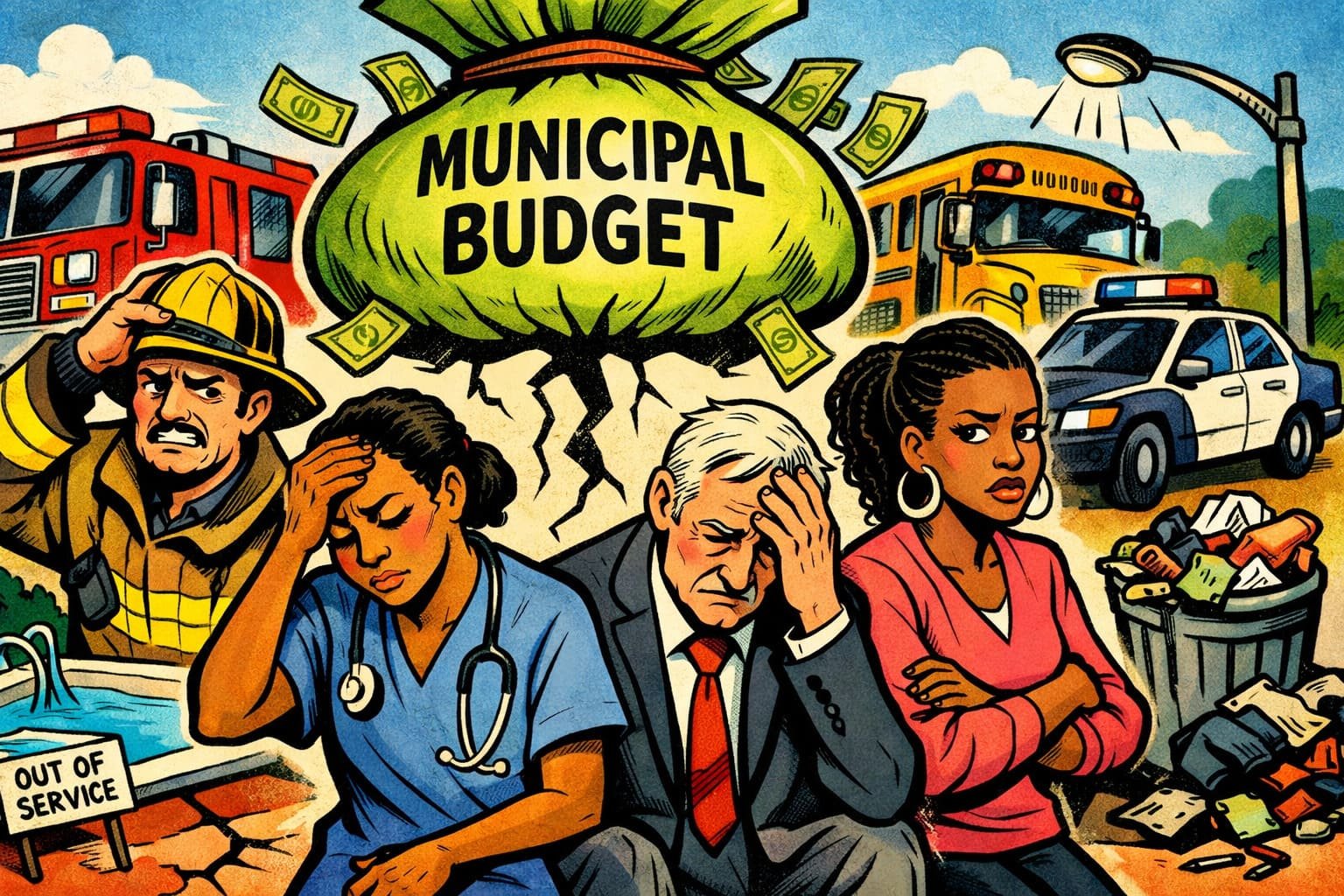
A city budget is where political poetry goes to die. Grand promises about inclusion, safety, mobility, parks, housing, culture, sanitation, and opportunity eventually end up in a document filled with payroll lines, debt service, pension obligations, maintenance backlogs, and unpleasant choices about who waits longer for what. Local government is the most intimate layer of the state because it touches the pavement, the bus stop, the library, the water pipe, the clinic, the trash route, the streetlight, the shelter bed. When municipal budgets crack, citizens do not debate theory. They feel it in the rhythm of daily life.
Cities are under pressure for reasons that rarely fit in one headline. Costs rise faster than local revenue. Infrastructure ages. Public sector wages climb. Pensions promised in easier times mature in harder ones. Downtown office districts lose tax energy when work patterns change. Residents demand more safety and more services while also demanding lower taxes. National governments often push responsibilities downward without fully funding them. Municipal leaders then perform a familiar ritual. They announce efficiency, promise modernization, and quietly stretch response times, defer maintenance, freeze hiring, or cut the easiest line item in sight, which is often something social and preventative.
Detroit became the emblem of urban fiscal collapse because it showed how long a city can postpone reality before reality takes over the microphone. Population loss, industrial decline, debt, and legacy obligations turned into a crisis that could no longer be patched by rhetoric. Bankruptcy was not a one line morality play about mismanagement. It was a warning about what happens when a city loses economic base while fixed promises remain stubbornly alive. The lesson travels well. Cities can look vibrant at the surface and still carry underwater liabilities large enough to drag down services when growth slows or interest costs rise.
Municipal pain is rarely distributed fairly. Affluent neighborhoods often shield themselves with private alternatives, private security, private transport, private schooling options, private healthcare access, and a greater ability to relocate if conditions worsen. Poorer districts cannot. They remain exposed to every crack in public provision. A bus route reduced by fiscal strain is not an inconvenience to everyone in the same way. A delayed permit hurts a builder. A delayed ambulance, broken streetlight, or water failure hurts a resident in a far more intimate register. Budget cuts are usually sold as neutral management. On the ground, they behave like class policy.
The water crisis in Flint became a devastating example of how local fiscal distress can turn technical decisions into human harm. Cost pressure, administrative failure, and disregard for risk combined into a disaster that permanently damaged trust. It showed that municipal austerity is not always a matter of cleaner spreadsheets and leaner administration. Sometimes it enters the body. Sometimes it poisons the basic assumption that public institutions will at least deliver safe water. A city can survive graffiti, potholes, and permit delays. It does not recover easily from the feeling that cost saving has outranked human safety in the hierarchy of government attention.
Municipal finance also exposes a contradiction in modern politics. Citizens want cities to solve national problems. Housing shortages, mental health breakdown, homelessness, addiction, migration pressure, climate resilience, economic inclusion, and public order all eventually arrive at city hall. Yet many cities do not control the tax base or legal authority needed to deal with those burdens properly. They are handed moral responsibility without equivalent fiscal power. That mismatch breeds public fury and administrative burnout. The mayor becomes the face of failure even when the revenue architecture was designed elsewhere. Urban leadership then starts to resemble crisis management with ceremonial ribbon cuttings.
A medium sized city can look prosperous on a sunny day and still be living off deferred repair. The roads hold until winter. The buses run until the fleet ages beyond reasonable repair. The library stays open until staffing shortages turn shorter hours into a norm. The park is maintained until equipment rusts out. Municipal decline is usually incremental, not cinematic. That makes it politically dangerous. Voters adapt to lower expectations one irritation at a time, then suddenly realize the city feels meaner, slower, dirtier, and less reliable. By then the backlog is expensive, the morale is poor, and the easy fixes are gone.
The most honest municipal leaders understand that the question is not simply how to cut. It is what a city is for. If local government tries to do everything badly, it will eventually fail at the essentials. Core services matter more than fashionable programs that win applause at conferences. Water, waste, transport, emergency response, permitting, housing delivery, and basic maintenance are not glamorous, but they are the machinery of urban dignity. A city that cannot keep the basics credible will struggle to persuade residents to fund higher ideals. Civic trust begins with ordinary competence, not rhetorical ambition.
That does not mean cities should retreat into bare bones administration. Great urban life depends on more than pothole repair. Libraries, parks, cultural life, early support systems, and public spaces often prevent larger social costs later. The trap is treating prevention as optional because its benefit is less dramatic than crisis response. A youth center cut today may become a policing cost later. A neglected mental health program may return as emergency burden. Municipal budgeting often punishes patience because the savings are immediate while the damage matures slowly. A serious city thinks in decades even when elections push leaders toward the next quarter.
Revenue reform matters too. Cities that rely too heavily on volatile property markets, downtown office values, or narrow tax sources invite instability. Broader, more resilient local finance systems help cities plan honestly and invest earlier. So does clearer coordination with national government. If cities are expected to absorb national dysfunction, they need revenue tools that match the assignment. It is absurd to demand metropolitan resilience while starving municipal capacity. The modern city is not a decorative administrative unit. It is where economic life, migration, technology, housing stress, and social fracture collide. Weak city finance eventually becomes weak national performance.
Municipal strain is often described as a technical challenge for accountants, planners, and bond lawyers. It is much more intimate than that. When local budgets tighten, public time gets stolen. Commuters wait longer. Parents travel farther. Small businesses navigate slower permits. Residents avoid public spaces that feel less safe. The city becomes more tiring. That exhaustion is hard to measure and easy to dismiss, yet it shapes how citizens think about government more than any speech. A bad local state teaches people that public life is a hassle to be endured rather than a system worth defending.
Late in the civic evening, when the buses are slow, the lights flicker on tired streets, and a family wonders why ordinary life feels harder than it used to, the municipal budget has already delivered its verdict. Cities do not collapse only through spectacular scandal. They can also fray through quiet underfunding, timid leadership, and the habit of postponing repair until the damage becomes part of the atmosphere. The future of the state may be debated in parliaments, but its credibility is tested at the curb. When local services start to hurt, trust does not vanish all at once. It leaks, and it leaks close to home.
