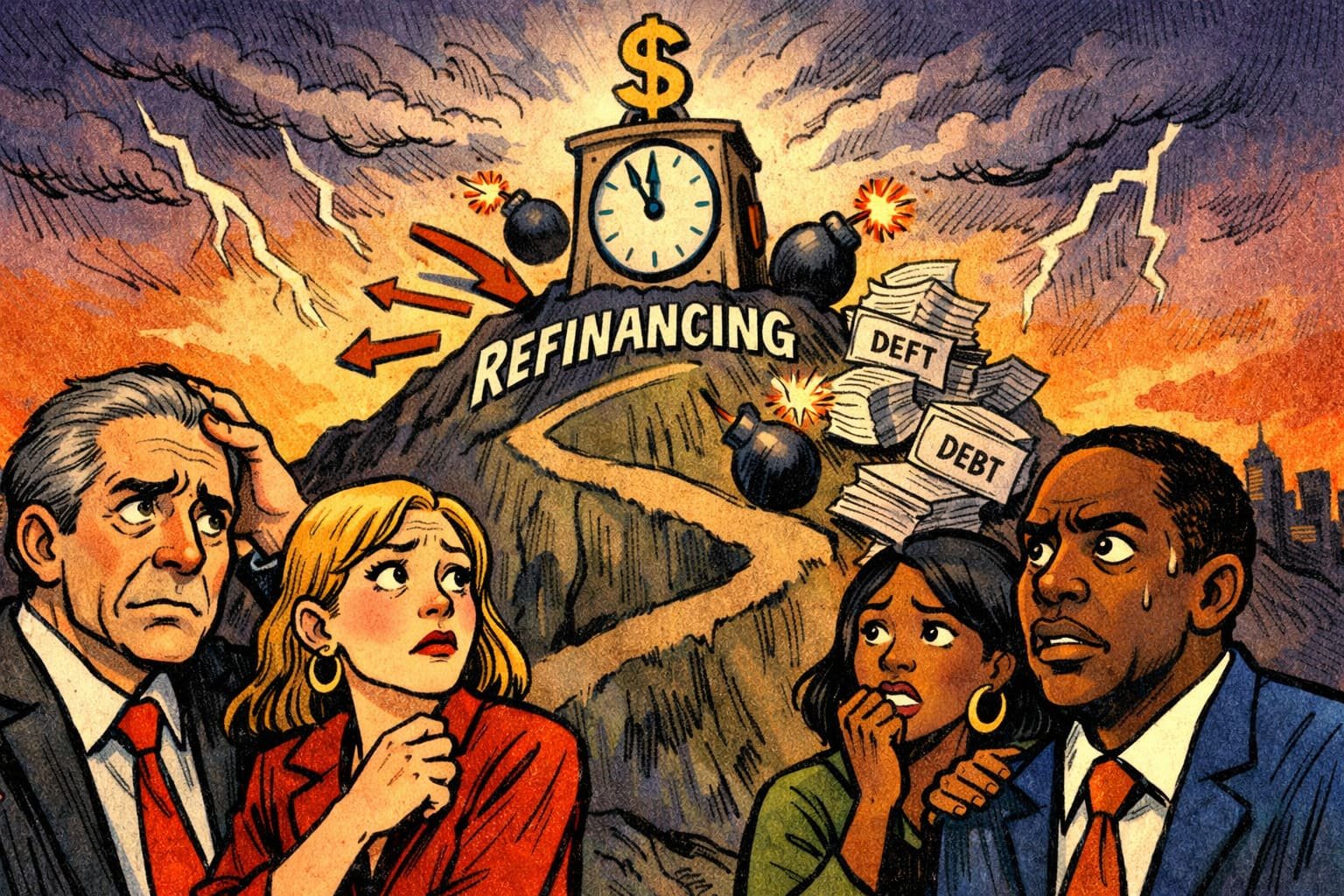
Cheap debt has a way of teaching the wrong lessons. It whispers that rollover is normal, that maturity can always be pushed forward, that interest costs are manageable, that markets will remain patient, and that tomorrow can be funded by another tomorrow. For years, governments borrowed in a world that made caution look old fashioned. Refinancing felt routine, almost boring. Then rates rose, volatility returned, and the old habit began to look less like strategy and more like a dependency. Debt refinancing risk is what happens when yesterday’s optimism meets today’s price tag and discovers the invoice has learned aggression.
The danger is not simply high debt. The danger is debt that must be renewed under worse conditions. A government can survive a large stock of obligations if maturities are well spread, credibility is strong, growth holds, and markets believe policy still has a steering wheel. Trouble starts when old bonds mature into a colder environment. Then interest costs jump without any new school, road, hospital, or bridge being built. The state pays more simply to stay in place. That is the fiscal equivalent of running on a treadmill that quietly tilts upward while the lights dim.
This problem becomes politically explosive because it feels invisible until it does not. Voters notice a new airport. They do not notice a debt rollover done at a worse yield. Yet that invisible rollover crowds out visible choices. More money goes to creditors. Less remains for services, investment, tax relief, or emergency response. Governments then start cutting around the edges, delaying projects, trimming programs, or raising revenue in ways they pretend are unrelated. The citizen experiences a thinner state without always seeing the financial plumbing underneath. Refinancing risk is silent at first. Then it starts speaking through scarcity.
Italy has long lived under the shadow of this logic. The country’s debt burden, weak growth, and exposure to changing market moods have made financing conditions a permanent political question. Italy is not a cartoon of collapse. It is far more instructive than that. It shows how a sophisticated economy can remain stuck between solvency management and broader ambition. When debt service absorbs attention, politics becomes defensive. Every reform is haunted by bond market reaction. Every shock threatens to narrow options. A state can remain functioning and still lose strategic freedom. That loss matters even before outright crisis appears.
The United Kingdom offered a different lesson during the market turmoil that followed an unfunded fiscal gamble. What shook investors was not debt alone but the impression that policy had become unserious. Refinancing risk intensifies when credibility weakens because markets do not merely price numbers. They price judgment. Once a government looks impulsive, contradictory, or casual about arithmetic, the cost of borrowing can move quickly. That movement is not always fair or stable, but it is real. The treasury learns in public what households already know in private: confidence lowers the price of borrowing, and panic rarely offers discounts.
Emerging economies live with this pressure more intensely because they often face currency risk, shallower capital markets, and more volatile investor sentiment. Countries such as Argentina have shown how refinancing pressure can spiral into wider economic instability when trust fades and exchange rate weakness compounds fiscal pain. Yet no nation should feel smug. Even wealthy states can drift into dangerous rollover structures if political leaders treat favorable conditions as permanent. Market access is not the same as market forgiveness. The first can endure for years. The second can disappear in a week and leave policymakers speaking in the tense voice of regret.
A corporate analogy helps. A retailer that used short term debt to expand during easy money may look brilliant while financing stays cheap. Once refinancing costs jump, the genius starts to resemble a timing accident. Governments play a larger, more patient game, but the underlying truth is similar. Borrowing can be wise. Refinancing can be normal. Dependence on benign markets is another matter. That dependence narrows sovereignty. It invites policy timidity in good times and fiscal brutality in bad ones. The state becomes less a planner of the future and more a manager of repayment calendars.
The real scandal is how often cheap money financed politics instead of productivity. Borrowing for infrastructure, education quality, energy resilience, or reforms that lift long term output can at least strengthen the future tax base. Borrowing to preserve unsustainable consumption or postpone routine political choices leaves little behind except obligation. When refinancing risk arrives, the weakness becomes obvious. Nations that spent borrowed money building capacity can defend the debt. Nations that spent it buying time discover that time has now become expensive. Markets are often crude judges, but they are rarely sentimental about the difference.
Good debt management is almost too dull for modern politics. Extend maturities when conditions are favorable. Diversify the investor base. Maintain credible fiscal institutions. Avoid sudden policy improvisation. Build buffers in good years. Be honest about contingent liabilities and off balance sheet temptations. Above all, do not confuse low rates with moral permission to relax. Refinancing risk is lower when governments use calm periods to reduce fragility rather than enlarge it. That discipline never wins applause because prevention feels uneventful. Yet the leaders who refuse boring prudence often end up staging expensive drama for everyone else.
There is a philosophical lesson here too. Refinancing risk is the revenge of postponed seriousness. It exposes the difference between wealth and liquidity, between access and resilience, between appearing solvent and being hard to scare. Households understand this instinctively. They know the terror of bills coming due at the wrong time. States hide that feeling behind institutional scale and formal language, but the feeling is still there. A government that must constantly return to markets under worsening terms begins to act like a nervous borrower. It smiles in public and rearranges the furniture at night.
The next decade may punish complacency more than excess. Aging societies, climate costs, geopolitical tension, and weaker growth all mean governments will still need to borrow. The question is whether they borrow from a position of strength or habit. Refinancing risk is not a call for austerity theater. It is a call for fiscal adulthood. Borrow where the future can carry it. Lock in time when time is cheap. Stop treating rollover as a substitute for strategy. Tomorrow always arrives, but it does not always arrive at the same price. That is the point many treasuries learn only after the market changes its tone.
In the cold machinery of sovereign finance, a maturity wall is only a date until conditions turn and the date starts looking back. Then ministers speak more carefully, growth forecasts become prayers in formal clothing, and every political promise must squeeze past the cost of yesterday’s decisions. Debt can buy time, but time is not loyal. It charges what the moment allows. The states that stay free will be the ones that borrow with memory, refinance with humility, and remember that cheap money is not a permanent feature of the moral universe.
