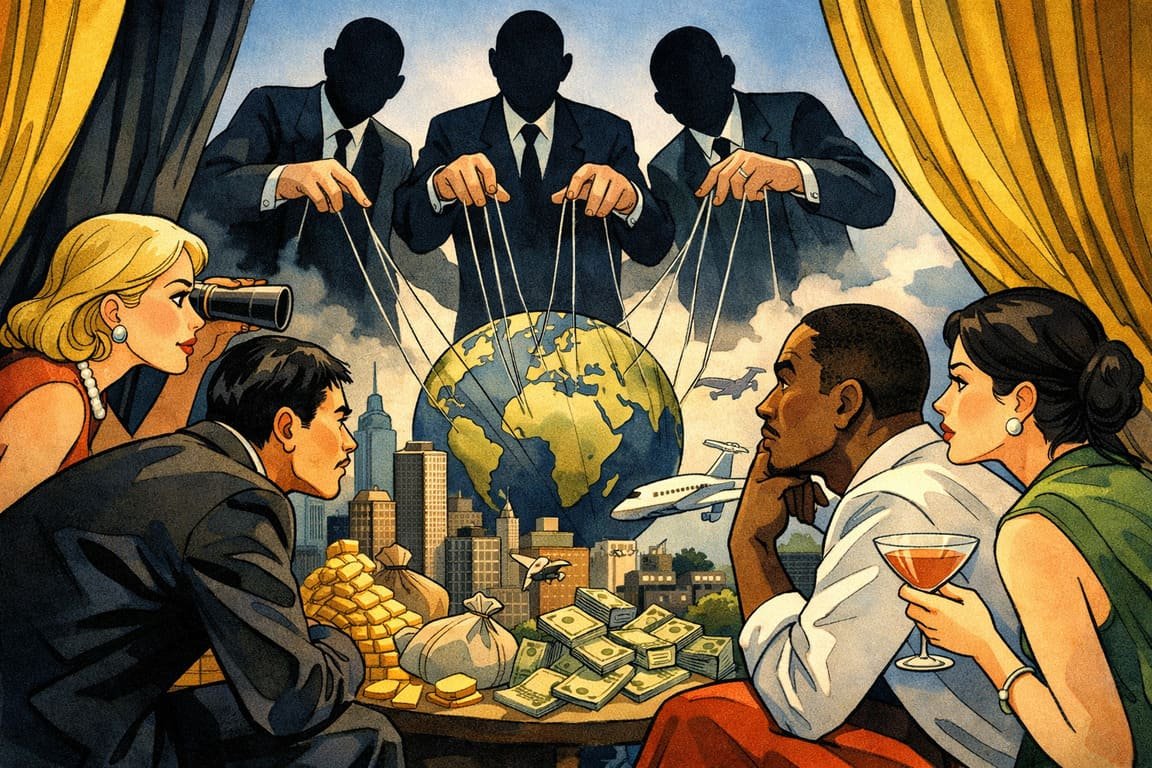
The meeting does not appear on any public schedule. No flags frame the room. No anthem signals importance. Screens flicker, encrypted channels hum, and decisions ripple outward without ever touching a ballot. This is where authority gathers now, quietly, confidently, and without an address. While textbooks still describe a world run by nation states, power has been busy relocating, shedding borders and discovering how much influence it can wield without ever asking to be elected.
For centuries, legitimacy followed territory. Governments ruled because they controlled land, taxes, and force. That logic is weakening. Today, influence belongs to those who control networks, platforms, capital flows, and attention. These actors do not need borders to matter. They move through them. Tech founders shape speech. Financial networks shift markets overnight. Decentralized groups coordinate globally with no headquarters to sanction. Power no longer waits for permission from geography.
What unsettles governments most is how difficult this power is to confront. You cannot vote out a platform. You cannot easily regulate a network that exists everywhere and nowhere. Jurisdiction dissolves when systems operate across legal frameworks designed for a slower era. States reach for tools built for another century and discover they no longer fit the problem.
Culture adapts faster than law. People increasingly trust communities, brands, and digital identities that feel responsive compared to distant institutions. Loyalty migrates quietly. A user base mobilizes faster than a parliament. An influencer shapes opinion more effectively than a policy paper. Authority begins to feel personal again, even when it is mediated by algorithms and profit incentives.
A fictional regulator once described the moment of realization with quiet disbelief. Every legal lever existed on paper. None worked in practice. The entity under scrutiny had no headquarters, no clear leadership, no fixed jurisdiction. Power without an address proved remarkably resilient. That moment marked a shift from enforcement to negotiation, from command to accommodation.
Fearlessness defines these new rulers. They do not face elections. They do not fear recall. Reputation matters more than legality. Attention matters more than legitimacy. When pressure mounts, they pivot, rebrand, or migrate platforms. Mobility becomes protection. Consequence becomes negotiable.
Philosophically, this shift strains the social contract. Citizens once traded certain freedoms for protection, accountability, and representation. Stateless power offers convenience without obligation. It extracts value without formal duty. The relationship feels transactional rather than civic. Over time, this erodes the expectation that authority should answer to the public by default.
Economically, the imbalance sharpens. Wealth accumulates in systems that outpace taxation frameworks. States struggle to fund public goods while private actors amass influence without parallel responsibility. Inequality widens not just in income, but in voice. Some speak into megaphones. Others shout into administrative silence.
Security implications follow naturally. Non state actors can disrupt infrastructure, influence elections, or destabilize regions without triggering traditional responses. Attribution becomes murky. Retaliation risks escalation without clarity. Deterrence loses meaning when adversaries lack territory to defend. Fearlessness thrives where consequences blur.
Yet admiration shadows anxiety. Stateless innovators solve problems governments ignored. They move quickly. They connect people across boundaries. They inspire loyalty through responsiveness rather than rhetoric. The danger lies not in their existence, but in the vacuum they fill when public institutions fail to adapt.
Governments face an uncomfortable choice. Attempt to crush these forces and risk irrelevance, or evolve structures that reassert relevance through transparency, speed, and cooperation. Some experiment with new regulatory models. Others cling to nostalgia. The gap widens where adaptation stalls.
Citizens legitimize this shift daily, often without noticing. Every click, subscription, and digital migration reallocates power. Participation no longer happens only at polling stations. It happens constantly, invisibly, shaping who governs norms, markets, and speech. Authority accumulates through habit.
As cities glow beneath satellites rather than borders, power continues flowing toward attention and convenience. The hidden rulers do not announce themselves. They simply operate, confident the world will adjust around them. And beneath that quiet confidence waits a question that refuses to disappear: when authority no longer needs a flag, who exactly is being trusted to decide how life should work?
