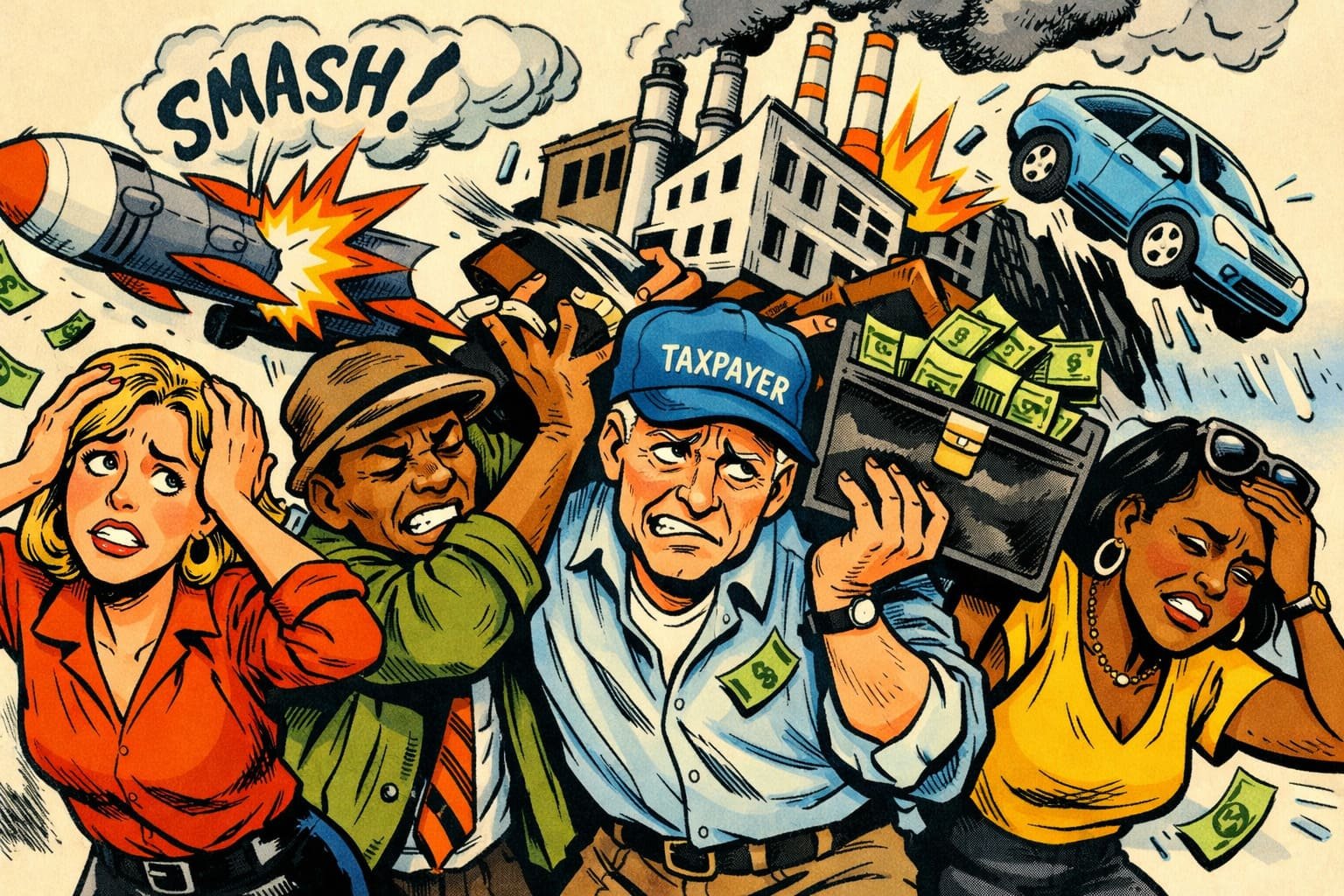
A strange faith has returned to modern government. It walks into cabinet rooms wearing the costume of national renewal, talks like strategy, and glows with the promise of jobs, factories, resilience, and technological destiny. Industrial policy now carries the aura of a superhero origin story. Ministers speak of semiconductors, batteries, steel, and critical minerals with the breathless tone of studio executives pitching the next cinematic universe. The mood feels grand. The bill, less romantic, usually arrives later, and it almost always knows the taxpayer’s address.
That is the seduction. Industrial policy sounds noble because it touches real anxieties. Supply chains crack. Rival powers subsidize. Voters fear hollowed-out towns. Leaders want factories, not lectures. The problem is not the instinct to build. The problem is that public money can slip from strategic investment into political theater with terrifying speed. The OECD has warned that industrial policy has surged back across advanced economies, while the IMF has argued that the bar for getting state aid right is high because poorly designed support can distort competition and waste public resources.
Taxpayers usually absorb losses for one simple reason. Governments are often better at announcing industries than disciplining them. It is easy to cut a ribbon beside a factory shell. It is harder to kill a subsidy after the photo, the speeches, the campaign promise, and the local headlines. Once public money gets wrapped around a chosen sector, every setback becomes an excuse for more support. Failure is rebranded as a temporary valley. Delay is called patience. A sinking project keeps getting fresh paint because no minister wants to confess that a national champion turned out to be a very expensive costume.
That script has played before. Solyndra became a symbol, not because every green subsidy fails, but because it exposed the political fragility of backing specific firms in fast-moving markets. Britishvolt offered a similar lesson from another angle. The story sounded modern, urgent, and patriotic, right up until execution and financing fell apart. These cases do not prove that states should do nothing. They prove something harsher. When public officials behave like venture capitalists without the discipline of loss, taxpayers become trapped in a role they never auditioned for, silent limited partners in a production they cannot edit.
Still, the anti-industrial-policy purists miss something important. Markets do not always build what nations later discover they needed. The early development stories of places like South Korea and Taiwan are filled with state direction, export discipline, and strategic support. The useful lesson is not that government should pick winners with mystical confidence. It is that governments can shape conditions, co-invest in capability, protect learning curves, and push firms toward performance. The difference between useful industrial policy and a subsidy bonfire usually comes down to governance, competition, and the political courage to say no after saying yes.
A minister who really wants to protect taxpayers should fear applause. Loud applause often means the scheme is emotionally satisfying, which is exactly when budgets become sloppy. Real industrial policy is not glamorous. It is procurement rules, clawback clauses, independent evaluation, tough milestones, open competition, and sunset dates that are actually honored. It looks less like a blockbuster and more like an accountant with steel nerves. That is why so many politicians prefer the dramatic version. Discipline is bad television. National rescue stories poll better, at least until the rescue needs rescuing.
The deeper fiscal issue is opportunity cost. Every subsidy carried on a ministerial smile is money not spent elsewhere. When one battery plant is treated like a national sacrament, a thousand quieter choices disappear from view. Training systems remain weak. Transport bottlenecks remain boring. Courts stay slow. Energy grids remain unreliable. Public research may be starved while headline projects feast. The taxpayer loss is not only the failed firm or the empty building. It is the invisible future that never got funded because politics fell in love with a visible symbol instead of a durable system.
A textile manufacturer in northern Italy once watched a regional grant scheme reward a flashy automation start-up while long-standing exporters could not get modest help to upgrade power systems and logistics. The start-up generated magazine covers and ministerial visits. The older firm kept patching along with leaking infrastructure and higher costs. A few years later the celebrated project had vanished, while the unglamorous exporter was still hiring, still shipping, and still begging for policies that noticed the plumbing of productivity. That kind of imbalance rarely becomes a scandal, but it drains public value all the same.
There is a smarter version of industrial policy, and it is almost annoyingly unromantic. Support broad capabilities. Build ports that work. Finance research platforms instead of political mascots. Use public procurement to create demand where learning matters. Make firms compete for support, then publish the terms. If subsidies are used, link them to delivery, not sentiment. The OECD has stressed the importance of keeping industrial policy pro-competitive, not merely pro-incumbent, precisely because concentrated aid can harden market power rather than create dynamism.
It also helps to remember that many industrial failures begin with good intentions and bad incentives. Civil servants are rewarded for movement, not always outcomes. Politicians are rewarded for announcements, not exits. Firms are rewarded for lobbying, not always building. Once those incentives align, industrial policy becomes a velvet trap. Everyone around the table can point to noble motives. Few can point to clear value. The taxpayer becomes the only adult in the room, except the taxpayer is rarely invited to the meeting and is handed the invoice after the room has emptied.
That is why the fiercest defenders of industry should also be the fiercest defenders of fiscal scrutiny. A country that wants resilience cannot afford performative strategy. Public money should build capability, not mythology. It should create spillovers, not dependency. It should make firms stronger, not merely louder. The true test is brutally simple. Would the policy still survive if every assumption had to be printed in plain language on the front page of tomorrow’s paper, beside the cost, the risk, the exit plan, and the name of the person who signed it?
In the end, industrial policy is not a morality play between markets and states. It is a test of whether a nation can resist being seduced by its own slogans. The factory floor may still hum, the ribbon may still gleam, and the speech may still sound like history being made. Yet the real drama unfolds somewhere quieter, in the ledger where ambition meets arithmetic. Every nation that wants strategic industry must answer the same merciless question: will it fund strength, or will it subsidize fantasy until taxpayers inherit the ashes?
