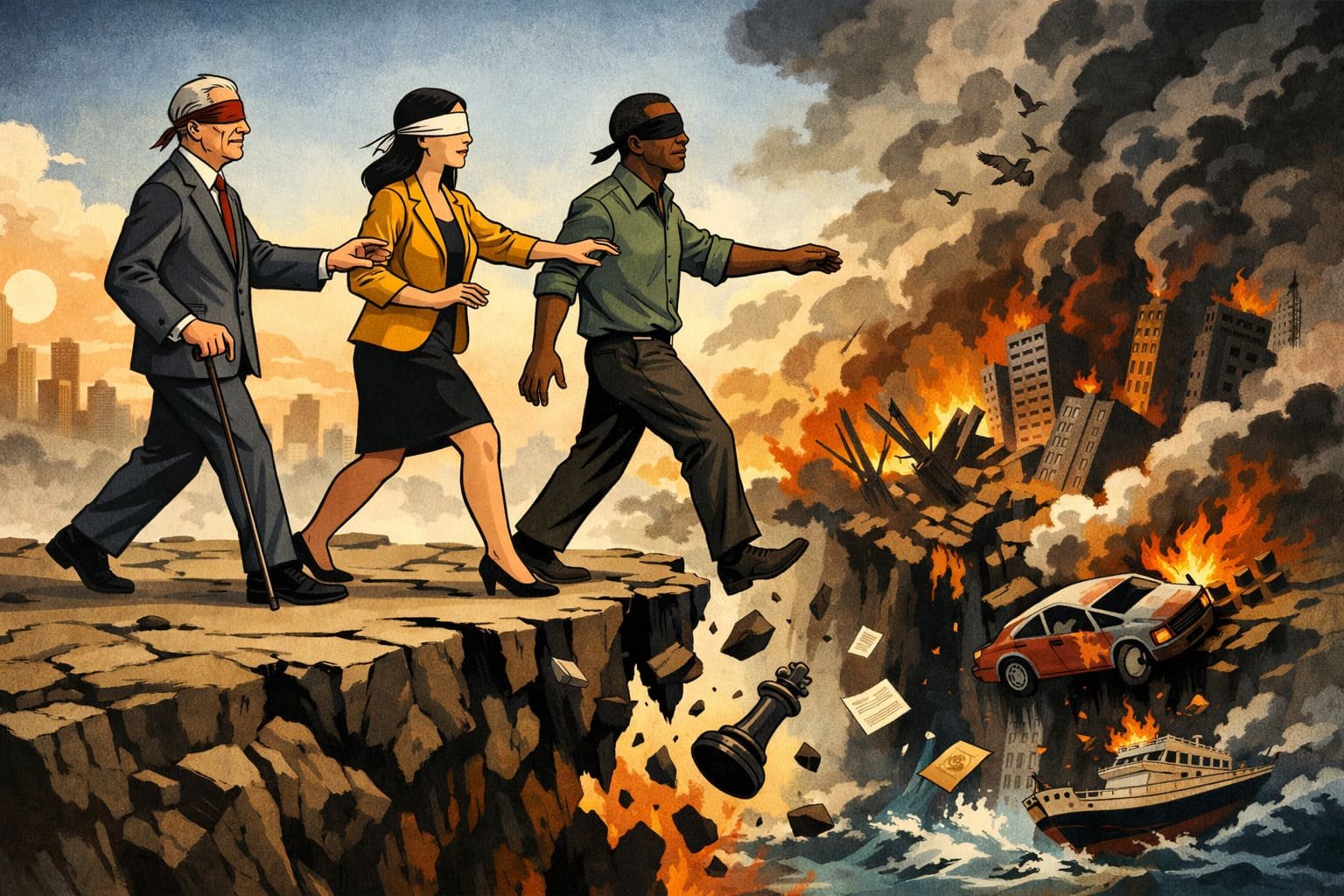
The office looked polished enough to fool a visitor. Glass walls, warm lighting, tidy notebooks, screens alive with dashboards that glowed like tiny altars to competence. The leadership team spoke in composed voices, using words like momentum, alignment, and opportunity as though language itself could keep the floor from giving way. Then the room went still for one raw second. Nobody could say where the company was truly going. That was the wound.
Weak vision is one of the most expensive problems in business because it rarely announces itself as weakness. It arrives disguised as busyness, consensus, optimism, and an endless stream of activity that looks impressive from a polite distance. Teams ship projects. Managers hold meetings. Sales keeps pushing. Marketing keeps posting. Operations keeps patching. The machine stays loud enough to hide the deeper silence. The company is moving, but nobody can explain toward what.
That silence has killed more businesses than open incompetence ever did. Kodak had talent, infrastructure, and history, yet struggled to commit clearly enough to a future it could already see flickering at the edge. Nokia built scale and influence, then drifted into one of the most painful lessons in strategic hesitation. Yahoo spent years with enormous reach and astonishing opportunity, yet its bigger problem was not lack of access. It was the absence of a hard, coherent, durable direction that could turn possibility into power. Weak vision does not always look foolish at first. Sometimes it looks flexible, sophisticated, even mature. Then the bleeding starts.
You can spot the early signs if you know where to look. The company tries to be many things at once. Strategy shifts with each new pressure wave. Teams stop understanding why priorities change. Strong employees become tired in that specific way people get tired when effort no longer feels attached to meaning. Customers begin sensing the fog before leadership does. Competitors smell it and sharpen their teeth. A business without clear vision becomes vulnerable in every direction because clarity is not a decorative virtue. It is the thing that keeps talent, capital, execution, and identity moving in one living line.
This article is about that line, and what happens when it breaks. You are about to see why weak vision drains companies long before a crisis becomes visible, why leadership without direction becomes a quiet form of organizational cruelty, why markets punish drift even when drift looks busy, and why the strongest leaders are not the loudest ones in the room but the ones who can make the future plain enough for other people to build it with conviction. A company can survive many hard seasons. It struggles to survive a leadership team that cannot see far enough, or speak clearly enough, to stop the blood loss before it becomes normal.
Quick Notes
1. Weak vision does not always look dramatic. It often looks like busy teams, crowded calendars, shifting priorities, and a company that cannot answer the simple question of where it is really headed.
2. Leadership without clear direction creates hidden damage. Talent tires faster, decisions get softer, culture becomes political, and the business starts spending energy instead of building strength.
3. A strong vision is not a motivational poster. It is a precise future that shapes choices, trade-offs, hiring, investment, and the daily rhythm of execution.
4. Companies bleed when leaders mistake adaptability for drift. Flexibility matters, but without a stable north star, adjustment becomes confusion in nicer clothes.
5. The firms that endure are not always the most charismatic. They are the ones whose leaders can see clearly, decide cleanly, and make other people believe the road ahead is real enough to walk.
Weak Vision Makes Motion Look Like Progress
You can get a surprising amount of mileage out of activity. Teams can fill their days with product updates, campaign launches, sales sprints, status meetings, reporting dashboards, and enthusiastic internal messages that make the company feel alive. That activity can be useful. It can also become camouflage. Without vision, motion starts posing as progress, and nobody notices the difference until too much energy has already been spent.
This is one of the oldest traps in management. Leaders feel pressure to keep the machine moving, so they reward visible effort over directional coherence. Work multiplies. Projects stack up. Priorities breed like rabbits in an unlocked garden. The company becomes noisier, not sharper. People start confusing speed with intelligence because stopping to ask whether the work belongs to a larger destination feels inconvenient, maybe even disloyal. That is how an organization can look industrious while quietly walking in circles.
You have seen big companies suffer exactly this fate. Yahoo, for all its reach and resources, often seemed caught between identities, media company, portal, tech platform, advertising force, acquisition machine, search player. That kind of strategic ambiguity can survive for a while when the market is generous. It becomes fatal when competitors with clearer intent show up and begin cutting straight lines through your fog. Vision weakness does not always produce immediate collapse. Sometimes it creates years of expensive wandering.
A founder named Selam ran a fast-growing consumer platform with a team full of bright people and a calendar that looked like a hostage situation. New initiatives kept appearing because every strong idea got treated like destiny. One month the company was obsessing over creator partnerships. The next month it was chasing enterprise accounts. After that came a sudden fascination with community memberships because someone had read a trend report and panicked attractively. Everyone worked hard. Nobody felt anchored. The office buzzed with motion and smelled faintly of cold coffee and burnt ambition. The business was not short on effort. It was short on a future sturdy enough to organize effort into force.
That is why vision matters before anything glamorous happens. It tells people what kind of movement counts. It turns activity into sequence, sequence into strength, and strength into compounding advantage. Without it, a business can remain breathless for years and still arrive nowhere worth the fatigue.
When Leaders Cannot See Clearly, Teams Start Bleeding Confidence
A weak vision does not stay trapped at the top. It leaks. It moves through the company in tone, timing, hesitation, and the strange little pauses that happen when smart people stop trusting that their work fits a bigger shape. Employees may not always use the phrase “leadership vision,” but they feel its absence in their bones. They feel it when priorities change without explanation. They feel it when projects begin with fanfare and die in silence. They feel it when leaders talk a lot about excitement and very little about direction.
Confidence in an organization is fragile in a particular way. It does not vanish the first time leadership misses a call. It erodes through repeated ambiguity. Teams begin to hedge. Managers protect themselves. Strong contributors stop investing emotionally because emotional investment without direction feels a bit like carrying water into a house with no roof. People still show up. They just stop believing with full force.
You can trace this dynamic through many troubled companies. Nokia’s later years in the smartphone transition became emblematic of what happens when strategic clarity weakens while market pressure rises. The issue was not that nobody in the building was intelligent. The issue was that uncertainty at the top multiplies into operational hesitation below. Once teams lose conviction in the destination, execution starts carrying the stiff, cautious rhythm of people waiting to be told which version of reality will survive the next meeting.
A creative agency led by Tomas learned this in miniature. His team was talented, loyal, and capable of outstanding work. For a while, the firm’s growth masked a deeper problem. Tomas kept changing the company’s identity depending on who was in the room. To clients, the agency was premium and selective. To recruits, it was disruptive and experimental. To the team, it was becoming productized. To investors circling at the edge, it was scalable and systems-led. Inside the office, people began joking that the company had more personalities than campaigns. The jokes were funny until the best strategist left, then the best designer, then the account lead who knew how to calm everyone else down. The firm did not lose talent because the market was cruel. It lost talent because confidence had started leaking out through every crack in the leadership narrative.
A strong vision gives people something rarer than motivation. It gives them orientation. It lets them sacrifice, decide, and endure with the sense that their work belongs to a coherent destination. Take that away, and the company may keep functioning. It just starts functioning with less courage, less trust, and less emotional stamina every quarter.
Drift Feels Sophisticated Until a Rival Shows Up With a Map
There is a fashionable type of leadership drift that likes to call itself openness. It presents itself as fluid, adaptive, nuanced, responsive to change. Some of that can be healthy. Markets do shift. Customer behavior changes. Technology redraws the ground under everyone’s shoes. The problem comes when leaders start using flexibility as a disguise for not deciding. That is when drift becomes expensive.
A company can get away with vague direction longer than it deserves if the category is still young or the competition is still sleepy. Once a rival arrives with a cleaner map, everything changes. Customers compare. Talent compares. Investors compare. The market does not ask which leadership team sounded the most intellectually balanced. It asks which business made the future easier to understand and easier to join. Clarity wins more often than cleverness admits.
Apple’s resurgence under Steve Jobs is remembered for design and product genius, and rightly so, but part of the force came from brutally restored clarity. The company stopped trying to be too many things at once. Focus turned from a polite concept into an operating law. Contrast that with businesses that remain strategically polite for too long, hoping the market will reward optionality. Markets usually reward the player who cuts deepest into a single, believable future.
A founder named Yasmin built a health services platform in a crowded category where everyone claimed to be transforming care. Her company’s early traction made the leadership team feel intellectually superior for staying broad. They wanted to serve consumers, employers, clinics, insurers, and governments with a grand ecosystem story that sounded wonderful at conferences. Then a rival entered the market with a narrower promise, simpler sales motion, and a crystal-clear value proposition for one high-pain segment. Customers understood it in seconds. Yasmin’s team needed three slides and a metaphor. The rival began taking accounts, then talent, then confidence. That is the thing about drift. It feels expansive until someone disciplined walks into the room and makes your complexity look like indecision.
Vision does not mean stubbornly refusing to learn. It means deciding what you are truly building strongly enough that change refines the path rather than erasing it every quarter. Rivals do not need you to be incompetent. They just need you to be blurry while they are sharp.
Weak Vision Corrupts Decision-Making One Compromise at a Time
Most companies do not bleed out from one giant leadership blunder. They bleed through a long chain of smaller compromises that become easier to justify when no clear vision is present to resist them. A soft decision here. A delayed decision there. A hire that does not fit but fills the seat. A product feature built for the wrong customer because the sales team shouted loud enough. A market expansion pursued for status rather than fit. Weak vision turns every choice into a negotiation. That is exhausting, and worse, it is corrosive.
Clear vision acts like a filter. It tells leaders what to reject before rejection becomes emotionally painful. Without that filter, almost everything starts sounding potentially sensible. The business becomes more vulnerable to internal politics, external noise, and the seduction of short-term wins that damage long-term shape. People call this pragmatism. Very often it is simply strategic anemia.
BlackBerry offers a painful reminder of how leadership can keep making defensible-looking choices while the larger direction slips away. Each individual compromise may appear rational in isolation. Protect the existing base. Respect what already works. Avoid self-disruption that feels premature. Yet without a stronger vision of the coming market, those choices accumulate into decline. The business does not die from one bad meeting. It dies from too many half-right decisions serving the wrong horizon.
A media startup called Lantern had a similar illness in smaller form. Its founder, Dev, had strong instincts but weak discipline around them. Every time revenue tightened, the company bent toward easier short-term money. Sponsored content crept in, then dictated editorial rhythm. A premium subscription idea was launched, then quietly deprioritized when ad income recovered for a moment. The team kept being told the company stood for trust, depth, and independence, but the decisions kept serving convenience. Employees could feel the contradiction in their teeth. Readers eventually felt it too. What looked like flexibility was really the slow poisoning of identity through compromise.
That is why strong leadership vision matters most at the level of ordinary decisions. Grand speeches are easy. The real test is whether the next hire, next partnership, next product choice, and next crisis response all move the company in the same believable direction. If they do not, the business starts bleeding from places spreadsheets cannot fully capture.
Great Vision Is Not Vague Inspiration, It Is a Usable Future
A lot of leaders mistake vision for mood. They give stirring speeches, use heroic language, and talk about changing the world in tones that suggest background music should be swelling somewhere nearby. That can be emotionally useful for about ten minutes. After that, people need something usable. A real vision is not just inspiring. It is operational. It helps people make better decisions on Tuesday afternoon when no one is performing leadership for a room.
Usable vision has a few brutal qualities. It is specific enough to guide trade-offs. It is stable enough to outlast mood swings. It is ambitious enough to attract talent and focused enough to prevent the whole company from chasing fashionable nonsense. Most importantly, it can be translated. Engineers can build from it. Sales can sell from it. Brand can speak from it. Hiring can filter from it. Without that translation power, vision becomes decorative.
Microsoft’s revitalization under Satya Nadella is often discussed in terms of cultural renewal and strategic repositioning, and both matter, but underlying that shift was a more coherent view of what the company should be and how its parts should align. Vision worked there not because it sounded poetic, but because it became legible across decisions, products, and posture. That is what leadership should aim for, not a quote that looks good on a wall, but a future people can build without having to decode the founder’s feelings every week.
A founder named Mireille ran a specialized logistics company serving medical clients. For years, the business had grown through hustle, relationships, and heroic improvisation. When complexity increased, those old strengths started turning into strain. Mireille finally sat down with her team and articulated a vision so plain it almost felt underdressed: to become the most trusted cold-chain logistics partner for time-sensitive medical deliveries in their region, known for reliability under pressure. That sentence changed the company more than a year of motivational talk had. Hiring sharpened. Service decisions simplified. Technology investments made more sense. Sales stopped chasing mismatched work just because it was available. The future became usable.
That is the secret. Strong vision bleeds less because it allows the organization to heal and strengthen around a coherent future. People can endure hard trade-offs if they understand what the trade-offs protect. They can handle slow seasons, painful choices, and disciplined focus if they can see the architecture those sacrifices are building. A vague dream exhausts. A usable future organizes.
The Last Light in the Hallway
After the meetings end and the office thins out, leadership becomes harder to fake. The hallway lights dim, the air goes cool and slightly metallic, and whatever story the company told itself all day begins to lose its makeup. In that quieter hour, a business can feel almost human. You can sense whether it knows where it is going or whether it is simply keeping itself busy to avoid admitting that the center has weakened.
Weak vision wounds a company in a strangely intimate way. It does not always explode in public. It stains the culture first. It dulls decisions. It makes talented people privately lonely. It turns strategy into posture and action into a nervous reflex. By the time the market punishes the business openly, the internal bleeding has usually been going on for a long while. Customers see the symptom. Employees lived with the ache.
The companies that endure understand something unfashionably simple. Leadership is not only about energy, charisma, or the ability to survive pressure without visibly sweating. Leadership is about sight. It is the discipline of seeing far enough, clearly enough, and honestly enough to give other people direction they can trust when conditions get ugly. That kind of vision does not make a leader magical. It makes the business less fragile.
Seen from a distance, the entrepreneur at the end of this story is not standing on a stage. The entrepreneur is walking a dark corridor after everyone else has left, hand brushing the wall, listening to the building breathe, asking whether the structure ahead is worthy of the people still inside it. That is the image that lingers because it reaches beyond management jargon and into responsibility. A company will forgive a hard season. It will even forgive a painful mistake. What it rarely survives for long is a leader who cannot offer a future sturdy enough to stop the bleeding.
So ask yourself this before the next quarter, the next hiring wave, the next confident presentation to people who want to believe you know the way: are you leading with a vision strong enough to carry others, or are you merely keeping the lights on while the company bleeds in the dark?