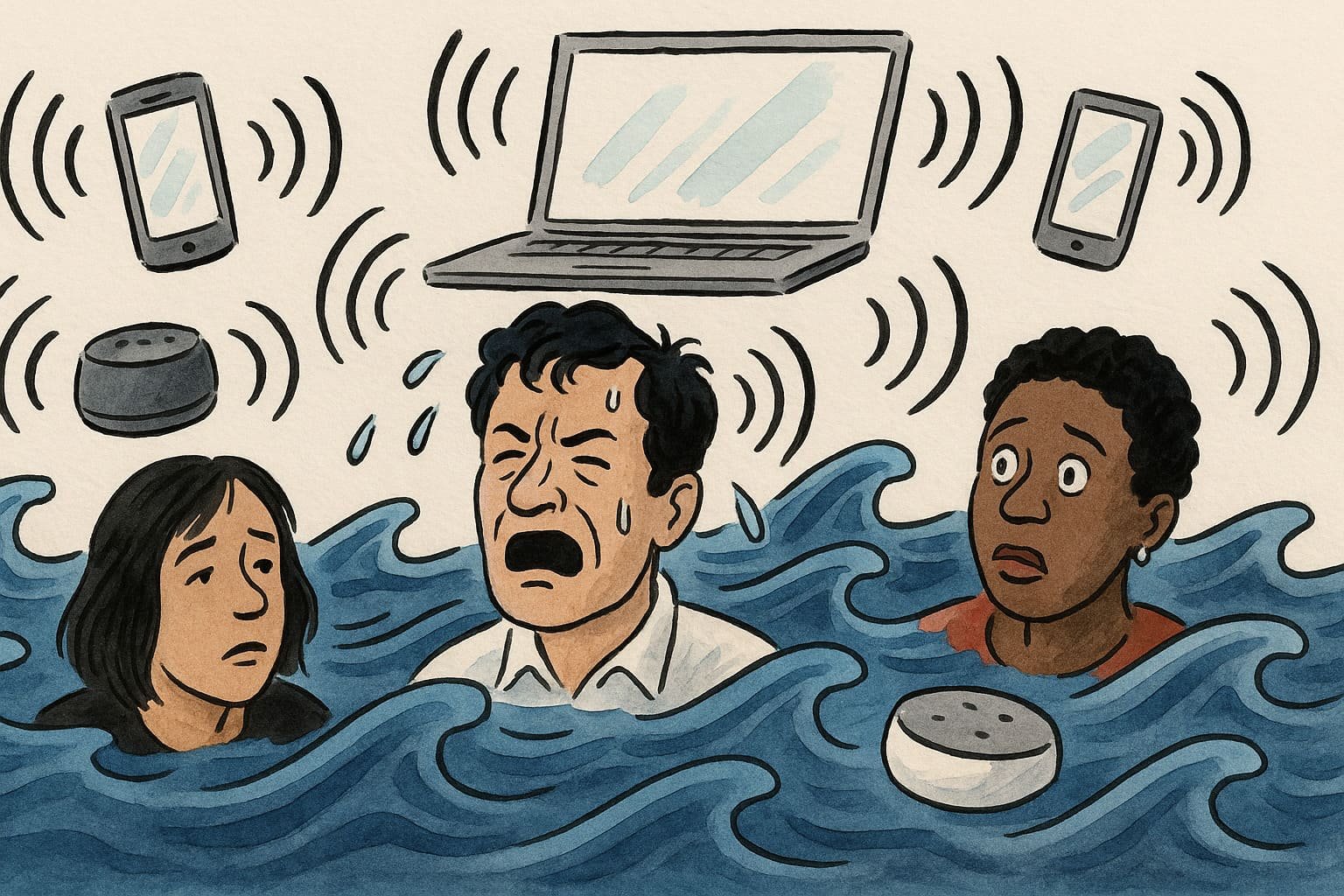
A single blue light flickers in the glass tower, its glow fractured by fingerprints across a thousand screens. Beneath that hum, a janitor wipes away the last crumb of someone’s forgotten midnight hustle, while outside, a driver shuffles TikTok feeds, his mind pinging like pinballs in a machine built for dopamine. The city pulses with silent alarms: Slack dings, YouTube hacks, and that endless chain of “urgent” newsletters that promise mental mastery but deliver only another cracked lens. Here, brilliance is an echo chamber, a choir of smart voices competing for space until genius sounds like static.
A stockbroker sips burnt coffee, scrolling a feed stacked with Nobel winners and AI prophets, his own thoughts swimming in a soup of must-read threads. Across the river, a design intern turns up her noise-canceling headphones to drown out the brainstorm, only to find her mind hijacked by a podcast on “neurohacking flow states.” The noise follows everyone; through meeting rooms, gym lockers, even into sleep, where the brain replays startup pitches and social strategies like some black mirror lullaby.
On the subway, a coder watches his reflection flicker between notification bursts and the half-heard chatter of virtual standups. Information floods the carriage: LinkedIn tips, TED Talk quips, deepfake headlines. Truth morphs into opinion, then back again, while real insight dissolves beneath a flood of recycled genius. The fatigue creeps in; subtle at first, then burning, sharp as the neon sign above a WeWork.
A founder, jacket crumpled, wonders when insight became indistinguishable from interruption. He scans a Slack thread on “disruptive productivity” while his own ideas stutter in a cloud of borrowed brilliance. Elsewhere, a recent graduate wakes in the glow of a phone buzzing at 2 a.m., sure that missing the latest AI hack will cost her tomorrow. The world’s intelligence has become a siren, and nobody knows who’s steering the ship.
In this digital coliseum, every mind is a gladiator: fighting not for clarity, but to stay afloat in the rising tide of smart noise. Welcome to the age of brain burn, where the race for intelligence is slowly boiling us alive.
Quick Notes
- Overwhelm Is the New Normal: Modern minds are not just distracted; they’re bombarded, every second, by a relentless barrage of “smart” content. This isn’t just annoying; it’s mentally corrosive, turning natural curiosity into a constant state of exhaustion.
- Too Much Genius, Not Enough Clarity: When everyone shares “breakthroughs” and “must-know” advice, genuine wisdom gets buried under viral noise. You’re left drowning in opinions, hacks, and conflicting facts, wondering why you never feel smarter.
- Tech Promised Focus, Delivered Overload: Digital tools claim to simplify work, but in reality, they amplify interruptions. Even “productivity hacks” turn into more tabs, more apps, and more pressure to keep up; fueling the very overload they promise to fix.
- Human Energy Isn’t Infinite: Real-life stories show that burnout now strikes even the brightest minds; engineers, founders, students when there’s no space left for original thought. Micro-case studies reveal people breaking under the pressure of too much brilliance and not enough silence.
- Escaping Smart Noise Takes Guts: To reclaim mental freedom, you need to build real boundaries, embrace boredom, and relearn what focus feels like. The secret isn’t another hack; it’s learning how to walk out of the noise and back into your own mind.
Mindset Meltdown – When Brilliance Becomes Background Buzz
Every notification is a tiny jolt; a ping that promises power, but delivers another layer of anxiety. You wake up to headlines that sound urgent, scroll through motivational quotes, and by noon, your brain is already thrumming with a strange kind of exhaustion. It’s not just the work or the world’s chaos; it’s the sense that every minute demands a new upgrade, another insight, an edge that will keep you from falling behind. This is not inspiration; it’s information indigestion, a burnout born of too much genius, not too little.
Consider Lauren, a young product manager at a rising fintech startup. She once loved the rush of new ideas, but lately, every brainstorm session leaves her numb. Her Slack is a waterfall of “must-read” research, while her inbox teems with newsletters from experts, each one contradicting the last. In her words: “It’s like standing in Times Square, but every billboard is a thought leader yelling at me.” Lauren’s story isn’t rare; it’s the new baseline for anyone plugged into modern business culture.
There’s a paradox here. The more connected you are, the more isolated your thinking becomes. Originality suffocates under the weight of too many borrowed ideas. What was meant to be a marketplace of insight now feels more like an overcrowded subway, everyone packed together, nobody able to move. The world’s smartest people are finding their own minds harder to access, their own voices drowned by the noise.
Psychologists now call it “cognitive fatigue,” but that phrase doesn’t capture the frustration of reaching for a thought, only to find it buried under yesterday’s “Top 10” list. The old frameworks; deep work, mindfulness, even digital detox can sound hollow when your culture rewards constant input and penalizes quiet reflection. A culture that can’t stop talking can’t hear itself think.
In the end, mental overload isn’t a side effect of brilliance; it’s a system failure. Brains aren’t designed for 24/7 genius. The real risk isn’t missing out; it’s burning out before your best ideas even get a chance to breathe.
Smart Tools, Dumb Consequences – How Tech Hijacked Human Focus
You believe the right tool can save you, but soon every tool becomes another distraction. That to-do app with “AI-powered focus” starts sending push notifications about your productivity goals. Your smartwatch vibrates during dinner with reminders about hydration and posture, while a voice assistant recites tomorrow’s news. The tools that once promised peace now wage war for your attention, each upgrade sharpening the noise instead of softening it.
Jason, a cybersecurity lead at a mid-sized firm, once championed digital minimalism. He deleted half his apps, installed blockers, and swore off email after 6 p.m. Yet, in his weekly team meetings, every conversation circled back to new tools, better dashboards, and real-time data streams. “We used to make decisions,” Jason jokes, “Now we just compare dashboards.” The proliferation of smart tech didn’t bring clarity; it multiplied distractions, turning once-sharp minds into togglers, always switching, never settling.
In theory, software should simplify. In reality, most “productivity” solutions just add more options, more channels, more reasons to check back in. Smart noise isn’t just a side effect of the digital revolution; it’s become its signature. The problem isn’t that you lack filters; it’s that every filter introduces another layer of noise.
Even the world’s biggest organizations aren’t immune. A former VP at a global consulting firm, quoted in The Wall Street Journal, admitted that their endless search for the “perfect platform” led to decision paralysis. They spent millions on integrations, but staff still defaulted to WhatsApp to actually get things done. The message is clear: adding intelligence doesn’t guarantee focus. Sometimes, it kills it.
Ironically, the tools meant to enhance your life end up scripting it. You’re not living; you’re managing notifications, optimizing calendar blocks, and worrying if you’re “missing out” on the next hack. Smart tech sold us on control. What it really delivered was a new kind of chaos.
The Noise Economy – When Thought Leadership Goes Full Volume
Scroll through LinkedIn and you’ll meet a thousand influencers each promising “the secret” to mastery, disruption, or unstoppable growth. Everyone’s a guru, every post is a manifesto, and wisdom feels as common as banner ads. Welcome to the noise economy, where the currency is not clarity, but cleverness; the faster, the flashier, the more viral, the better.
Sophie, a communications lead at an ad agency, found herself drowning in the endless tide of “thought leadership.” Her team spent hours crafting perfect posts, only to see them buried in a sea of competing hashtags. She recalls a pitch meeting where her idea was dismissed because it hadn’t “gone viral” yet. “We’re not building campaigns,” she told a colleague. “We’re just screaming louder than everyone else.” The quest for influence, once rooted in expertise, has become a race to out-noise the competition.
Thought leadership, at its best, can drive real progress. But when everyone’s talking, the message blurs. What used to be rare insight becomes a recycled meme, stripped of nuance and repackaged for maximum clicks. Organizations pay top dollar for “personal branding” workshops, hoping to engineer authenticity, not realizing that too much authenticity, like too much salt, kills the flavor.
The result is a marketplace of ideas that prizes spectacle over substance. It’s easy to mistake volume for value when the algorithm rewards what’s loudest, not what’s deepest. In this world, the cost of staying relevant is constant performance; the mental tax of always being “on,” always “engaging,” always waiting for the next like.
Case studies show this isn’t just an annoyance; it’s a crisis of meaning. Employees leave companies not because of workload, but because the work itself loses its center, its soul. The endless echo of smart noise drowns out not only innovation, but also the quiet courage it takes to say, “I don’t know.” In a world this loud, true wisdom sounds almost silent.
Human Burnout – Real Minds, Real Stories, and the High Price of Noise
You can’t solve brain burn with a breathing app or a week off-grid. Real exhaustion has a flavor: the dry mouth after back-to-back Zoom calls, the tension in your shoulders after a day of doomscrolling. Ask anyone in tech, media, or creative work and you’ll hear a chorus of subtle confessions. “I forgot what I was saying in the middle of a sentence.” “My best ideas come in the shower, when my phone’s nowhere near.” Burnout now attacks not from overwork, but from a chronic lack of mental space.
Meet Malik, a startup founder who built a successful SaaS company, only to find himself losing words mid-pitch. Investors raved about his vision, but Malik’s mind kept skipping like a scratched vinyl. He finally took a month off, moving to the countryside with no Wi-Fi. There, among sheep and silence, his old clarity crept back. Malik’s story, now shared at leadership summits, is a modern parable: it’s not ambition that kills creativity, but noise that never stops.
Scientists have a term for this: “decision fatigue.” But in boardrooms and classrooms, it’s called “hitting the wall.” The symptoms are everywhere; exhausted teachers who can’t remember lesson plans, developers who lose track of code, doctors who forget why they entered the room. This isn’t laziness; it’s the price of an overloaded mind.
A 2022 Gallup survey of workplace wellbeing found that employees who checked email constantly were twice as likely to report feeling “mentally fried” by noon. But stats only go so far. The real story is the head of HR who spends weekends deleting Slack, or the engineer who uninstalls LinkedIn every Sunday to taste quiet again. These aren’t failures; they’re acts of survival.
Burnout isn’t weakness. It’s a warning light. When every day feels like a marathon of alerts, meetings, and “urgent” updates, the smartest thing you can do is step away. Those who make it out alive are not the fastest or the loudest, but the ones who remember how to turn down the volume.
Escaping the Inferno – How to Reclaim Your Mind in a Smart Noise World
You don’t need another five-step system or a “productivity retreat” in Bali. Escaping smart noise means learning to live with less and doing it on purpose. This isn’t a hack, but a discipline. The bravest people in tech now block their calendars for “blank time,” defend phone-free mornings, and say “no” to most new tools. They don’t do this to be trendy, but because their sanity depends on it.
Case in point: an anonymous manager at a Fortune 100 company quietly started running “silent meetings.” No devices, no slides, no live-tweeting. The first sessions felt awkward, but soon the team found themselves thinking more deeply, arguing less, laughing more. Performance improved, but so did trust. It wasn’t magic; it was the miracle of quiet.
There’s power in boredom. Neuroscientists have found that daydreaming once considered a waste is actually essential for creativity. Some of the world’s best inventors, from Steve Jobs to Shigeru Miyamoto, credited their biggest breakthroughs to walks, not workflows. You don’t find new ideas in noise. You find them in the silence between interruptions.
To really escape, you have to go against the grain. That might mean uninstalling social apps, muting your notifications, or setting a rule: no screens before coffee. It might mean risking “missing out” so you can finally tune in to yourself. These choices are uncomfortable because they challenge the cult of smart noise. But every person who’s done it reports the same result: focus returns, creativity wakes up, and life feels more yours.
In the end, the only way out is through. You’re not running from intelligence; you’re choosing to build it on your terms. In a world set to maximum volume, sometimes the bravest thing you can do is find the off switch.
When Silence Becomes Genius
Night settles on the city’s skyline, lights slowly dimming, neon reflected in puddles left from a summer storm. In a corner office, a laptop screen fades to black, the only sound the gentle tap of rain against the glass. A founder sits in the quiet, eyes closed, letting thoughts unspool; no notifications, no “must-reads,” just the soft hum of her own mind reawakening. Across town, a coder walks home in silence, his pockets heavy with the weight of a phone he hasn’t checked in hours, a slight smile curling as a forgotten idea returns.
The world, for once, pauses. The carnival quiets, genius stops shouting, and in that rare hush, wisdom slips back in; soft, unannounced, unmistakable. Here, brilliance is not a storm but a single, clear spark. It’s what remains when the smart noise finally stops. You hold the switch. The real question: will you ever use it?
Why scroll… When you can rocket into Adventure?
Ready to ditch the boring side of Life? Blast off with ESYRITE, a Premier Management Journal & Professional Services Haus—where every click is an adventure and every experience is enchanting. The ESYRITE Journal fuels your curiosity to another dimension. Need life upgrades? ESYRITE Services are basically superpowers in disguise. Crave epic sagas? ESYRITE Stories are so wild, your grandkids will meme them. Want star power? ESYRITE Promoted turns your brand cosmic among the stars. Tired of surface-level noise? ESYRITE Insights delivers mind-bending ideas, and galactic-level clarity straight to your inbox. Cruise the galaxy with the ESYRITE Store —a treasure chest for interstellar dreamers. Join now and let curiosity guide your course.