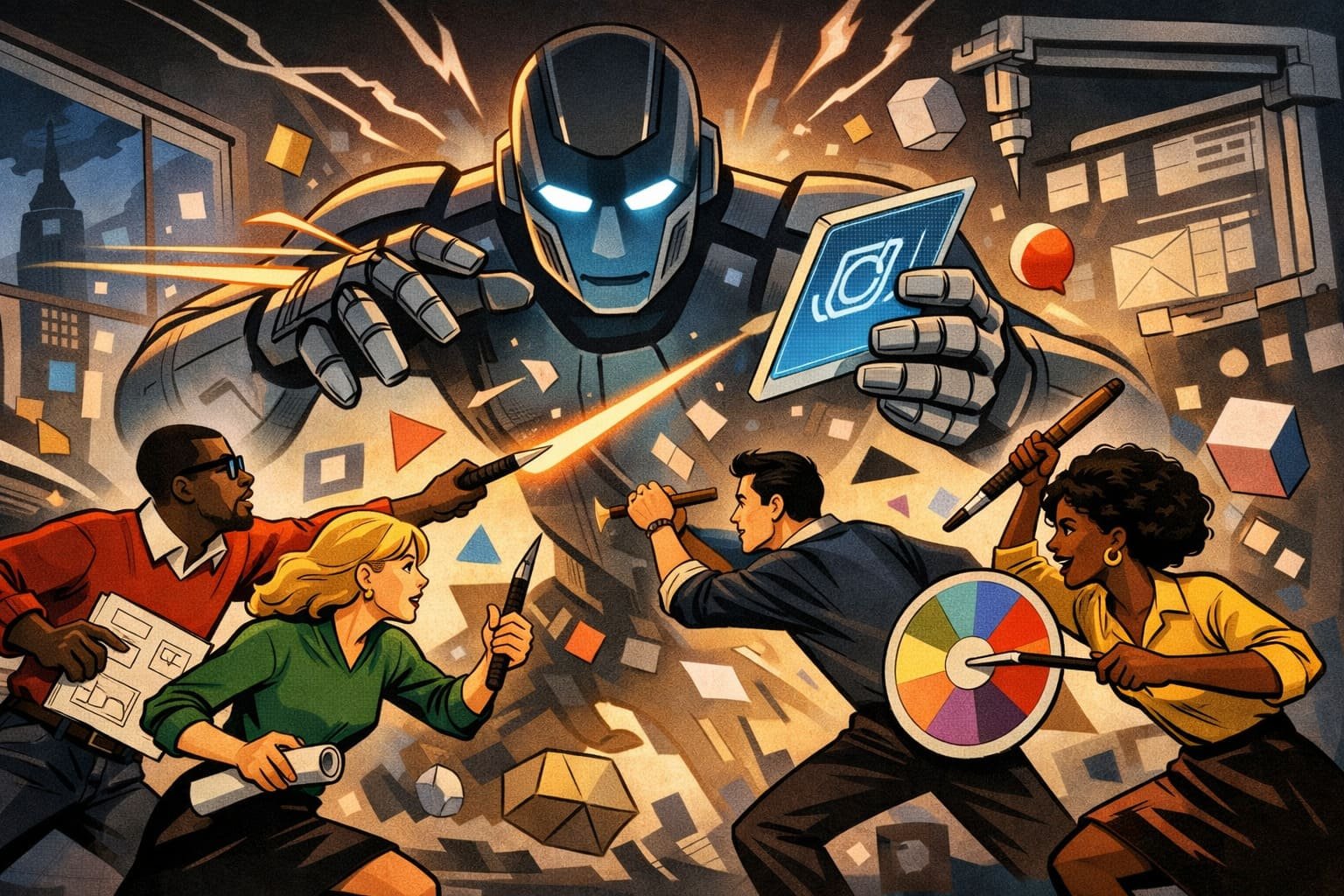
A studio table sat under white light, scattered with failed drafts, coffee rings, and a laptop humming beside a pencil sharpener that nobody had touched in weeks. The machine on the screen could generate a dozen layouts before the designer finished blinking. It could remix color, spacing, composition, and style with unnerving fluency. What it could not do was care which version felt honest. That still belonged to the person with tired eyes and ink on their fingers.
The Sketchbook Is On Fire
Design has always lived in tension with its own tools. New software arrives. Old habits tremble. Then the tools get faster, and the humans are told to become more efficient or disappear. Artificial intelligence pushed that pressure into overdrive. It can draft logos, build wireframes, mock interfaces, generate brand systems, and spit out variations at a pace that makes older workflows look like they were carved into stone.
That speed created a strange panic. Some designers feared replacement. Others feared sameness. Both fears were justified. AI is brilliant at pattern recognition, which is exactly why it can also make everything start to look like everything else. When the machine learns style without taste, design turns into a mirror hall. Beautiful, repetitive, and slightly dead.
So the fight back has begun. Not as a tantrum. As a reminder. Humans are not competing with AI on volume. They are competing on judgment, memory, contradiction, and meaning.
The Machine Can Mimic Taste, But Not Taste It
A strong design is not just an arrangement of shapes. It is a decision about what should matter. That distinction is where AI still stumbles. A brand strategist named Mirelle once tested a generative system on a product rebrand. The output was technically impressive. It balanced color. It followed trends. It even looked expensive. Yet every version felt strangely interchangeable, as if it had been designed by committee inside a polite vacuum. The final human-led direction kept one awkward detail the model had tried to remove. That imperfection gave the brand its nerve.
This is the difference between imitation and authorship. AI can borrow from the past faster than any human team ever could. It can recognize what has worked before and remix it endlessly. But taste is not just pattern selection. Taste is refusal. Taste knows when to keep the odd thing, the rough edge, the emotional bruise that makes a design memorable.
The design world understands this more clearly than most industries. People do not fall in love with polish alone. They fall in love with perspective. A poster, app, product, or website becomes unforgettable when it feels like a point of view rather than a template with confidence issues.
The Rebellion Of The Human Hand
There is a renewed hunger for evidence that a person was involved. Hand-drawn marks. Imperfect line work. Strange alignments. Slight asymmetry. Quiet quirks that would have been cleaned up by automated tools a year ago are now being preserved on purpose. The human touch has become a signal of care, not inefficiency.
A small packaging brand run by a founder named Anika built its identity around that idea. Their competitors used AI-generated visuals that looked polished but oddly hollow. Anika’s team kept one uneven line in the logo and one slightly off-center illustration in every label. Customers noticed, even if they could not explain why. The products felt touched by a mind, not assembled by a system.
That reaction is not sentimental fluff. It is recognition. Human beings are extremely good at sensing when something has breath in it. They can tell when an object carries friction, judgment, and intention. The machine can simulate style. It still struggles with soul.
The backlash against AI design is not anti-technology. It is anti-erasure. People do not want beauty scrubbed clean of fingerprints. They want evidence that another mind was present, making choices with them in mind.
Design Systems Need A Conscience
AI thrives in systems. That is both its power and its danger. It can produce endless assets, consistent layouts, and scalable visual language. But systems without conscience become factories for mediocrity.
A UX team at a fintech startup once let automation handle nearly every visual decision in an interface refresh. The product was consistent. It was also cold. Users completed tasks, but they did not linger, explore, or trust the experience enough to feel any attachment. The team eventually reintroduced human review around tone, hierarchy, and emotional pacing. Engagement improved because the interface started behaving like something made for people instead of metrics.
That lesson matters far beyond digital products. Design has always shaped behavior. When AI becomes the default coauthor, the question shifts. Who sets the values inside the system? Who decides what counts as elegant, accessible, respectful, or humane?
The strongest design teams will not be the ones that use AI the most. They will be the ones that know when to interrupt it. They will treat the model like a fast intern with excellent memory and limited ethics. Useful, powerful, and never the final authority.
The New Design Economy
The economics of design are changing fast. AI lowers production costs. That is obvious. What matters more is that it also raises expectations. Once people can generate fifty options in a breath, they start demanding something those options cannot provide. They want coherence. They want relevance. They want emotion. They want work that feels chosen, not merely produced.
A founder named Soren built a boutique agency after noticing clients were drowning in cheap AI output. The market was flooded with visuals, but not with direction. His studio stopped selling volume and started selling discernment. The positioning worked because the real shortage was not content. It was judgment. Businesses could produce more than ever. They still needed someone to decide what deserved to exist.
This is where human designers regain leverage. Not by fighting AI on speed. By becoming curators of meaning. They can translate culture, history, emotion, and context into work that generic systems cannot quite reach. The more the machine floods the zone, the more valuable a sharp point of view becomes. That is not a romantic theory. It is a survival strategy.
The Human Signature Still Matters
A dark monitor sits beside a row of sketches, each version carrying tiny corrections that no algorithm would have considered important. One curve was softened. One margin tightened. One color held back because it said too much. The final composition feels calm, but not sterile. Confident, but not obvious. It carries the texture of decision.
That is where humans are winning. Not in brute output. In narrative control. In emotional nuance. In the strange, unglamorous work of knowing when a design is technically good but spiritually wrong.
AI will keep changing design. It will reshape production, accelerate workflows, and expand access. But the most memorable work will still come from people who know how to resist the machine just enough to preserve meaning. The future of design is not humans versus AI in a winner-takes-all fight. It is humans fighting to keep style from becoming sludge. And that battle is already shaping the brands, interfaces, products, and cultures people will remember.
