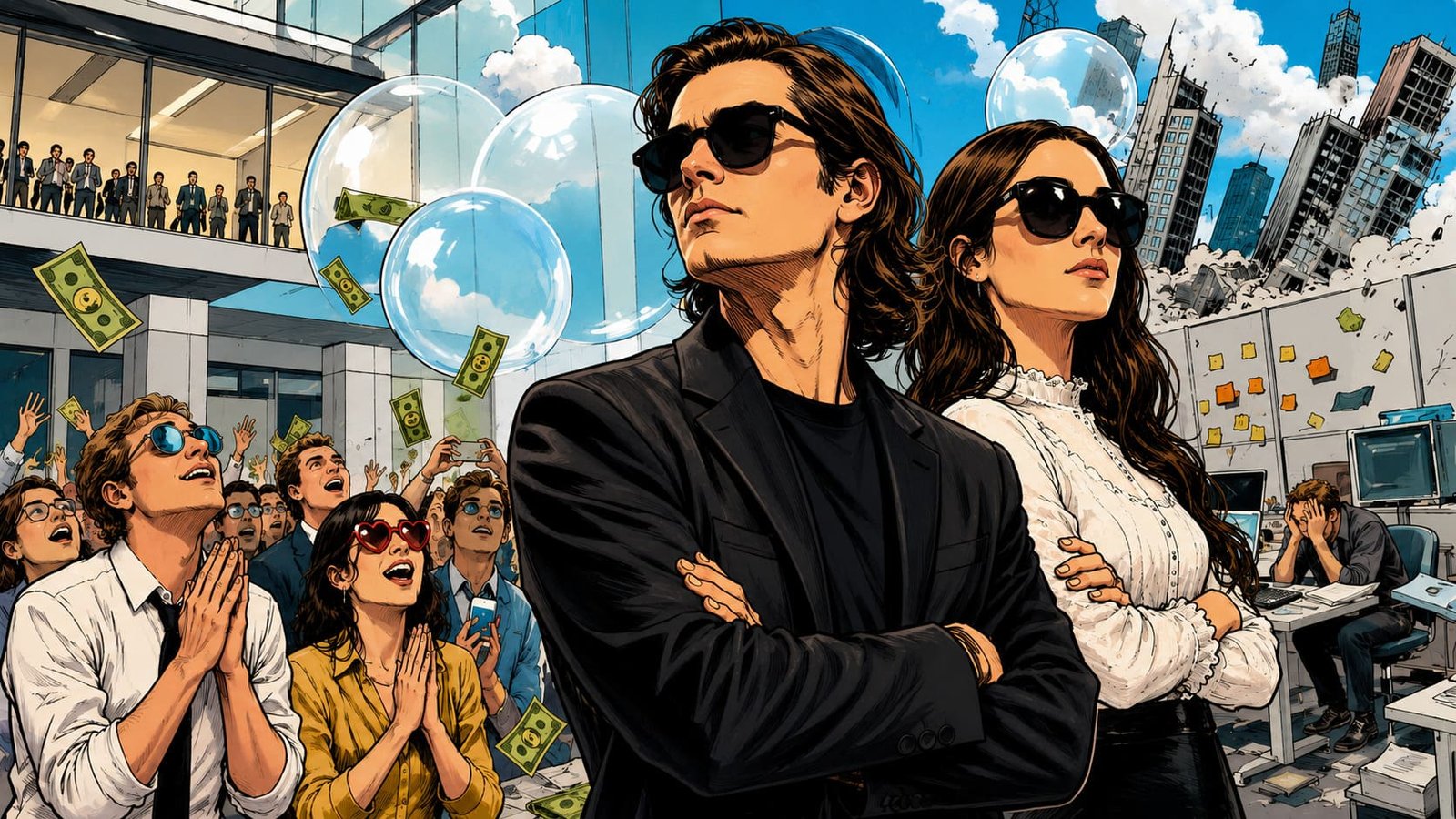
Candles flickered inside glass-walled coworking spaces in WeCrashed while ambitious young professionals wandered through kombucha taps and motivational slogans searching for meaning disguised as entrepreneurship. The offices looked less like workplaces and more like futuristic wellness retreats designed by people who believed capitalism could achieve enlightenment through exposed brick and expensive lighting. Somewhere between meditation speeches, tequila-fueled conferences, and billion-dollar valuations, Adam Neumann convinced investors that renting office space was not merely a business. It was a movement. That distinction becomes the beating heart of the series. Modern capitalism no longer sells products alone. It sells emotional identity.
Jared Leto’s Adam Neumann moves through the show with hypnotic unpredictability. One moment he resembles a visionary prophet intoxicated by possibility. The next, a reckless performer sprinting ahead of reality itself. His charisma feels dangerously authentic because modern corporate culture repeatedly rewards people who can convert confidence into atmosphere. Adam does not simply pitch investors. He creates emotional weather. Employees feel chosen. Customers feel progressive. Billionaires feel spiritually adjacent to innovation. The machinery surrounding him behaves almost religiously. That is what makes WeCrashed so compelling. It understands startups as emotional ecosystems, not merely financial entities.
Anne Hathaway’s Rebekah Neumann deserves equal attention because she embodies the strange fusion of spirituality and branding that defined an era of startup excess. Rebekah speaks about energy, destiny, and human transformation while luxury and valuation metrics swirl around her like incense smoke inside a cathedral built from venture capital. Watching the couple together feels like observing two people attempting to merge Silicon Valley mythology with Hollywood manifestation culture. It sounds absurd at first. Then viewers remember how many real investors accepted the performance completely.
A strategy consultant in Nairobi once described attending a startup summit where founders spoke about “changing humanity” despite operating businesses that delivered groceries faster to wealthy neighborhoods. The room smelled faintly of overpriced coffee and performative optimism. “Nobody wanted to admit we were discussing convenience wrapped in philosophical language,” she laughed quietly afterward. WeCrashed captures that atmosphere with surgical precision. The series understands that modern business culture often inflates ordinary operations into existential missions because ambition alone no longer satisfies people. They want transcendence attached to profit.
The brilliance of the show lies in its examination of scale obsession. WeWork expanded aggressively across global cities while internal discipline struggled to keep pace. Employees worshipped growth metrics almost religiously because modern startup ecosystems reward velocity over sustainability. “Blitzscaling” became gospel during that era. Expansion signaled genius. Caution signaled weakness. WeCrashed quietly dismantles that ideology. Bigger does not automatically mean wiser. Some organizations grow so quickly they outrun coherence itself. By the time structural cracks appear publicly, the mythology surrounding the company has already become too emotionally expensive for insiders to question honestly.
There is a remarkable sadness beneath the satire. Adam genuinely seems to crave belonging, admiration, and historical significance. That emotional hunger transforms the series from corporate comedy into something more intimate. Many founders secretly fear ordinariness more than failure. Building empires becomes psychological armor against invisibility. The tragedy is ancient. Alexander the Great understood it. Celebrity culture amplifies it. Social media industrializes it. WeCrashed simply relocates the hunger into modern startup culture where valuations function like public proof of personal worth.
One operations manager named Priya worked for a rapidly expanding fintech company in Singapore where employees were encouraged to describe the office as “family.” Team dinners blurred into emotional loyalty rituals. Executives delivered speeches about purpose while quietly demanding impossible hours behind the scenes. When layoffs arrived suddenly, the emotional whiplash devastated workers more than the job losses themselves. “It felt like waking up inside a staged relationship,” she admitted later during an industry panel. WeCrashed channels that exact emotional betrayal. Corporate cults thrive by confusing professional participation with existential belonging.
Visually, the series captures startup culture with intoxicating sharpness. Neon-lit events pulse with euphoric energy. Open-plan offices buzz like giant dopamine laboratories. Music swells while founders promise to reshape civilization through disruption and community. Yet beneath the spectacle sits exhausting fragility. Investors chase narratives faster than fundamentals. Employees perform enthusiasm because skepticism threatens momentum. Everyone becomes trapped inside collective optimism too expensive to interrupt. The atmosphere resembles a luxury cruise ship accelerating toward fog while passengers keep dancing because the champagne remains cold.
The relationship between Adam and investors adds another fascinating dimension. Billionaires repeatedly tolerate irrational behavior because they fear missing transformational success stories. Venture capital increasingly operates through emotional contagion as much as financial analysis. Nobody wants to become the person who ignored the next revolutionary company. Fear of exclusion distorts judgment. WeCrashed exposes this beautifully. Markets often reward storytelling long before they reward sustainability. A compelling narrative can temporarily overpower spreadsheets, governance, even common sense.
Near the end, skyscrapers shimmer against city skylines while exhausted employees carry cardboard boxes through offices once marketed as the future of human connection. Adam still speaks the language of destiny even as the empire fractures around him. That contradiction gives WeCrashed its haunting emotional force. The series understands that modern culture has blurred the line between leadership and performance so thoroughly that many organizations no longer know the difference between vision and spectacle. Somewhere inside those beautifully designed coworking spaces, ambition slowly transformed into theatre and belief became currency more volatile than money itself. The final realization lingers with uncomfortable clarity: when charisma becomes stronger than accountability, entire systems start mistaking emotional intoxication for wisdom.
Editorial Disclaimer: Whether a TV Show is rooted in fiction or inspired by real events, the actions, decisions, and behaviors portrayed within are not intended to be encouraged, replicated, or endorsed in real-world settings. This review exists solely to analyze the storytelling, characters, themes, and business dynamics presented in the TV Show for educational, analytical, and entertainment purposes. Any ethical or unethical conduct depicted in the TV Show does not reflect the views, values, or endorsements of ESYRITE.
