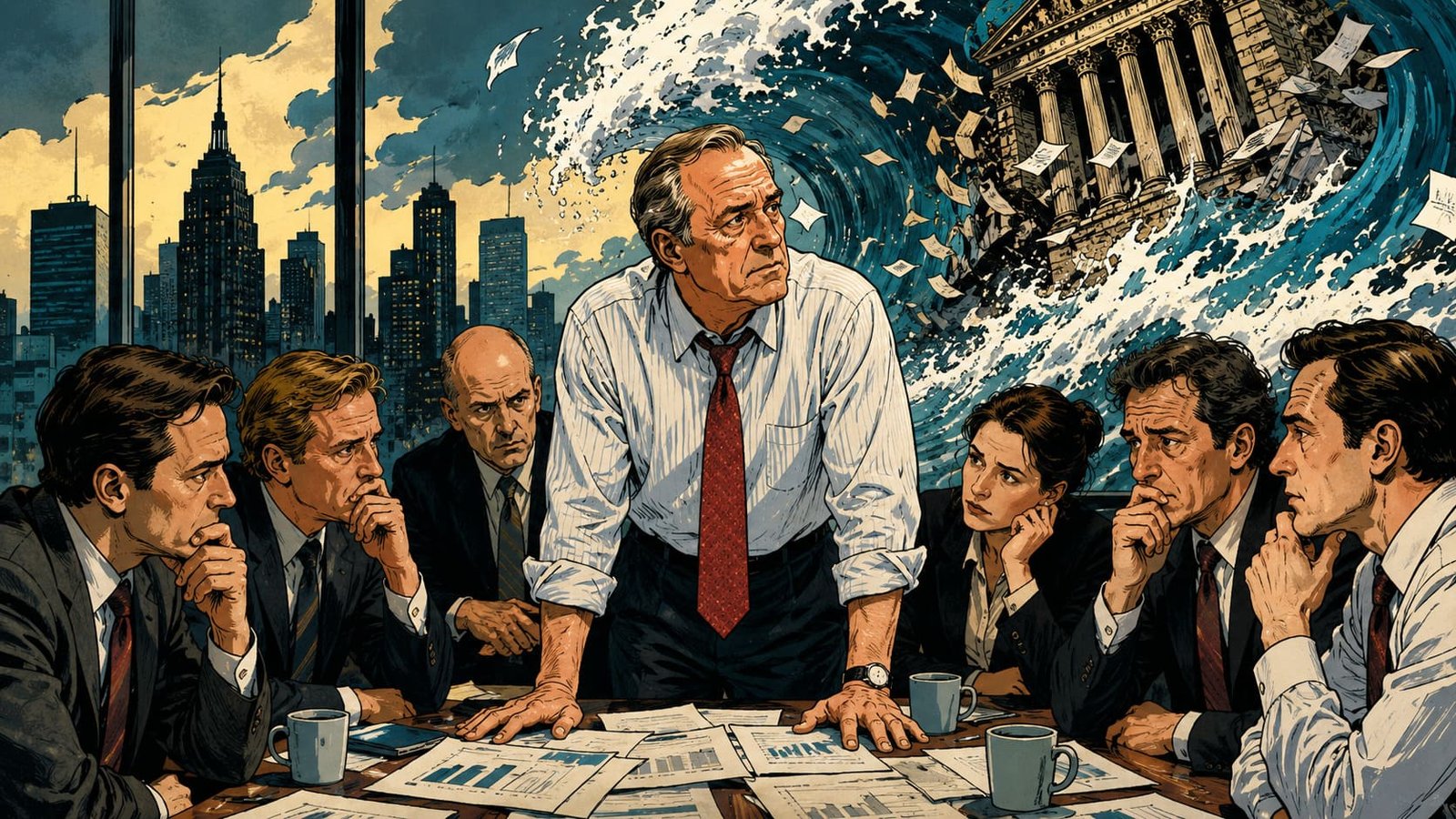
The elevators moved softly through a glass tower where exhausted analysts carried cardboard boxes past security guards pretending not to look directly at fear. Outside, Manhattan glittered with the confidence of a civilization drunk on its own reflection. Inside, fluorescent lights hummed over spreadsheets capable of detonating economies before sunrise. Margin Call unfolds like a financial horror film disguised as corporate realism. There are no superheroes crashing through skylines. No villains stroking white cats beside volcano lairs. Just frightened executives in expensive suits trying to survive a disaster they helped create but no longer fully control. The movie captures a terrifying truth about modern institutions: systems rarely collapse because nobody saw danger coming. They collapse because too many people saw it and kept moving anyway. J.C. Chandor’s film strips away the mythology surrounding Wall Street until power looks less glamorous and more like a sleepless emergency meeting fueled by panic, ambition, and cold takeout food gone stale beneath conference-room lighting.
What makes Margin Call extraordinary is its emotional restraint. The film never screams. It whispers. That whisper feels lethal because the characters understand consequences intellectually while remaining emotionally detached from them operationally. Zachary Quinto’s Peter Sullivan discovers the firm’s exposure almost accidentally, like a chemist realizing the laboratory air itself has become explosive. The scene lands with chilling precision because catastrophe enters quietly. Most institutional failures begin this way. One overlooked variable. One ignored warning. One exhausted employee staying late enough to notice patterns others preferred not to examine too closely. A risk consultant named Mara once described corporate collapse as “watching adults professionally negotiate with gravity.” That sentence hovers invisibly over every scene in Margin Call. The executives know the system is unsustainable. The real debate concerns timing, optics, and personal survival.
Jeremy Irons’ portrayal of John Tuld transforms the film into something almost Shakespearean. Tuld does not behave like a cartoon villain. He behaves like a man who has spent decades metabolizing moral compromise until it feels operationally normal. That subtlety matters. Truly dangerous systems rarely announce themselves with theatrical evil. They normalize emotional distance gradually. Tuld speaks calmly about economic destruction because the machinery of high finance trained him to convert human suffering into abstract movement across screens. Modern capitalism often rewards precisely this psychological detachment. Markets praise efficiency, not empathy. A private equity associate named Simon once admitted after a restructuring deal, “The layoffs looked cleaner in PowerPoint.” That sentence sounds brutal because it exposes how institutional language anesthetizes conscience. Margin Call understands that language itself can become a moral hiding place.
The movie also captures the strange loneliness of corporate hierarchy. Every character seems emotionally isolated despite constant proximity to others. Conversations happen inside elevators, empty hallways, dim conference rooms, and silent car rides through sleeping streets. Nobody truly trusts anyone because incentives have contaminated intimacy. That emotional architecture feels deeply familiar in modern professional culture. Organizations preach collaboration while structuring competition beneath every interaction. Employees perform confidence while privately fearing obsolescence. Executives discuss “human capital” as though people were interchangeable software components. One banker named Leila described investment firms as “casinos where everyone dresses like funeral directors.” Margin Call thrives inside that contradiction. The glamour of Wall Street dissolves under pressure until ambition itself starts resembling a survival reflex rather than aspiration.
Paul Bettany’s Sam Rogers becomes the film’s exhausted moral center precisely because he recognizes the human cost behind abstract decisions. His grief over his dying dog lands harder than many boardroom confrontations because it reveals emotional life still exists beneath corporate armor. Sam understands the firm is about to sell toxic assets while disguising danger from buyers desperate enough to trust institutional credibility. Yet he stays. That tension gives the movie its emotional bite. Ethical discomfort does not automatically produce ethical action. Many intelligent people remain inside broken systems because leaving threatens identity, income, status, or stability. A healthcare executive named Nadine once confessed during a late-night airport delay that “most professionals slowly become translators between their conscience and their compensation.” Sam embodies that painful negotiation perfectly.
There is a remarkable scene where senior leaders gather around a conference table discussing the coming collapse with the emotional tone of people planning catering logistics for a wedding. That emotional numbness is the point. Financial systems grew so massive and abstract that consequences became geographically and psychologically distant from decision-makers themselves. Families losing homes remain invisible to executives focused on market exposure before opening bell. The film never needs melodramatic speeches because the banality of the conversations already feels horrifying. One of the movie’s sharpest observations is that intelligence alone provides no protection against moral decay. Many characters fully understand the mathematics behind the disaster. Their failure is not cognitive. It is ethical. Civilization often mistakes technical competence for wisdom, then acts surprised when brilliant people engineer catastrophe elegantly.
The younger employees carry a different kind of tragedy. They inherited a system already spiritually compromised before they fully entered it. Penn Badgley’s Seth Bregman drifts through the film with quiet disillusionment, aware the entire culture feels hollow yet uncertain how escape would even look. That emotional fatigue defines large sections of modern professional life. Talented graduates enter prestigious industries believing they are joining engines of progress only to discover bureaucracies optimized for extraction, optics, and short-term incentives. A software engineer named Tomi once stared across a rooftop bar in Berlin and admitted something painfully simple. “Everybody keeps calling this success, but nobody looks alive.” That sentence belongs spiritually inside Margin Call. The film recognizes how institutions consume emotional vitality long before individuals consciously notice the erosion occurring.
Visually, the movie feels cold without becoming sterile. Nighttime Manhattan glows like circuitry beneath rain-streaked windows. Office interiors appear simultaneously luxurious and emotionally vacant. The cinematography mirrors the psychology perfectly. Wealth surrounds the characters while meaning evaporates quietly underneath it. Even moments of humor carry bitterness. A senior executive casually discussing bridge collapses as normal economic events lands like existential satire. The movie suggests modern financial systems treat human instability as cyclical background noise rather than moral emergency. That realization becomes especially disturbing because nobody inside the film appears uniquely monstrous. They are recognizable professionals operating inside incentives larger than themselves. Margin Call refuses easy villains because systemic dysfunction survives precisely through ordinary participation.
Before dawn reached the skyline, traders prepared to unload poison disguised as opportunity onto strangers who still believed the machine deserved trust. In a quiet patch of earth outside the city, one weary executive buried his dog beneath cold soil while helicopters sliced through the darkness overhead like mechanical vultures circling invisible wreckage. The markets would open soon. Phones would ring. Lives elsewhere would begin collapsing silently inside kitchens, apartments, and family homes far removed from polished conference tables. That is the lingering horror of Margin Call. The film understands that civilizations rarely implode through dramatic explosions alone. Sometimes they decay through calculated decisions made by emotionally exhausted people convincing themselves survival justifies everything. And somewhere deep inside the machinery of modern ambition, that logic still waits patiently for another frightened room full of intelligent adults willing to press the button again.
Editorial Disclaimer: Whether a film is rooted in fiction or inspired by real events, the actions, decisions, and behaviors portrayed within are not intended to be encouraged, replicated, or endorsed in real-world settings. This review exists solely to analyze the storytelling, characters, themes, and business dynamics presented in the film for educational, analytical, and entertainment purposes. Any ethical or unethical conduct depicted in the film does not reflect the views, values, or endorsements of ESYRITE.
