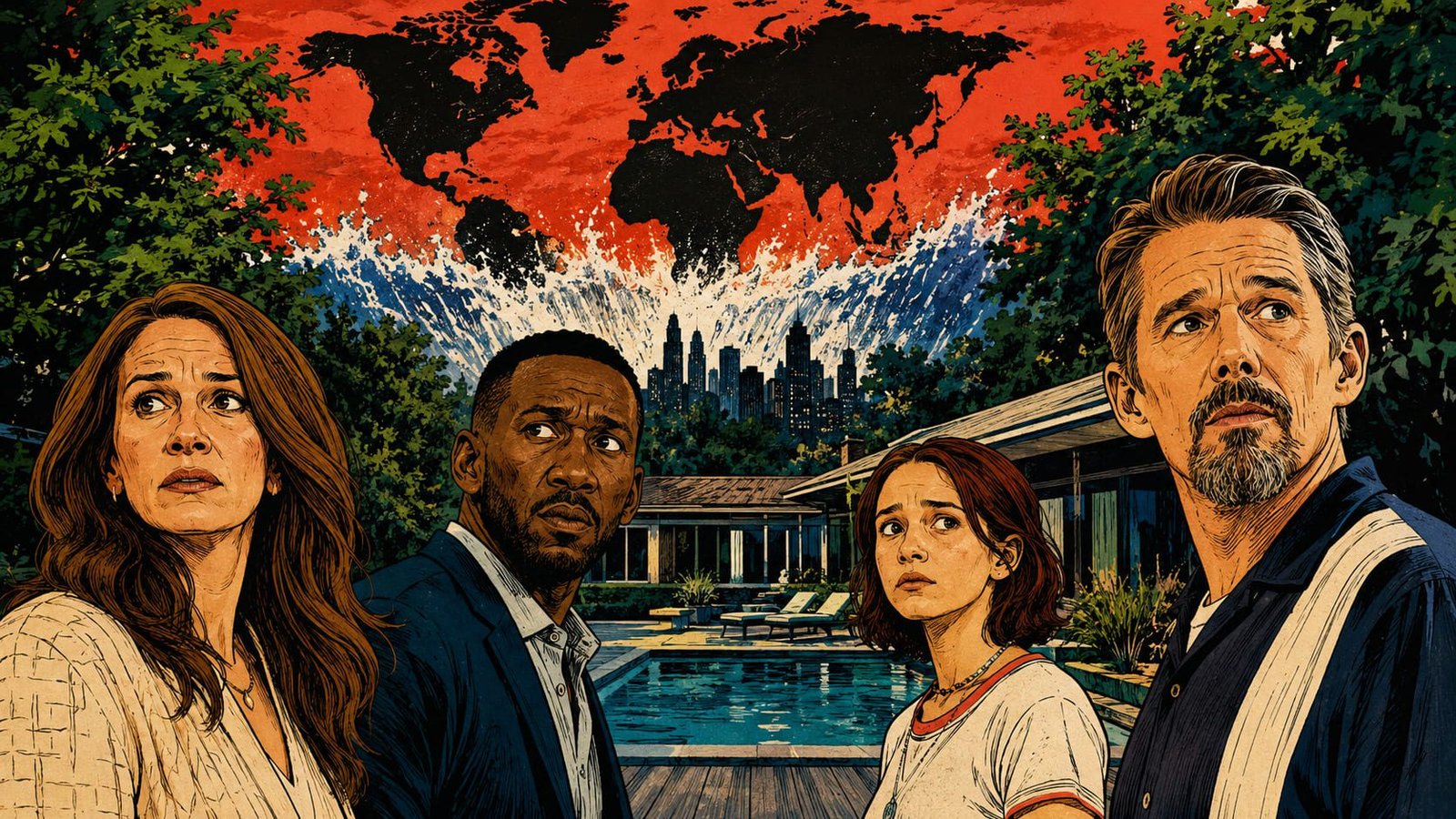
The swimming pool shimmered with obscene calm while somewhere beyond the trees the machinery of modern civilization quietly began to fail. Wine glasses clinked beneath soft vacation lighting. Phones stopped working. Ships drifted toward disaster like confused steel ghosts. A child stared at a frozen television screen searching for reassurance from a world suddenly incapable of providing any. Leave the World Behind unfolds with the slow dread of a psychological fever dream where comfort becomes suspicious and ordinary silence starts sounding dangerous. Sam Esmail directs the story like a man peeling wallpaper off the inside of American confidence. The film does not rely on monsters or traditional apocalypse spectacle. Its real terror comes from exposing how thin civilization actually is once systems stop functioning on command.
The house itself becomes a perfect metaphor for modern privilege. Elegant architecture. Expensive décor. Endless distractions. Yet beneath the polished surfaces sits profound dependence on invisible infrastructure nobody fully understands. Electricity, algorithms, supply chains, satellites, data centers, logistics networks. Modern life functions because millions of fragile systems cooperate quietly in the background. Most people never think about them until disruption arrives. A retail executive named Bianca Hale once admitted during a conference retreat that her company could track customer preferences across continents in real time but struggled to explain where several core products were physically manufactured. That contradiction hovers throughout Leave the World Behind. Civilization increasingly feels technologically advanced and psychologically unprepared at the same time.
Julia Roberts plays Amanda with sharp-edged anxiety that gradually mutates into suspicion. Her discomfort around strangers reveals one of the film’s deepest obsessions: trust has become emotionally expensive. Modern societies encourage hyper-individualism while quietly eroding communal instincts. People learn branding before empathy. Security before vulnerability. Opinion before listening. When uncertainty appears, tribal reflexes emerge almost instantly. A property developer named Leonard Pike once described a blackout during a luxury networking event in Miami. Within minutes executives who had spent hours discussing collaboration and innovation began hoarding bottled water and accusing hotel staff of incompetence. “It felt like civilization running on battery saver mode,” one employee reportedly muttered afterward. Leave the World Behind captures that emotional unraveling with painful accuracy.
Mahershala Ali’s G.H. Scott carries the quiet exhaustion of a man who understands systems deeply enough to recognize their fragility. His presence introduces another tension running beneath the film: expertise no longer guarantees authority during cultural panic. Modern audiences consume information constantly while trusting almost nobody completely. Institutions damaged their own credibility through decades of manipulation, spectacle, and contradiction. The result is psychological freefall. A cybersecurity consultant named Rina Volkov once warned clients that misinformation campaigns succeed not because people believe everything, but because they eventually stop believing anything at all. That atmosphere saturates Leave the World Behind. Characters drift through uncertainty searching not merely for answers, but for orientation itself.
The film’s refusal to explain everything frustrates some viewers. That ambiguity becomes part of its brilliance. Real societal collapse would likely feel fragmented and surreal rather than narratively clean. Information would arrive unevenly. Rumors would spread faster than facts. Human beings would cling desperately to familiar routines because routine creates emotional stability. One scene involving autonomous vehicles piling into chaos feels especially haunting because it exposes a broader truth about technological dependence. Entire populations now outsource decision-making to systems they barely comprehend. Convenience slowly becomes vulnerability. A logistics manager named Omar Velez once joked that modern cities resemble giant vending machines where people panic the moment a button stops working. The joke stopped feeling funny during a regional network outage that disrupted transportation systems for hours.
Animals moving strangely throughout the story deepen the atmosphere beautifully. Deer gather silently. Flamingos appear in bizarre locations. Nature starts behaving like a witness observing human confusion from the outside. That imagery carries philosophical weight. Modern civilization often imagines itself separate from natural systems rather than embedded within them. The film quietly dismantles that illusion. Human beings build glass towers, financial empires, and streaming platforms while remaining biologically fragile creatures vulnerable to fear, misinformation, and environmental instability. There is something almost biblical about the movie’s emotional texture, though it avoids moralizing directly. Instead it lets discomfort spread gradually like static electricity beneath the skin.
Ethan Hawke’s Clay represents another fascinating modern archetype: the well-meaning professional unprepared for genuine crisis. He knows how to navigate consumer culture but struggles when normal systems disappear. That emotional paralysis feels disturbingly recognizable. Many educated people possess specialized knowledge yet lack practical resilience. A marketing director named Celia Monroe once confessed after a severe storm stranded her neighborhood that she knew more about optimizing digital engagement metrics than locating emergency supplies without internet access. Her statement sounded absurd until several neighbors admitted similar fears. Leave the World Behind repeatedly exposes how technological abundance can disguise emotional helplessness.
Near the end, the film stops feeling like a thriller and starts resembling an x-ray of modern consciousness itself. Characters wander through luxury interiors while distant explosions stain the horizon red. Screens flicker uselessly. Familiar structures dissolve into confusion. Yet the most haunting detail involves how desperately everyone wants normality to return. Human beings crave predictability because predictability allows identity to remain stable. Once systems fail, people confront something terrifying beneath the panic: many lives were built around consumption rather than meaning. Leave the World Behind leaves behind the eerie sensation of standing inside a perfectly designed house while hearing civilization crack faintly somewhere beyond the walls. The film understands that societies rarely collapse in one dramatic instant. More often they dissolve through accumulated distrust, emotional exhaustion, and invisible systems failing quietly behind polished surfaces. And when the lights finally flicker out, the hardest question may not be how to survive, but whether anything truly human was left glowing underneath all the machinery in the first place.
Editorial Disclaimer: Whether a film is rooted in fiction or inspired by real events, the actions, decisions, and behaviors portrayed within are not intended to be encouraged, replicated, or endorsed in real-world settings. This review exists solely to analyze the storytelling, characters, themes, and business dynamics presented in the film for educational, analytical, and entertainment purposes. Any ethical or unethical conduct depicted in the film does not reflect the views, values, or endorsements of ESYRITE.
