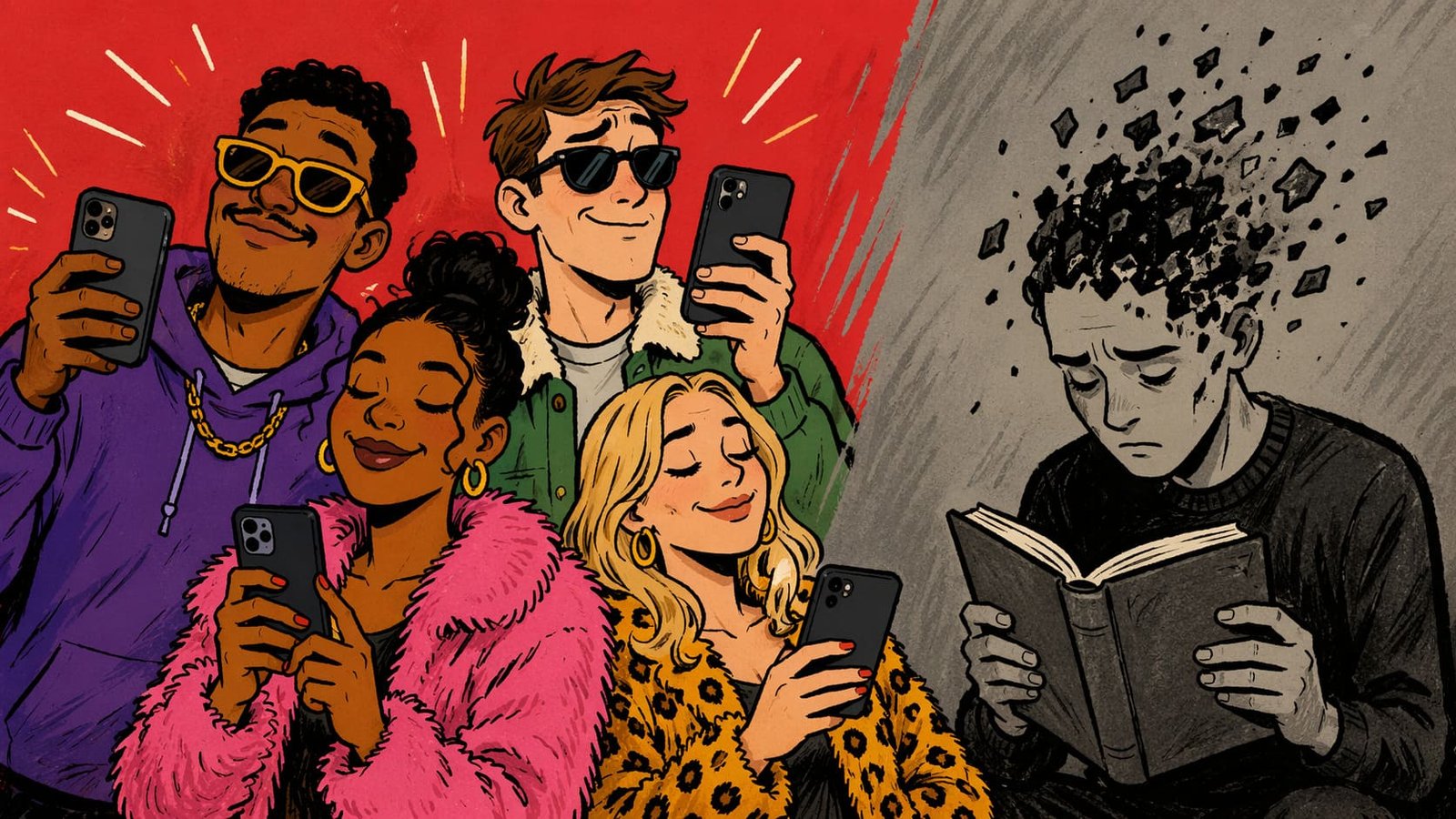
A glowing screen flickers in a dark room while a thumb keeps moving, faster than thought, faster than memory. One trend rises, peaks, dissolves. Another replaces it before the first has time to leave a trace. Music clips, fashion edits, micro-ideas packaged for instant reaction. Nothing lingers long enough to settle. Everything feels urgent, yet strangely forgettable. The feed moves like a conveyor belt of relevance, and somewhere inside that motion, meaning begins to thin out.
What used to be called culture now behaves more like velocity. Trends are no longer signals of collective taste evolving over time. They are bursts of attention engineered for rapid consumption. A song becomes popular not because it endures, but because it circulates. A style gains traction not because it resonates deeply, but because it replicates easily. The metric has shifted from depth to spread, from memory to momentum.
A young brand strategist named Omar once built a campaign around a viral dance challenge. Engagement exploded overnight. The product became visible, recognizable, part of the conversation. Weeks later, the same audience had moved on completely. Omar reviewed the data and noticed something unsettling. Awareness had increased, but attachment had not. The campaign had captured attention without creating meaning. It had ridden the wave, but it had not anchored anything.
Trend culture rewards immediacy. It favors what can be understood in seconds, shared in moments, and replaced without resistance. This creates a paradox. The more content is consumed, the less any single piece matters. The audience becomes skilled at recognizing patterns quickly, but less inclined to invest emotionally. Familiarity increases, while significance declines. Everything feels known, yet nothing feels important.
Platforms like TikTok have perfected this dynamic. The algorithm prioritizes engagement, not continuity. Content surfaces based on interaction, not intention. A creator can go from obscurity to visibility overnight, then disappear just as quickly. The cycle is efficient, but it rarely allows for sustained connection. Visibility becomes a moment, not a relationship.
There is also a psychological cost to constant trend participation. Keeping up requires attention, adaptation, and a willingness to shift identity quickly. What was relevant yesterday may feel outdated today. This creates a subtle anxiety, a sense of always being slightly behind or slightly out of sync. The pressure is not always explicit, but it is persistent. Relevance becomes a moving target that never settles.
A content creator named Lina built her presence by consistently engaging with emerging trends. Her growth was rapid. Followers increased. Opportunities followed. Over time, however, Lina noticed a fatigue that was difficult to articulate. Each new trend required a version of herself that felt slightly adjusted, slightly less grounded. The audience responded, but the connection felt thinner. Lina began experimenting with slower, more intentional content. Growth slowed, but engagement deepened. The shift revealed a trade-off between scale and substance.
Pop culture reflects this tension clearly. Songs that dominate charts for brief periods often fade quickly, replaced by the next viral hit. In contrast, artists like Adele build work that lingers, not because it trends, but because it resonates. The difference lies in intention. One approach prioritizes immediacy, the other prioritizes endurance. Both can succeed, but they create very different relationships with audiences.
Trend worship also reshapes how value is perceived. Something gains legitimacy not through intrinsic quality, but through visibility. If enough people engage, it must matter. This logic is efficient, but it can be misleading. Visibility measures attention, not depth. A widely shared idea may be shallow, while a deeply meaningful one may remain obscure. The hierarchy becomes inverted, rewarding what spreads rather than what sustains.
A small business owner named Javier once shifted his product design to align with trending aesthetics. Sales increased temporarily. Customers recognized the style, felt familiar with it, responded quickly. Months later, the same aesthetic felt overused. Demand declined. Javier realized that building around trends created a dependency on constant reinvention. Stability became difficult. Each cycle required a new adaptation, a new alignment, a new risk.
There is a deeper tension beneath this cycle. Trends promise relevance, but they often deliver fragmentation. Each new wave resets context, making it harder to build continuity. Stories lose coherence. Identities become fluid to the point of instability. The self becomes a series of adjustments rather than a consistent narrative. This fluidity can feel liberating, but it can also feel disorienting.
A cultural analyst named Noor once described trend cycles as “collective improvisation without memory.” The phrase lingered because it captured something essential. Participation feels dynamic, creative, alive. Yet without memory, creation struggles to accumulate meaning. Each moment stands alone, disconnected from what came before. The result is a culture that moves quickly but rarely deepens.
In a quiet room, long after the screen has dimmed, a person scrolls through saved posts that once felt urgent, now reduced to fragments of a past attention cycle. The images blur together, stripped of their original context. What remains is not the trend itself, but a faint awareness of having moved through it.
In that stillness, where motion finally pauses, a question emerges with quiet insistence: if everything is designed to be replaced, what happens to the parts of you that were built to last?
