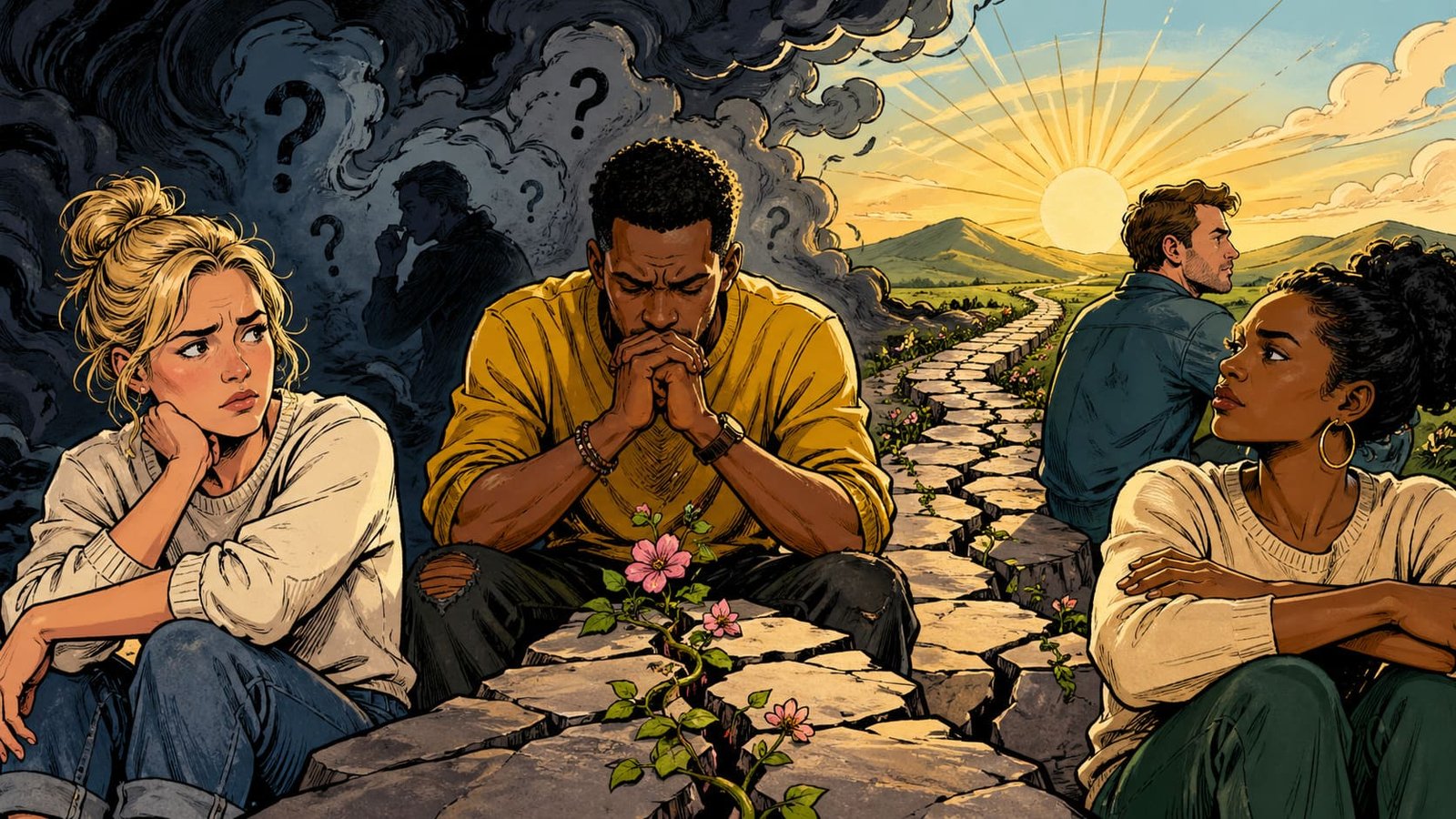
A cathedral stands half-lit in the late afternoon, its stained glass fractured by years of neglect. Light still passes through, but it arrives uneven, broken into colors that feel more honest than perfect. Visitors walk in expecting silence, yet what lingers is tension. Not the absence of belief, but the presence of questions that refuse to settle. The modern world often assumes that faith thrives on certainty, that belief requires clean answers and unwavering conviction. It sounds neat, almost comforting. Yet the deeper reality moves in the opposite direction. Faith does not grow in the absence of doubt. It grows through it, shaped by the very fractures people try to avoid.
Certainty has a seductive quality. It offers clarity, control, and the illusion of final answers. In an era obsessed with information, certainty feels like the ultimate prize. Data promises precision, algorithms promise predictability, and expertise promises authority. Still, beneath all that assurance, something restless remains. Questions about meaning, purpose, and identity rarely resolve into simple conclusions. They linger, evolving over time. A medical researcher named Anika spent years studying complex diseases, building a reputation for rigorous analysis. Yet when her own health began to fail, she found herself asking questions that no study could answer. Her training gave her knowledge. It did not give her peace. What emerged instead was a quieter, more complex form of belief, one that coexisted with uncertainty.
Doubt, often framed as weakness, carries a different kind of strength. It forces reflection, prevents complacency, and opens space for deeper understanding. Without it, belief risks becoming rigid, detached from lived experience. Philosophers and theologians have long wrestled with this tension. Søren Kierkegaard described faith as a leap, not a conclusion. That idea captures something essential. Faith is not the end of questioning. It is the decision to continue despite unanswered questions. It acknowledges the limits of human understanding while still choosing meaning.
The relationship between doubt and faith becomes especially visible in moments of personal crisis. When life unfolds according to plan, belief can feel stable, almost effortless. When disruption arrives, it is tested. A journalist named Mateo built his career on uncovering facts, exposing inconsistencies, challenging assumptions. His work demanded skepticism. Yet after a series of personal losses, he found himself confronting a different kind of uncertainty. The tools that once defined his identity offered little comfort. What emerged was not a rejection of his critical mindset, but an expansion of it. He began to see that doubt did not have to dismantle belief. It could refine it.
Pop culture reflects this dynamic in subtle ways. Characters who struggle with doubt often resonate more deeply than those who appear certain. Their journeys feel real because they mirror the tension people experience in their own lives. Stories that explore faith without questioning tend to feel distant, almost artificial. Those that embrace complexity create a stronger connection. This pattern suggests that audiences recognize something authentic in the coexistence of belief and uncertainty. It reflects a lived reality rather than an idealized version of it.
There is also a social dimension to this tension. Communities built around shared beliefs often grapple with how to handle doubt. Too much rigidity can push people away, creating an environment where questioning feels unsafe. Too much ambiguity can dilute the sense of shared meaning. Finding balance requires acknowledging that doubt is not an enemy to be eliminated but a force to be integrated. A community organizer named Leila once described her role as creating space for difficult conversations. She noticed that when people felt free to express uncertainty, their commitment to the community often deepened. The willingness to engage with doubt made the connection more genuine.
The modern emphasis on personal authenticity adds another layer to this conversation. People are encouraged to explore their beliefs, to question inherited ideas, to construct their own frameworks of meaning. This process often involves periods of doubt that can feel disorienting. Yet it also creates the possibility for a more intentional form of faith, one that is chosen rather than assumed. This shift does not eliminate tension. It amplifies it. It asks individuals to navigate uncertainty without losing their sense of direction.
At a broader level, the interplay between doubt and faith reflects a deeper truth about human experience. Life rarely offers complete clarity. It unfolds in fragments, shaped by moments of insight and confusion, certainty and ambiguity. Faith, in this context, becomes less about having all the answers and more about how one responds to the absence of them. It is a posture, a way of engaging with the unknown rather than avoiding it.
In a quiet corner of that cathedral, a figure pauses, tracing the uneven lines of colored light on the floor. Each fragment tells a story, incomplete on its own yet part of something larger. The cracks in the glass do not diminish the light. They change how it enters, how it is perceived, how it is felt. Outside, the world continues its search for certainty, building systems that promise control and clarity. Inside, a different realization takes shape. Faith is not weakened by doubt. It is defined by it, sharpened by the questions that refuse to disappear. And in that tension, something quietly enduring emerges, not perfect, not final, but deeply alive.
