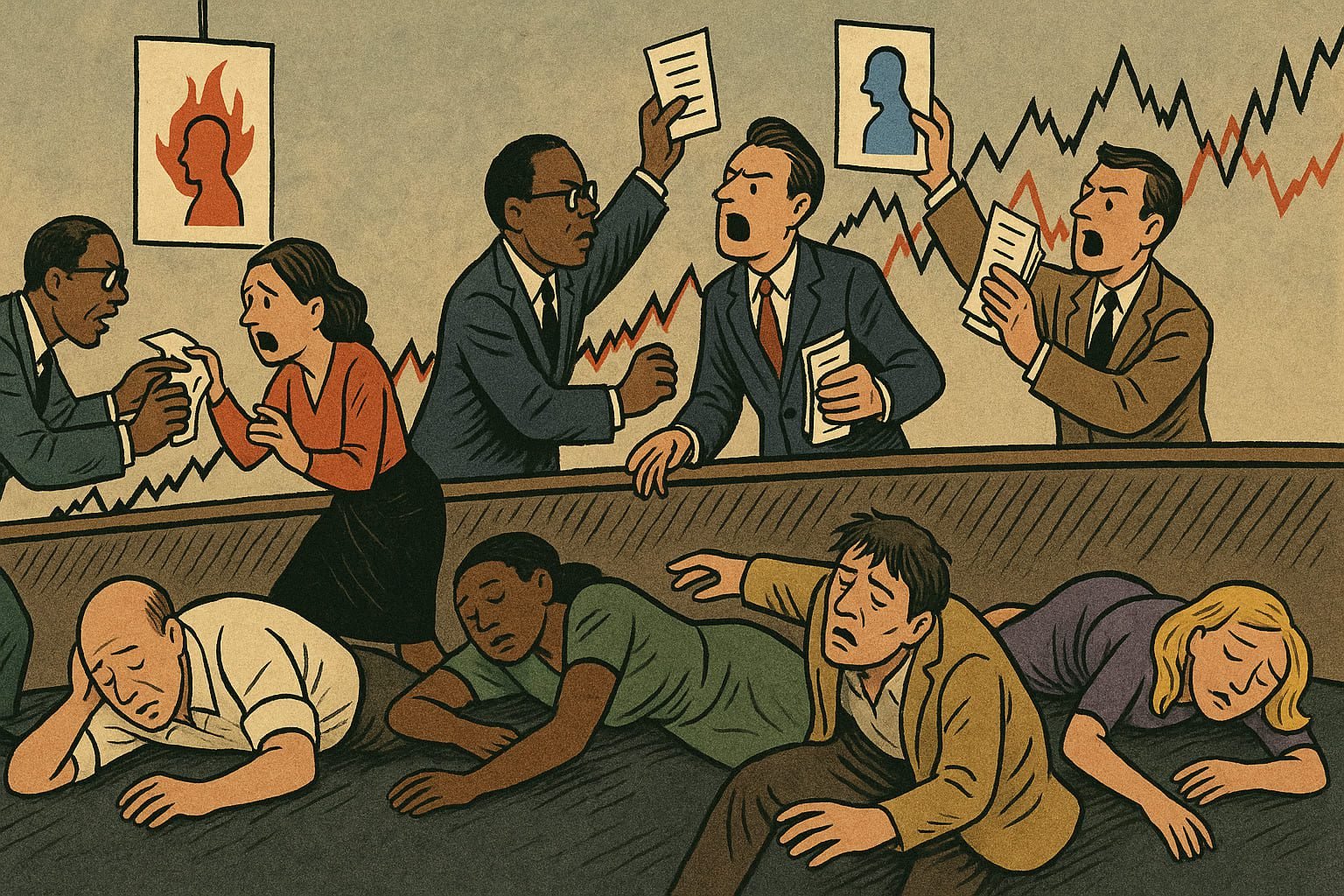
Neon lights flicker across a silent boardroom where glass walls reflect hungry eyes glued to a river of numbers. Each face glows pale blue from a parade of ticker symbols and the perpetual hum of market alerts, while empty coffee cups sit abandoned, their contents long since traded for adrenaline. Chairs squeak as anxious bodies lean closer, but the room never breathes easy—each second brings another verdict, a verdict that can make or break lives. Screens display more than stocks; they broadcast victories, failures, and the silent suffering of those caught between ruthless ambition and fleeting security. The smell of burnt toast lingers, a small reminder of forgotten comfort in a world addicted to the chase.
There’s a moment—a heartbeat—when the screen freezes. Eyes dart around, every soul silently bargaining with fate for another win, one more trade, another slice of victory. The rhythm of Wall Street is a symphony of longing and fear, but nobody speaks of what is lost between the digits. In these moments, profit is king and humanity is merely an afterthought. Behind every celebration there’s a shadow, behind every windfall, an invisible price.
Outside, rain beats against the windows in sync with the market’s pulse. A janitor pushes a broom past a discarded badge with the name “Lila Morales,” a reminder that ambition is never an individual sport. Somewhere across town, Lila’s daughter asks why her mother never comes home before sunrise. The boardroom is a coliseum, and the casualties are rarely counted until the final bell tolls.
The cold calculus of markets rewards only what can be measured. Yet in the hush of closing hours, stories leak out—stories of dreams sold, promises broken, values traded for expediency. The air tastes metallic, heavy with regret and anticipation. One manager whispers to another, “Don’t blink. The second you do, the market eats you.” And so, they stare into the glare, unblinking, souls mortgaged for a bonus, always hoping the next trade will justify the cost.
Somewhere in the archives, a forgotten ledger records not just assets, but the vanished warmth of trust, meaning, and connection. There are no line items for heartbreak or dignity, but their absence shapes every transaction. As dawn creeps over the skyline, it’s clear: this is no ordinary market. This is soul stock, and humanity itself is up for auction.
Quick Notes
1. Every Transaction Tells a Story: Markets are not cold machines. Each trade echoes a human sacrifice—time, health, or relationships—silently fueling the system’s relentless grind.
2. Ruthless Trades, Real Losses: Chasing profits at any cost leaves scars. The collapse of empathy and values in boardrooms leaves communities reeling and families fractured.
3. The Myth of Infinite Growth: Corporate ambition often devours more than it creates. When companies treat people as numbers, everyone eventually pays a price that spreadsheets can’t tally.
4. Trust Is the Hidden Currency: Betrayed employees and misled investors leave in their wake a deficit that outlasts any financial crash. The collapse of trust shatters companies faster than any scandal.
5. Redemption Starts at the Core: Regaining humanity in economics begins by valuing people over short-term gains. Only when organizations put souls before shares can they truly thrive.
The Auction Block—Where Values Disappear
The world of finance spins on an axis of urgency, where every tick upward hides the decline of something priceless. Executives, blinded by quarterly targets, sacrifice vacation days and ethical lines in pursuit of another percentage point. At a global conglomerate, one regional director confided to a journalist that “bonuses arrive, but the sense of meaning never does,” a sentiment echoing through empty hallways after midnight. An intern at a hedge fund, tasked with slicing jobs to meet cost projections, whispered to a friend, “I thought I was helping, but it felt like tearing pieces from my own chest.”
Behind the headlines of corporate takeovers and blockbuster IPOs, there’s a silent ledger where human costs accumulate. Each merger promises efficiency but leaves behind laid-off workers and broken communities. In Detroit, when an automaker moved operations overseas, diners closed, schools lost funding, and neighborhoods faded to gray. A mother who once worked on the assembly line now juggles two part-time jobs, her laughter a little thinner but her resolve untouched.
Values once central to business—loyalty, fairness, stewardship—are often the first to be sold when profits falter. An anonymous whistleblower at a leading tech startup recounted boardroom debates where “ethics” was a checkbox, not a compass. Meanwhile, workers in satellite offices stare at screens, calculating how much of themselves to trade for security.
In the late-night glow of a company cafeteria, a CFO ponders how to tell her team that jobs will be cut to boost share price. She remembers when her own father lost his job to a “restructuring” and wonders if she’s become part of the same machine. “We celebrate record highs,” she tells a colleague, “but sometimes it feels like we’re selling pieces of our own soul.”
The auction block is never empty. Every transaction erodes something silent and precious, and the audience rarely sees the toll until the lights flicker and the room empties out.
Profit’s Shadow—When Ambition Devours Empathy
Ambition electrifies the economy, but its current can shock the heart right out of a company’s culture. One morning in Silicon Valley, the founder of a promising app startup declared, “Speed beats perfection,” launching an all-hands sprint that left engineers and designers sleeping under desks. By launch day, the team celebrated success with pizza, but one developer quietly resigned, leaving a sticky note: “What’s left when the work is gone?”
Pop culture loves a ruthless winner, but rarely do the highlight reels show the sleepless nights, shattered friendships, or silent divorces. Take the story of Cameron Yu, a top trader whose record-breaking streak made headlines—until a panic attack in a luxury hotel room exposed the cost. “No one warned me that winning could feel so empty,” Cameron later told a business magazine.
Profit, pursued at any cost, often becomes a vampire, draining empathy and fueling cutthroat competition. A mid-level manager at a logistics firm noticed her team’s laughter fading as new KPIs arrived. “The numbers became our boss,” she said, “and everything else—birthdays, sick days, kindness—became distractions.” When one worker missed a shift for a funeral, colleagues debated whether grief was a valid reason to fall behind.
Even as brands preach authenticity and purpose, the shadow of ambition lingers. A viral tweet from a junior accountant read, “Why do our values only matter when there’s extra money?” It sparked a weeklong debate online, but at the next team meeting, the same tired slides appeared—vision statements without vision, ethics statements ignored in the rush for results.
Profit’s shadow stretches further than quarterly reports. It slips into homes and hearts, convincing people to measure their worth by outcomes, not effort. At a holiday party, a finance director clinked glasses with her team, saying, “To another record year.” Yet, as confetti fell, a young analyst confided to a friend, “I wish I remembered what happiness felt like when the markets closed.”
The Human Balance Sheet—Assets You Can’t Replace
Every organization publishes balance sheets, but none capture the full value of human spirit, trust, or the collective memories that shape culture. Accountants can tally assets, but they cannot quantify loyalty, resilience, or the simple kindness that binds teams together.
Take the real story of “Makers & Minds,” a mid-sized tech firm in Austin. When a financial downturn struck, executives debated layoffs. Instead, CEO Tara Shelton asked every department to propose creative ways to cut costs without cutting people. Employees rallied, suggesting shared remote work, voluntary pay freezes, and skills exchanges. The company weathered the storm—and years later, retained most of its talent, outperforming rivals who chose the ax over ingenuity.
Numbers look precise, but they are incomplete. A star salesperson, Nina Patel, once told her colleagues, “Clients buy from us because they trust our word, not just our price.” When Nina left after a public disagreement over a misleading marketing claim, the firm’s sales pipeline shrank despite a boost in ad spend. Her absence became a case study: reputation, once lost, is nearly impossible to reacquire.
Boardrooms brim with strategy sessions, but few consider the cost of eroding trust. After a high-profile fraud scandal at a financial institution, local coffee shops buzzed with stories of shattered savings and canceled plans. “My father trusted them for decades,” said a retiree, “but a spreadsheet can’t rebuild what they destroyed in a single quarter.”
In everyday moments—a manager covering a shift for a sick parent, a mentor teaching skills without expectation of reward—real value is created. Yet these assets are invisible to the market’s eyes, leaving organizations vulnerable to collapse if they treat people as disposable.
When the auditors leave and the market closes, what remains isn’t just profit or loss. It’s the sum of every quiet act of integrity, every relationship built on trust, and every sacrifice made in the name of something bigger than a bonus.
Trust Crash—The True Cost of Betrayal
Markets crash on rumors, but the real earthquakes begin when trust crumbles. Investors may recover from losses, but betrayed employees and customers carry wounds that linger long after the headlines fade.
Take the fall of a major European bank that manipulated interest rates. Overnight, reputations evaporated, careers ended, and cities mourned the closure of historic branches. A former teller, Maria Jensen, described standing outside the shuttered doors as “like watching a friend disappear.” Trust, she realized, “was our real currency.”
The corporate world is littered with scandals: fake accounts, rigged emissions tests, and vanished retirement savings. Each story makes the nightly news, but the daily pain unfolds quietly. One factory worker, whose pension vanished in an accounting scandal, now tutors children to pay rent. He jokes about “teaching the next generation not to trust anyone with a briefcase,” but the laughter never reaches his eyes.
Trust isn’t rebuilt by glossy campaigns. A health startup, “VeriSure,” tried to recover from a data breach by offering gift cards, but clients stayed away, haunted by the sense of violation. “Once bitten,” said a longtime user, “you never feel safe again.” In these moments, every slogan rings hollow.
The collapse of trust costs more than revenue; it erodes the very ground beneath a company’s future. Even as new hires arrive, the ghosts of past betrayals haunt the hallways, whispering caution and cynicism. As one industry analyst put it, “A company with broken trust can’t buy loyalty at any price.”
Restoring trust is a marathon, not a sprint. Leaders who own their mistakes, apologize, and invest in genuine repair slowly rebuild what spreadsheets cannot track. But for every headline about redemption, there are a dozen untold stories of promises shattered, bonds broken, and dreams auctioned for one last desperate trade.
Redemption Dividend—Soul Before Shares
In a world obsessed with margins, some companies are charting a different course. They believe the only true growth is growth that lifts everyone, not just shareholders.
Meet “Harvest Collective,” an agricultural co-op in the Midwest. When commodity prices crashed, most rivals slashed jobs. Harvest’s board invited all employees to a town hall, explaining the crisis openly and asking for ideas. Farmers offered to forgo bonuses; managers volunteered for extra shifts. Together, they survived—emerging with a stronger sense of purpose and loyalty. “It was tough,” said foreman David Blake, “but we kept our souls intact.”
Philosophers have long argued that business is an extension of community, not its replacement. When organizations prioritize people, profits often follow. “You can’t build a lasting brand without trust,” says retail pioneer Janice Wu. Her company’s policy? Share success with employees, reward ethical decisions, and apologize—publicly—when mistakes are made.
Redemption is not just a story for legends. It happens in the small choices: hiring someone with a past mistake, funding a team’s passion project, honoring a supplier’s crisis. Each act, though invisible on a ledger, adds up to something greater—a culture that endures.
Soul before shares means betting on people first. When leaders invest in empathy, forgiveness, and fairness, they unlock a dividend that no quarterly report can predict. Harvard’s Behavioral Insights Lab found that organizations embracing these values weather crises with less turnover and higher morale, fueling growth that lasts.
The path to redemption is open, but only for those willing to rethink what success means. In the end, companies that put humanity at the center of their strategy write stories that matter, inspire loyalty, and build legacies that outlive any fleeting market high.
Humanity’s Dividend
A train screeches through the midnight city, its lights flickering over deserted sidewalks and half-lit billboards promising “limitless returns.” Inside a narrow apartment, a former executive stands at a window, phone silent, portfolio closed. The city hums below, indifferent to one more story of profit and loss. Somewhere a child laughs, unburdened by the market’s verdicts, spinning a coin and declaring herself rich for a moment.
Office towers loom, monuments to ambition and ingenuity, but their windows reveal empty desks, discarded dreams, and the stubborn persistence of hope. In a hospital breakroom, a nurse shares a chocolate bar with a janitor, neither knowing the other’s portfolio or paycheck, but both rich in something markets cannot measure.
A street musician plays an off-key song as night falls, collecting smiles and coins. His melody carries down the avenue, echoing through marble lobbies and empty boardrooms, daring anyone listening to remember what it means to feel alive. The city blinks, restless but unbroken, refusing to let the auctioneer’s gavel be the final sound.
Tomorrow, the markets will reopen. Traders will return to their screens, hands trembling with anticipation, but somewhere, a manager will pause before another ruthless trade and remember the price of her own soul.
You know what’s truly valuable: the dividends you pay to others in kindness, the credit you give to dreams, and the wealth that grows when you stop trading pieces of your humanity for fleeting wins.
