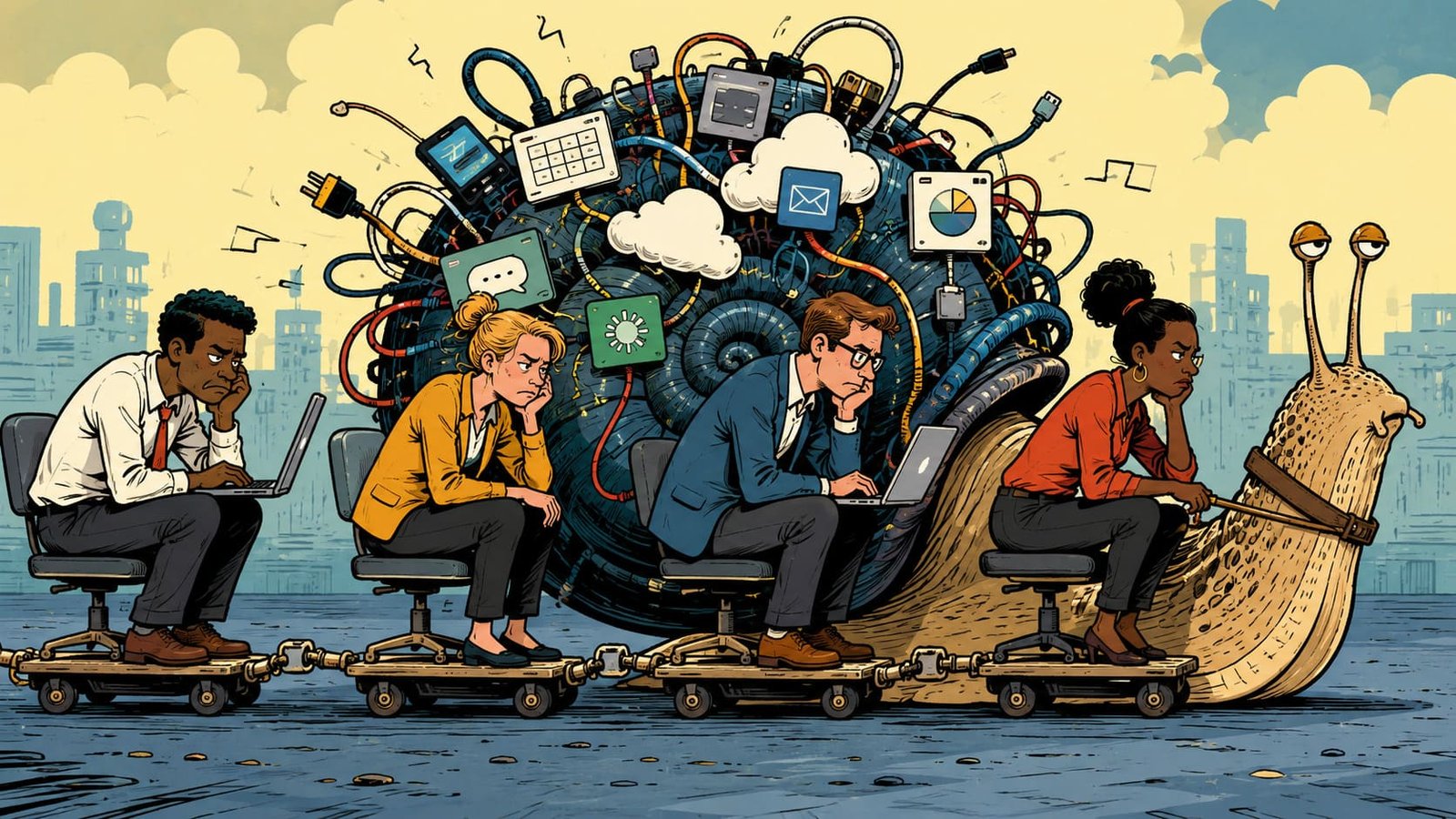
A new application appears on a company laptop with the cheerful promise of making everything easier. By lunchtime, employees have created accounts, attended a training session, connected the platform to two other systems, and learned which notifications they must now ignore. Nobody made a foolish decision. Every choice looked sensible in isolation. Yet a strange arithmetic has taken hold in modern work: add enough tools designed to save minutes, and an organization can end up spending hours managing the tools instead of doing the work they were supposed to improve.
Technology rarely announces its hidden costs. A new platform needs permissions, passwords, integrations, training, maintenance, data standards, administrators, and somebody willing to answer the inevitable question, “Where does this go now?” A dashboard may clarify performance while creating another screen to monitor. Collaboration software may improve communication while creating another inbox. Automation may eliminate a repetitive task while introducing exceptions that require human intervention. The problem is rarely the technology itself. The problem is allowing every tool to optimize a small piece of work while nobody owns the experience of the whole system.
Toyota offers a useful management lesson because its production philosophy places enormous attention on waste, including unnecessary movement, waiting, defects, and rework. Digital organizations can suffer from the same waste while believing themselves modern. A finance team once adopted a sophisticated expense platform, only to discover that executives still demanded the old spreadsheet each Friday. Employees dutifully maintained both. The new system had not replaced bureaucracy. It had given bureaucracy a second monitor. That is how digital transformation can become an expensive way of doing yesterday’s work with better fonts.
A different company discovered the problem through communication. Its new workplace platform created channels for projects, departments, interests, announcements, celebrations, questions, emergencies, and the office football predictions. Participation looked wonderful. Attention was being shredded. Marcus, a team leader, finally asked every channel to justify its existence by naming an owner, purpose, audience, and expected response. Many disappeared. Nobody complained for long. The organization had not lost communication. It had lost communication that had no reason to exist, which turned out to be one of its more productive losses.
This is why technology creates what might be called coordination debt. Every system adds another layer of decisions about where information belongs, who owns it, which version is authoritative, what happens when two systems disagree, and who fixes the connection when something breaks. A salesperson may update one customer record in three places. An analyst may export data from one platform to repair another. A manager may spend Friday morning reconciling dashboards instead of speaking with the team those dashboards were supposed to help. None of this appears in the product demonstration. Yet employees live inside those consequences every day.
Smart organizations therefore learn to subtract before they multiply. Before purchasing another platform, leaders should ask which process can disappear, which report nobody uses, which approval can be removed, which meeting has become ceremonial, and which existing tool is already good enough. Technology should make the organization more capable, not merely more technologically decorated. A company can possess an impressive digital ecosystem and still operate like a filing cabinet with Wi-Fi. The real measure of transformation is wonderfully plain: after all the new technology arrives, does work feel easier to understand, easier to finish, and easier to improve? If not, perhaps the most innovative system still waiting to be installed is called less.
