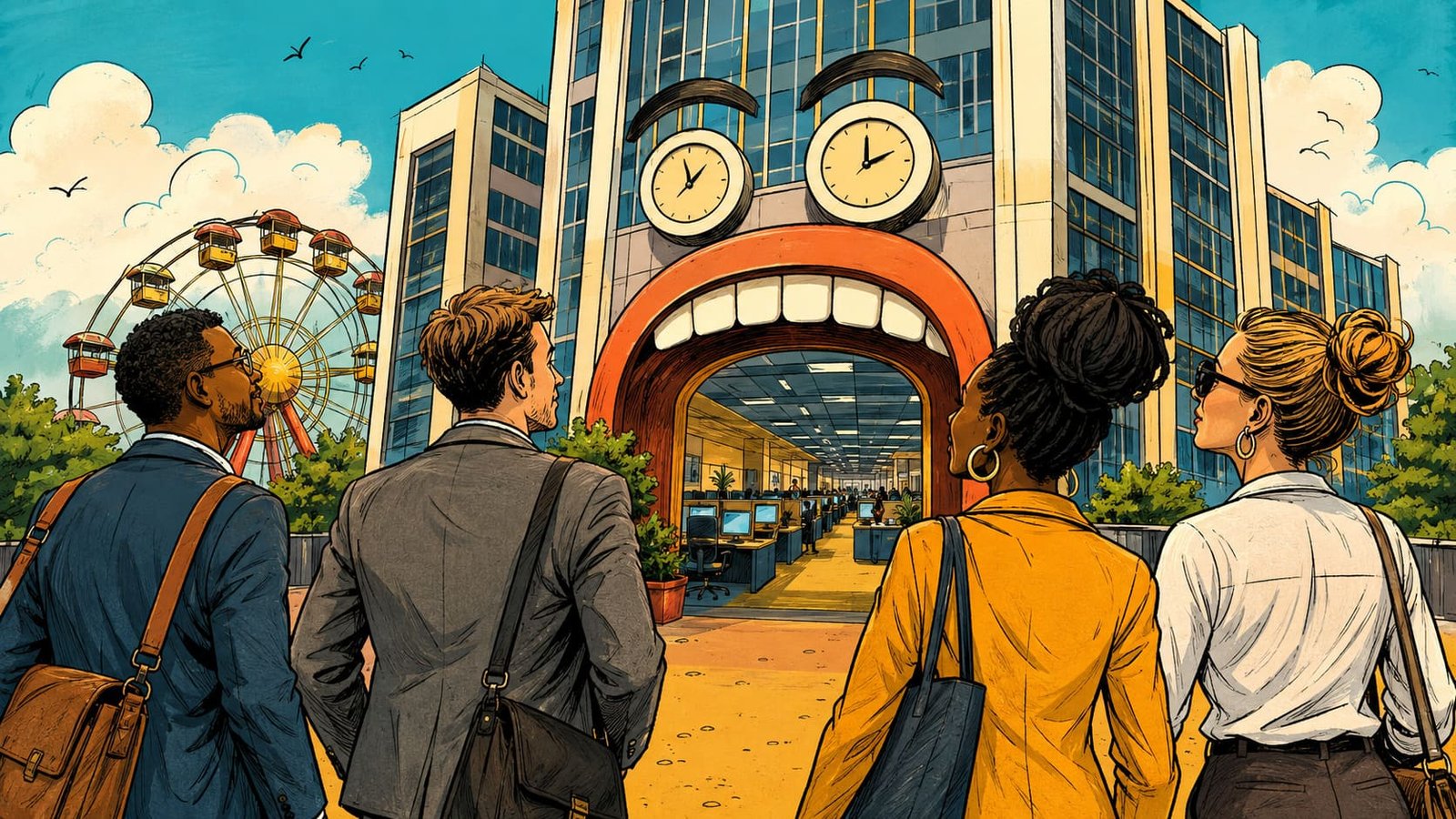
An office lobby waits like a theatre before the curtain rises. Coffee machines hiss, reception lights glow, elevators release small clusters of commuters, and a security gate records another arrival. Yet a laptop could have performed much of what brought those people there. That is the strange new bargain facing employers: when work can travel almost anywhere, a building must earn the journey. A desk is no longer enough. The office has to become a place where proximity produces something worth physically gathering for.
For decades, presence was treated as evidence of commitment. If employees occupied their desks, managers could see work happening, or at least see people being available for it. Hybrid work has exposed the weakness of that assumption. An employee can spend an entire day in an office answering video calls with people in other locations and accomplish little that required being there. Physical presence creates value when it changes the quality of interaction, learning, trust, creativity, or decision-making. Otherwise, commuting becomes a ritual performed mainly to reassure the organization that work is occurring.
Dropbox offers an instructive example through its virtual-first approach, which emphasizes remote work while treating physical gatherings as purposeful experiences rather than routine attendance. Atlassian has similarly experimented with workplace environments designed around collaboration and connection instead of simply replicating rows of desks. Consider a product team arriving for a difficult strategy session: a room is prepared for debate, walls are available for mapping ideas, colleagues who rarely meet in person finally share lunch, and a junior employee overhears a conversation that changes how she understands the customer. None of those moments is guaranteed by an office. Good design merely gives them somewhere to happen.
A manager named Rafael once walked through his company’s headquarters and noticed a peculiar scene. Nearly every desk was occupied, yet half the employees were wearing headphones while speaking to colleagues through video calls. The building was full and the culture felt absent. He stopped measuring office success through attendance and began asking a more revealing question: “What happened today because people were physically together?” At first, the answers were embarrassingly thin. Over time, teams redesigned office days around workshops, mentoring, customer sessions, difficult decisions, and social rituals. Attendance became a consequence of purpose rather than a substitute for it.
That shift changes what leaders should expect from workplace design. If employees are asked to travel, the organization is spending their time before they even open a laptop. The return therefore cannot simply be another version of remote work surrounded by expensive furniture. An office should make certain activities easier, richer, faster, or more human. A private conversation can benefit from physical presence. So can mentoring, creative disagreement, team formation, and the accidental encounter that produces an idea nobody scheduled. The office earns its cost when the building creates value that a screen struggles to reproduce.
A destination has a reason for being visited. A great restaurant offers food that feels worth travelling for; a stadium offers collective energy that television cannot fully recreate. Workplaces face a similar test, although nobody should have to pretend a conference room is Disneyland. The strongest offices will not compete with home by becoming prettier versions of home. They will become deliberately useful places where relationships deepen, decisions accelerate, knowledge moves sideways, and people occasionally encounter the unexpected. When work becomes portable, the office loses its old authority. That may be good news. It finally forces the building to prove why it deserves to exist.
