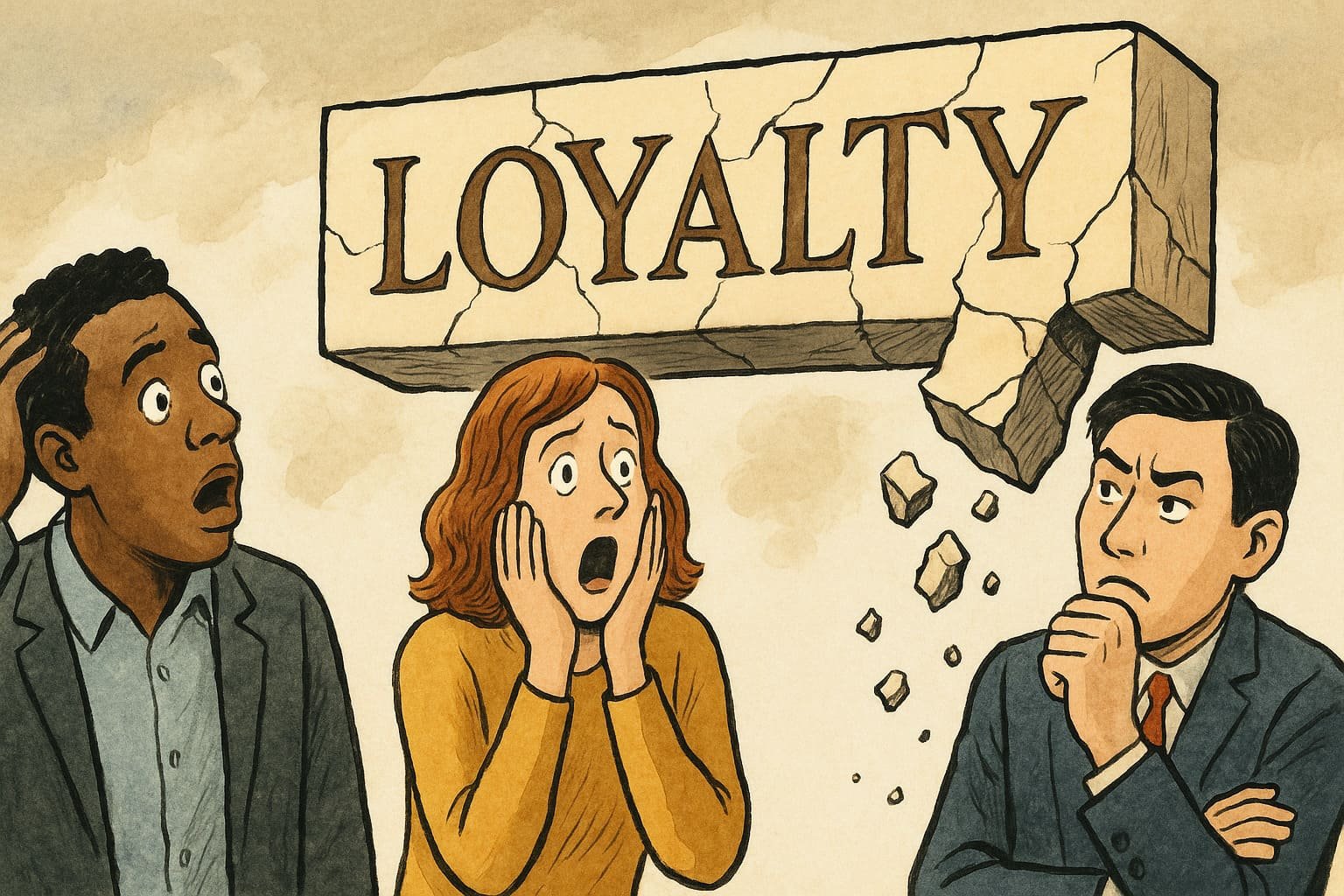
Loyalty used to be the holy grail of branding; a golden handshake between company and customer, sealed with trust and repetition. But that handshake is slipping, and fast. Customers are ghosting brands with the same cold indifference reserved for an expired Tinder match. And the terrifying part? It’s not because of price, product, or packaging. It’s because brands have become predictable, preachy, and painfully impersonal in a world that now demands agility, empathy, and personalization. If you’re not shaking in your brand boots yet, you should be.
Quick Notes
- Emotional loyalty is dead weight when transactional value rules: Even long-time customers jump ship for brands that meet their moment.
- Subscription fatigue is making loyalty programs obsolete: People are unsubscribing from anything that doesn’t deliver daily value.
- Consumers now reward brands that share values, not just value: Social alignment is the new competitive edge.
- Loyalty marketing is now about moments, not memberships: Contextual, personalized touchpoints win.
- Trust has overtaken loyalty as the new ROI: Transparency, not tradition, retains customers.
Death of a Devotion: Why Loyalty Is No Longer a Given
Once upon a time, your local grocery store knew your name, your favorite cut of steak, and the fact that you hated plastic bags. That kind of loyalty felt intimate, almost sacred. Fast forward to now, and customers will dump your brand for a better discount with the emotional detachment of deleting a spam email. Brands spent decades building pyramids of loyalty, only to discover the ground beneath them had turned to sand. Loyalty didn’t vanish; it evolved into a game of value-hopping, where the highest bidder wins.
Take Blockbuster. It had millions of loyal members, late fees and all. But the moment Netflix offered convenience, freedom, and instant access, loyalty meant nothing. Customers pivoted with zero remorse. And this wasn’t a betrayal; it was evolution. Brands that cling to the illusion of everlasting loyalty are stuck in a romanticized past that today’s consumers have outgrown. In a marketplace driven by speed and service, sentimentality doesn’t pay the bills.
Modern loyalty is transactional, conditional, and brutally honest. It’s about who shows up when needed, not who’s been there the longest. Customers don’t care about your brand history; they care about their current need. If you’re not solving that, you’re invisible. This creates a terrifying scenario where customer churn becomes the norm, not the exception. Even Apple, once the deity of devotion, is seeing its cult wane under Android’s ecosystem lure.
This isn’t disloyalty. It’s digital Darwinism. Brands must accept that loyalty is no longer inherited; it’s earned again and again through meaningful engagement. Every touchpoint is a test. One miss, and you’re out of the customer’s mental inbox. Relevance, not ritual, keeps them coming back.
Loyalty isn’t dead. It’s just gotten smarter and pickier. And it’s calling out brands that coasted for too long. The question isn’t whether your customer will stay. The question is, why should they?
Loyalty Programs Are the New Pyramid Schemes
The truth is ugly: most loyalty programs are dressed-up traps designed to keep customers spinning on a rewards wheel that never leads anywhere meaningful. Points? Expire. Tiers? Rigged. Perks? Barely perks. And customers are catching on. They’re not loyal to your brand; they’re stuck in a game they never asked to play.
Remember when frequent flyer miles were aspirational? Now, they’re just frustrating. Travelers hoard miles like digital Monopoly money, only to discover blackout dates and inflated redemption rates. That disillusionment doesn’t just damage loyalty; it burns bridges. If your loyalty program feels like a corporate maze with fine print booby traps, your customer will walk away and never look back.
Subscription fatigue is the next body blow. Consumers are drowning in monthly memberships, each one promising exclusivity and value. But the math doesn’t add up anymore. When the novelty fades and the benefits shrink, even your most loyal subscribers start questioning the cost. Spotify, Netflix, Peloton; all are witnessing waves of cancellations not because the product failed, but because perceived value vanished.
Starbucks may have pioneered the mobile rewards revolution, but even it is seeing cracks in the foundation. When rewards become harder to earn or less exciting to redeem, the emotional connection dissolves. The modern consumer expects instant gratification not a slow drip of digital breadcrumbs. The moment the reward feels manipulative instead of motivating, trust breaks.
To survive, loyalty programs must pivot from retention schemes to relationship enhancers. That means exclusivity, customization, and surprise. Think less airline miles, more Spotify Wrapped; personal, unexpected, and emotionally rewarding. It’s not about locking people in. It’s about making them want to stay.
Values Over Valuation: The Rise of Ideological Loyalty
The game changed when Patagonia said, “Earth is now our only shareholder.” Suddenly, customers weren’t just buying jackets. They were buying into a movement. Loyalty morphed into allegiance. And brands without a cause began to look colorless and cowardly. In a world on fire; literally and figuratively, alignment matters more than algorithms.
Millennials and Gen Z aren’t shopping brands. They’re recruiting belief systems. They want to know where you stand on climate change, social justice, and data ethics before they add you to cart. And no, a rainbow-themed logo every June won’t cut it. Surface activism is a loyalty killer. Performative branding is being roasted in public faster than a bad Tinder date.
Nike took a risk with Colin Kaepernick and reaped loyalty dividends by owning its stance. Gillette lost some customers but gained a new generation by challenging toxic masculinity. Meanwhile, brands that sat on the sidelines are watching their relevance evaporate. Inaction is now seen as complicity. Silence isn’t neutral; it’s damaging.
Customers want brands that fight for something. They want evidence of ethical sourcing, transparent practices, and real impact. When people align emotionally, they invest more deeply. That kind of loyalty isn’t bought with coupons. It’s built with conviction. Purpose, once a PR play, is now the core of brand equity.
This isn’t about going woke for clout. It’s about showing up for your community with integrity and clarity. Brands that play it safe are playing to lose. Loyalty in 2025 isn’t a coin toss; it’s a referendum on your soul.
Real-Time Relevance Is the New Loyalty Driver
Alexa knows your name, your habits, your sleep cycle. And that’s the new bar. If your brand doesn’t deliver hyper-personalized experiences, you’re not just behind; you’re forgettable. Customers want what they want, when they want it, served with a side of psychic precision. Relevance isn’t just a competitive edge. It’s survival.
Take Netflix’s algorithm. It tailors suggestions so well it feels like a friend. Meanwhile, cable TV still thinks one-size-fits-all scheduling works. It doesn’t. People reward brands that anticipate needs before they’re voiced. Amazon’s “buy it again” prompts outperform loyalty points because they save mental energy. Convenience is the new currency.
Brands like Sephora use data to predict what products you’ll need next, then slide them into your checkout journey like a best friend giving you a heads-up. That’s not marketing. That’s magic. And it creates sticky loyalty by making the customer feel seen. Feeling understood has replaced feeling rewarded.
Even crisis communication has gone real-time. Remember when Airbnb refunded travelers during the pandemic, no questions asked? That wasn’t policy. That was pulse-reading. Loyalty blooms when brands act faster than customer expectations. When they pivot from scripted to human.
This shift demands agile tech, predictive analytics, and emotional intelligence. It’s not about CRM systems. It’s about CRM empathy. True loyalty now lives in micro-moments; those blink-and-you’ll-miss-it chances to say, “We get you.” Miss those, and you’re just another forgotten tab.
Trust: The New ROI That Loyalty Can’t Match
In the post-truth economy, people don’t believe what you say. They believe what you prove. And that means loyalty has a new boss: trust. You can fake a logo. You can’t fake character. Every breach, from Facebook’s privacy scandals to luxury brands greenwashing their supply chains, chips away at the foundation.
Loyalty is passive. Trust is active. It takes years to build, seconds to destroy, and forever to repair. And right now, brands are hemorrhaging it. Just look at the backlash when influencers promote products they don’t use. That’s not just annoying. That’s betrayal. Today’s customers are forensic. They scroll receipts, cross-reference claims, and call BS with surgical accuracy.
Transparency isn’t optional anymore. It’s table stakes. Whether it’s disclosing how your products are made, where your data goes, or how your algorithms work, the modern consumer expects clarity. H&M got flamed for misleading sustainability claims. Meanwhile, Everlane’s transparent pricing made it a darling among skeptics. Authenticity attracts. Spin repels.
Trust breeds advocacy. When people believe in you, they become evangelists. That’s deeper than loyalty. It’s devotion without the punch card. It’s when someone recommends your product without being asked. It’s when your brand becomes part of their identity. That’s priceless.
To earn trust, brands must get vulnerable. Own mistakes. Show faces. Speak plainly. Because in a noisy world full of empty promises, the quiet power of honesty stands out. And in that honesty lies the only kind of loyalty worth chasing.
Loyalty Didn’t Die. It Just Evolved Beyond Recognition
Here’s the gut punch: loyalty isn’t gone. It’s just smarter, faster, and way less patient. It won’t wait for your next campaign or tolerate your marketing fluff. Today’s loyalty is lean, mean, and emotionally precise. It’s forged in alignment, fueled by trust, and delivered in real-time. Brands that refuse to adapt are not just losing loyalty; they’re becoming irrelevant.
The playbook has changed. No more betting on tradition, outdated programs, or passive customer behavior. Winning loyalty now requires bold transparency, emotional intelligence, and lightning-fast adaptation. Loyalty isn’t a department. It’s a living conversation happening across every customer touchpoint.
Ask yourself this: If your brand disappeared tomorrow, who would miss it? If the answer is unclear, your loyalty strategy isn’t a strategy at all. It’s a relic. So rip up the old rules, embrace the messy truth, and build something worth sticking around for.
Because in a world where loyalty crumbles, the only brands that survive are the ones brave enough to earn it every single day.
Why scroll… When you can rocket into Adventure?
Ready to ditch the boring side of Life? Blast off with ESYRITE, a Premier Management Journal & Professional Services Haus—where every click is an adventure and every experience is enchanting. The ESYRITE Journal fuels your curiosity to another dimension. Need life upgrades? ESYRITE Services are basically superpowers in disguise. Crave epic sagas? ESYRITE Stories are so wild, your grandkids will meme them. Want star power? ESYRITE Promoted turns your brand cosmic among the stars. Tired of surface-level noise? ESYRITE Insights delivers mind-bending ideas, and galactic-level clarity straight to your inbox. Cruise the galaxy with the ESYRITE Store —a treasure chest for interstellar dreamers. Join now and let curiosity guide your course.
