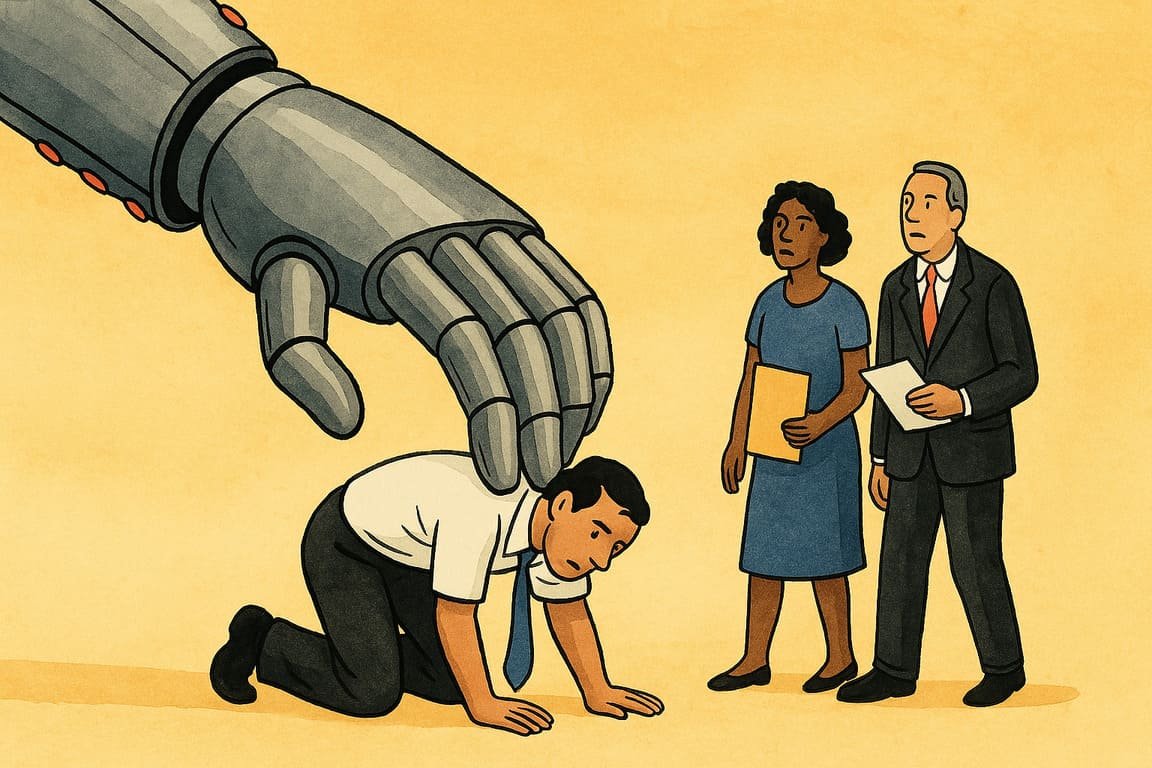
The city never sleeps. Somewhere behind a wall of mirrored glass, the air shivers with fluorescent anxiety while a lone employee sits hunched before a screen, the pulse of a billion algorithms humming beneath their fingertips. Out on the street, delivery drones swoop low, their shadows flickering over sidewalks still warm from yesterday’s heat. In one corner office, a CEO leans forward, caught between hope and terror, as a dashboard delivers a ruthless verdict on productivity. Every pixel on that screen has teeth now. Every graph is a loaded weapon, every automation another hand reaching for the steering wheel. Underneath it all, a new kind of storm is building: not the arrival of more machines, but the slow, shattering realization that the rules of human value have been rewritten overnight.
Across boardrooms and basement startups, executives are whispering about “talent transformation” while programmers clutch coffee cups and stare down the silent threat of their own code. The atmosphere thickens with the perfume of panic and ambition. Social feeds become a battleground, each viral headline more frantic than the last: “Is Your Job Safe from AI?” “Five Roles Robots Can’t Replace (Yet)!” A strange blend of fear and thrill moves through workplaces. This isn’t just about jobs lost or gained. It’s about the sudden, vertigo-inducing moment when humans realize they’ve been recast, without warning, in the grand production of work.
Now, the classic office hero—the rainmaker, the team whisperer, the creative spark—faces a new challenger: the machine that never needs sleep, sick days, or coffee breaks. Yesterday’s MVP watches as dashboards offer instant feedback, as software sprints ahead, as decision-making shifts from gut instinct to cold, luminous calculation. In every sector, old hierarchies fracture and new ones rise, jagged and untested. A middle manager at a logistics firm confides over lunch that her new AI co-pilot caught a mistake that would’ve cost millions. She laughs, but there’s a tremor in it—a hint of awe, a shade of dread.
Familiar rituals unravel. The Monday meeting, the annual review, the celebratory team lunch—each feels like a relic from another era. Ambition mutates. Instead of climbing ladders, people are building escape hatches, launching side hustles, or learning to speak “machine” before their résumés go extinct. Whole professions feel suddenly mythic: a newspaper editor replaced by a trend-spotting algorithm; a legal researcher eclipsed by software that reads thousands of cases in seconds. What once made humans special is up for grabs. The old question—“What do you do?”—now rings with electric uncertainty. It’s the dawn of a new drama, and the world’s watching, breathless.
Beneath the chaos, a quiet war is waged: human meaning versus mechanical efficiency. In the break rooms, on Slack channels, inside the anxious scroll of LinkedIn, people wonder if work can still offer purpose when machines own the scoreboard. The first shot has been fired. No one knows who will be left standing, or what it will even mean to win.
Quick Notes
- Machines Now Set the Pace: Technology’s grip tightens every day, squeezing out old routines and making every workplace feel like a competition against the clock and the code. No role is immune, and the pressure is real.
- Adaptation Becomes Survival: Learning to collaborate with machines, not just compete against them, separates those who thrive from those who fade. Rapid adaptation isn’t just an edge—it’s the new cost of entry.
- Human Value Gets Redefined: Soft skills, creativity, and emotional intelligence emerge as rare currencies. As AI handles the grind, it’s uniquely human judgment and imagination that shine brightest—if you dare to use them.
- Workplace Power Shifts: Authority isn’t about tenure or title anymore. Those who harness digital tools with emotional intelligence, who lead transformation rather than resist it, shape tomorrow’s landscape.
- Meaning is Up for Grabs: The new world of work can be thrilling or hollow. How people redefine success, purpose, and connection in the age of automation will determine who finds fulfillment—and who gets left behind.
Code Red: When Machines Take the Lead and Humans Recalculate
The boardroom once echoed with the steady rhythm of old-school ambition. Promotion was a climb, success a finish line, and every setback could be spun into a story about grit. But today’s reality crackles with a different tension: machines quietly pull ahead, redrawing the boundaries of what counts as “work.” Screens flicker with analytics, chatbots replace assistants, and even the sales pitch is powered by algorithms that can read a client’s mood before a single word is spoken.
In this pressure cooker, adaptation isn’t optional. The employees who thrive are the ones who treat technology not as an enemy, but as an unpredictable partner. At a global consumer goods giant, a veteran sales manager named Claudia tells her team, “Let the AI do the grunt work. We’re here for the bold moves, the impossible deals, the human touch.” Her group’s results soar, not because they resist automation, but because they learn to wield it as a tool—one that multiplies their reach and sharpens their instincts. It’s not just survival. It’s a reinvention of what makes someone valuable.
Yet, for every success story, there’s a counter-narrative. At a once-booming publishing house, copyeditors scroll through job boards while a new platform churns out “optimized” content by the hour. The break room becomes a confessional, as one editor whispers, “I’m still here, but now I’m just a human proofreader for a machine.” The result isn’t always mass layoffs. Sometimes it’s quieter, more existential: a subtle hollowing out of pride, purpose, and camaraderie.
Pop culture jumps into the fray, stoking anxiety and fascination. Movies like “Her” and “Ex Machina” offer blueprints for love, work, and ambition in worlds ruled by code. On social media, memes mock the rise of the robot boss, while viral TikToks teach you how to “future-proof” your career with nothing but grit and a LinkedIn Premium account. Every joke is a pressure valve; every fear, a warning shot.
Through it all, one truth is impossible to ignore: nobody gets to sit out this revolution. Startups, Fortune 500s, and small family businesses alike must rethink the DNA of their organizations. Teams with the courage to reinvent, retrain, and reimagine their work win the day. The rest get swallowed by progress, their legacies digitized and forgotten. The rules have changed, and every player has skin in the game.
Success now belongs to the curious, the restless, the endlessly adaptable. The new stars aren’t those who “beat” machines, but those who know how to ask better questions, build unexpected partnerships, and see past the cold logic of data. It’s no longer about doing more with less. It’s about doing the human things machines still can’t imagine.
The Great Unlearning: Human Skills in the Age of Infinite Feedback
As the rhythm of work grows faster, the value of what’s uniquely human becomes clearer. In a world where digital platforms judge every decision, where automation tracks your every move, and where artificial intelligence threatens to rewrite job descriptions overnight, it’s not technical skills that save careers—it’s emotional intelligence, creative grit, and real-world judgment.
Inside a software startup in Nairobi, the founder, Eliud, gathers his small team for a morning check-in. The codebase hums in the background, quietly flagging bugs and suggesting fixes. Eliud’s focus isn’t on code at all, but on a tense conversation between two designers who disagree about a product launch. “The tech will get us halfway,” he tells them, “but it’s your honesty, your guts, and your willingness to challenge each other that will get us to the finish line.” The group listens, tension dissolves, and the work moves forward with renewed energy.
Across industries, stories like this echo louder each day. At a famous design studio, clients keep coming back not for flawless renderings, but for creative insights that feel risky, bold, and deeply human. Teams who embrace debate, vulnerability, and a willingness to rethink everything from scratch are the ones who set trends, not follow them. Even as software handles the grind, it’s the unpredictable spark of human intuition that lights up boardrooms.
But the shift isn’t painless. Many seasoned professionals—once envied for technical mastery—find themselves outmaneuvered by younger colleagues who build trust faster, communicate with empathy, and aren’t afraid to challenge “best practices.” The badge of expertise is being rewritten in real time, and the race now rewards those who blend old wisdom with the humility to unlearn, relearn, and ask for help.
Old power dynamics falter. New hierarchies emerge based on emotional capital, storytelling skills, and the courage to challenge both machine and tradition. This rebalancing creates a strange, thrilling new order where the next workplace legend could be a quiet mentor, a fearless contrarian, or an offbeat creative who sees connections nobody else can.
The future isn’t about competing with machines, but about cultivating the kind of depth, adaptability, and empathy that no algorithm can replicate. In this new world, “human resources” means more than a department—it’s the source code of every great company’s soul.
Real-World Disruption: When Workplaces Become Wild Experiments
The transformation isn’t just theoretical. Every day, across the globe, workplaces are running wild experiments—some by choice, some by necessity. The most exciting (and terrifying) part? There are no guarantees.
In Tokyo, a retail giant rolls out AI-powered inventory systems. The tech quickly optimizes stocking, reduces waste, and boosts margins, but store managers notice something else: customer complaints rise. Shoppers miss the friendly faces who once recommended new products or offered a kind word. One manager, Hiroko, creates a “human moment” program—inviting staff to spend extra time chatting with regulars. Within months, sales jump. It’s not the machines but the stories, the laughter, and the surprise personal touches that turn casual buyers into loyal fans.
Meanwhile, at a Silicon Valley fintech startup, the head of HR, Carla, faces a dilemma. Her company’s chatbot can handle payroll, onboarding, and even coaching on time management. Employees whisper that the “bot” is more helpful than Carla herself. Carla pivots, focusing on personal growth sessions and team-building retreats that foster real human bonds. Her move pays off: engagement and innovation soar, and the company’s culture shifts from transactional to transformational.
Yet, for every workplace that finds a winning formula, another stumbles. At a big consulting firm, the latest algorithm-driven performance tracker demoralizes staff. Employees feel watched, not trusted. Productivity drops, and the most creative thinkers leave for more flexible startups. The firm learns a painful lesson: technology is a tool, not a panacea. Trust, belonging, and meaning cannot be downloaded or automated.
These stories reveal a simple truth. The greatest disruption isn’t about machines replacing people, but about what happens when humans forget their own power to invent, connect, and create meaning. The best companies are those brave enough to experiment—not just with new tech, but with radical new approaches to leadership, collaboration, and purpose.
The wildest experiments are happening on the front lines, where theory meets the chaos of daily life. Those who embrace the chaos, learn from failure, and put human connection first are the real winners in this strange new world.
Tomorrow’s Heroes: Building Power and Meaning Beyond the Machine
Every transformation creates its own mythology—heroes, villains, and unexpected plot twists. In today’s world of work, the true heroes aren’t those with perfect résumés or digital badges. They’re the risk-takers, the builders, the ones who refuse to let their value be defined by a spreadsheet.
Across the Atlantic, a boutique marketing agency faces extinction after a machine-learning competitor undercuts them on price and speed. The founder, Lila, gathers her skeleton crew in a dimly lit café. Instead of surrendering, they launch a campaign powered by real stories—handwritten thank-you notes, quirky customer interviews, and live community events. The result? Clients fall in love with the agency’s wild, imperfect, and utterly human touch. Their work is slower, but it resonates more deeply, forging bonds no algorithm can break.
Elsewhere, a gig worker named Isaac bounces between freelance jobs mediated by cold apps and faceless rating systems. Frustrated, he starts a side project teaching digital skills to local teens. His workshops fill with laughter, ideas, and friendship. Isaac discovers that while platforms can dictate wages and rules, they can’t control how people show up for each other. The real revolution happens not in code, but in the messy, unpredictable spaces between people.
Leadership changes shape, too. The next generation of leaders aren’t just tech-savvy—they’re emotionally fluent, fiercely curious, and unafraid to rewrite the script. They inspire loyalty not through hierarchy, but by inviting others to join them in the wild act of making meaning out of chaos.
If there’s a secret to thriving in this machine-powered world, it’s this: Never let the algorithm define your worth. Build networks, start conversations, and refuse to be automated out of your own story. The future belongs to those who dare to show up as fully human, even in the face of relentless efficiency.
Where Machines Falter, Meaning Begins
The rain beats against the windows of a quiet co-working space, echoing through a sea of abandoned desks and glowing monitors. A single lamp casts long shadows across the face of a founder staring into the digital abyss, searching for something that no code can conjure. The scent of stale coffee hangs in the air, blending with the electric whir of servers still grinding away in the background. All around, the silence is loud with questions left unasked, ambitions left unfinished, and the raw ache of possibility. In the soft glow, the founder’s eyes reflect both fear and wonder—a vision of a future that can’t be optimized away.
A janitor moves quietly through the room, humming a forgotten tune as he tidies up the mess left by another all-night strategy session. He pauses, noticing a sticky note on the whiteboard: “Remember the why.” It’s a simple message, overlooked in the rush to automate, digitize, and optimize everything to perfection. Yet, in this single, stubborn moment of humanity, something unbreakable glimmers—the reminder that meaning can’t be manufactured, only lived.
Through the glass, the city’s lights pulse in rhythm with countless ambitions, some chasing relevance, others seeking a place to belong. The world spins forward, hungry for progress, but somewhere in the swirl of zeros and ones, the next chapter is being written by those who refuse to surrender the wild, complicated magic of being human.
A question lingers in the air, sharp and unsparing, refusing to be dismissed: Will you surrender your story to the machine, or will you dare to write the next line yourself?
