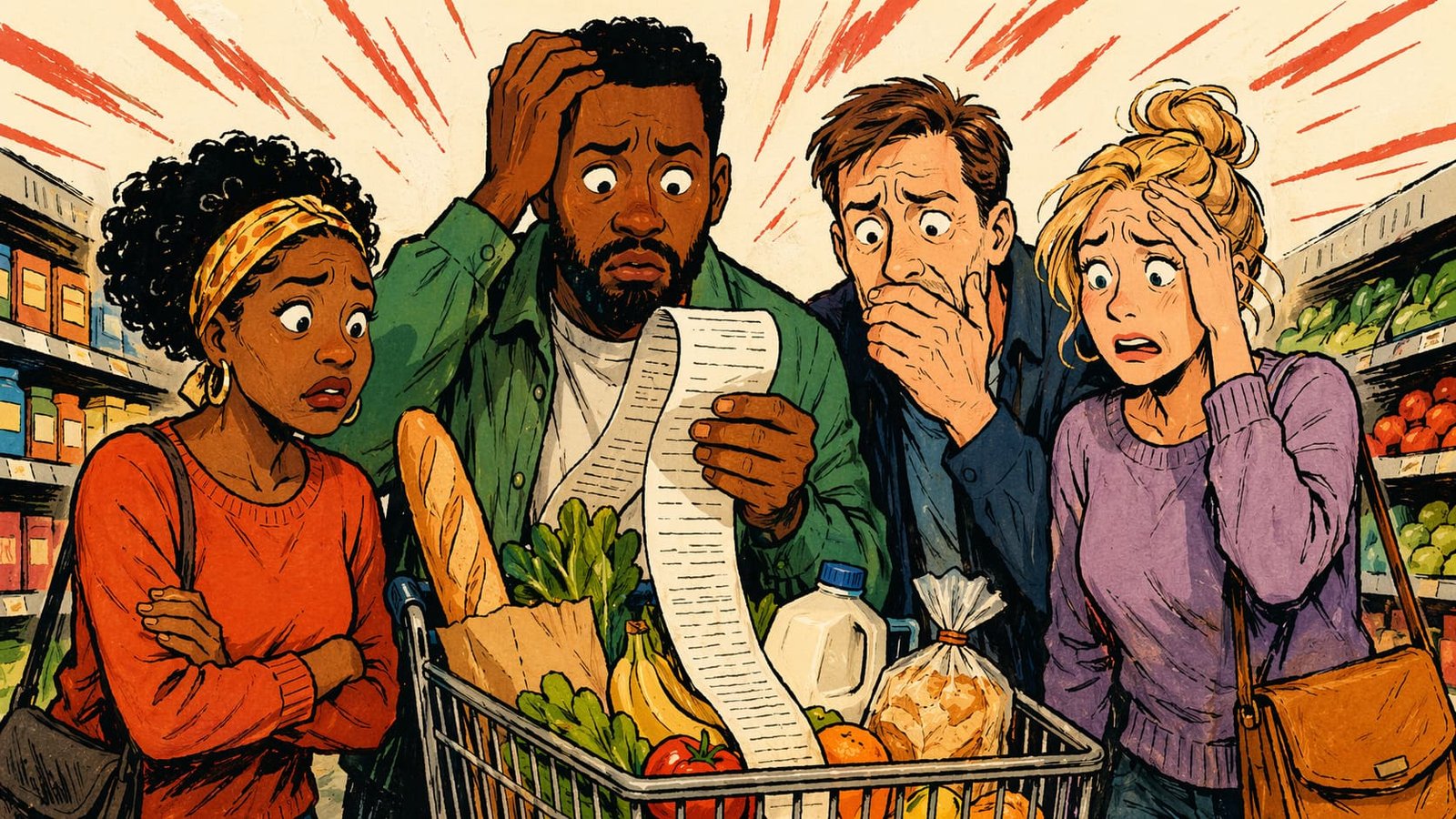
Fluorescent lights hum above narrow aisles where numbers have quietly betrayed their promises. A hand reaches for a familiar product, pauses, then retreats as if the price itself pushed back. Nothing dramatic unfolds. No alarms. No visible rupture. Yet something essential has shifted. The act of buying food, once routine, now carries a faint tension, a calculation that was never meant to dominate something so basic.
The grocery store has become a stage where modern anxiety performs without rehearsal. Prices rise not as a sudden shock but as a steady creep that erodes certainty. What used to feel stable now feels negotiable. A basket that once represented comfort now signals compromise. People adjust without announcing it, swapping brands, shrinking portions, delaying purchases. The change is subtle, but it accumulates, reshaping habits in ways that extend far beyond the checkout line.
There is a psychological shift that accompanies rising grocery costs. Food is not just sustenance. It is routine, identity, even a form of control in an unpredictable world. When that control weakens, something deeper unsettles. Households begin to think differently, not only about what they can afford, but about how they live. Meals become decisions rather than rituals. Planning replaces spontaneity. The kitchen, once a space of creativity, starts to feel like a site of negotiation.
Consider Miriam, a school administrator who once approached grocery shopping with a sense of ease. Her routine was simple, guided by preference rather than price. Over time, that ease dissolved. She began comparing labels, calculating value, questioning small indulgences that once felt insignificant. One evening, she stood in front of a shelf longer than usual, holding a product she had bought for years. She placed it back, not out of necessity, but out of principle. That moment marked a shift. The decision was no longer about the item. It was about what it represented.
The broader economic forces behind rising grocery bills are complex, tied to supply chains, energy costs, and global disruptions. Yet for most households, the experience is immediate and personal. It shows up in smaller carts, in altered menus, in quiet conversations about budgeting. The abstraction of economics becomes tangible in the most ordinary places. The impact is felt daily, not as theory, but as lived reality.
A small business owner named David once shared how his family adapted over time. He began treating grocery shopping with the same discipline he applied to his business. Lists became precise. Waste became unacceptable. Bulk buying replaced convenience. At first, it felt restrictive. Over time, it introduced a different kind of awareness. He understood his consumption in a way he never had before. Yet he admitted something that lingered beneath that awareness. Efficiency came at the cost of ease.
The cultural narrative around food is also shifting. There was a time when abundance was celebrated openly, when variety signaled prosperity. Now, restraint is quietly becoming a new form of sophistication. Cooking at home gains renewed importance. Simplicity is reframed as intentional rather than limiting. Yet this shift is not purely aesthetic. It is driven by necessity as much as choice, blurring the line between lifestyle and constraint.
A chef named Massimo Bottura once built a project around food waste, transforming overlooked ingredients into meals that carried both meaning and dignity. His work highlights a deeper truth. Value is not always tied to cost. Creativity can emerge from limitation. Yet the broader question remains. When limitation becomes widespread, does creativity sustain, or does fatigue set in?
The tension between rising costs and daily living creates a quiet form of pressure. It does not announce itself loudly, but it shapes decisions continuously. Households become more strategic, more cautious, more aware. This awareness can be empowering, but it can also feel heavy. Every choice carries weight. Every purchase invites scrutiny. The simplicity of routine gives way to constant evaluation.
In a modest apartment kitchen, a family gathers around a meal that looks different from what it once was. Portions are adjusted. Ingredients are substituted. The conversation flows, but beneath it sits an unspoken understanding. This is not just about food. It is about adaptation. About navigating a landscape that no longer feels as stable as it once did.
The grocery bill, once a background detail, has moved to the foreground of daily life. It reflects more than prices. It reflects priorities, constraints, and the evolving relationship between people and their resources. It forces a reconsideration of what is essential and what can be let go.
As the receipt prints and the total settles into memory, the moment passes quietly, almost unnoticed. Yet it leaves behind a subtle imprint, a recalibration that will influence the next decision, and the one after that.
Somewhere between the shelves and the kitchen table, a question begins to take shape, not as panic, but as reflection: when survival starts to feel strategic, what happens to the simple act of living?
