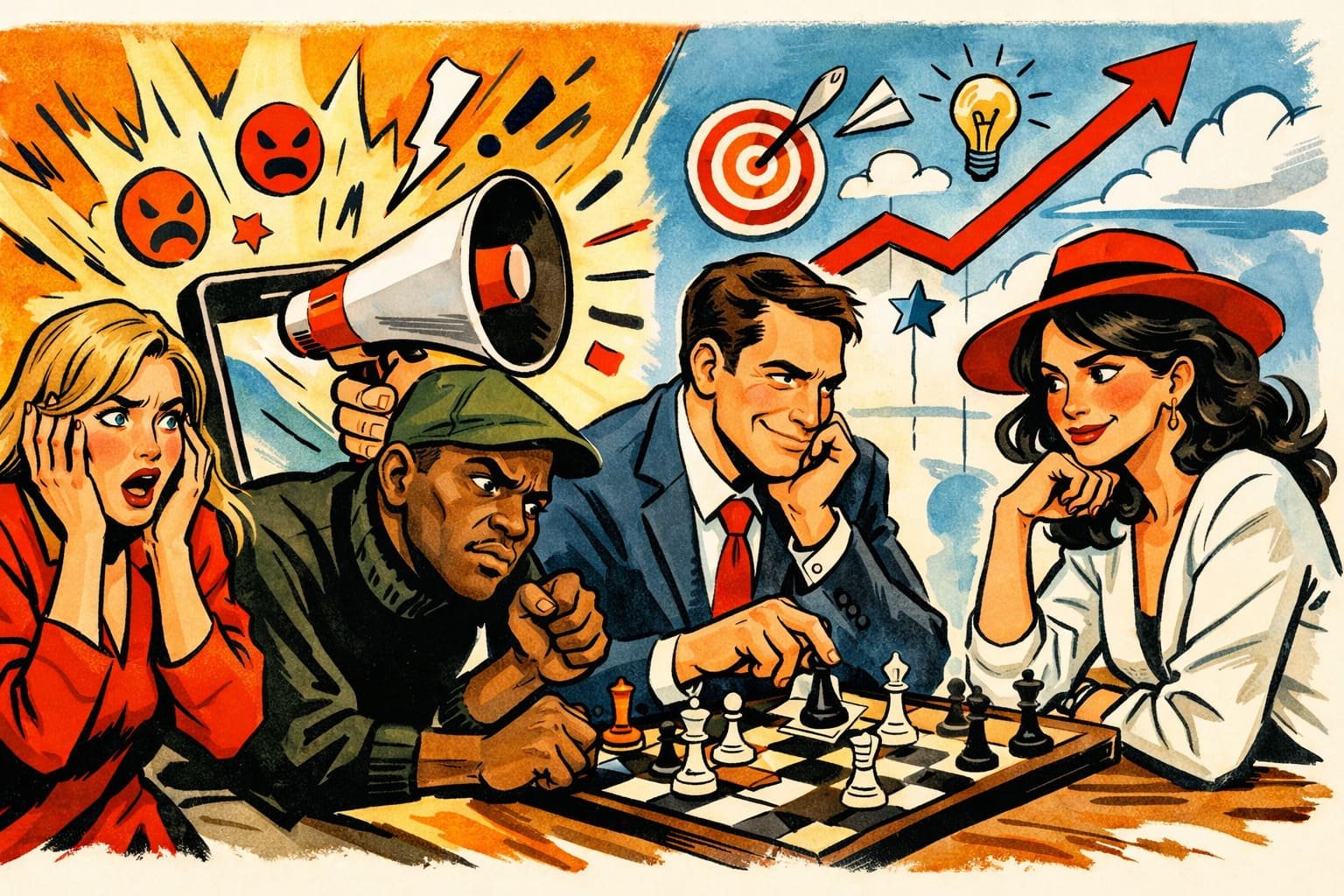
Every crowded feed resembles a busy railway station where thousands of voices arrive carrying polished promises, polished graphics, and polished certainty. Almost nobody stops. Then an awkward sentence appears, challenging a familiar belief instead of chasing applause, and conversations suddenly gather around a message that refuses to sound like marketing. That moment exposes an uncomfortable reality. Content rarely earns attention because it exists. It earns attention because a deliberate strategy understands which emotional nerve deserves gentle pressure before another polished headline disappears forever.
Many organizations still confuse consistency with effectiveness. Publishing every day feels productive, yet repetition without purpose slowly trains audiences to ignore familiar rhythms. Strategy changes that equation because every article, video, email, or podcast performs a specific job inside a larger system. Harvard professor Michael Porter famously argued that strategy means choosing what not to do. Content follows the same discipline. Every unnecessary topic steals attention from the story that truly deserves to become memorable.
Adobe quietly illustrates this principle through education instead of endless promotion. Tutorials, creator stories, and practical inspiration often build stronger loyalty than direct product pitches because they solve problems before requesting purchases. Patagonia follows another path, speaking about environmental responsibility even when doing so complicates commercial conversations. A small architecture firm experienced its own breakthrough after replacing glossy project galleries with thoughtful essays explaining why neglected public spaces influence mental health. Prospective clients arrived already trusting the firm’s judgment rather than merely admiring attractive buildings.
A curious observation appears inside museums. Visitors sometimes spend longer examining a handwritten note beside an exhibit than admiring the masterpiece itself. Context changes value. During a strategy workshop, consultant Marisol Vega asked her marketing team to remove every slogan from a campaign draft and replace each headline with one difficult customer question. Uneasy silence filled the room before genuine excitement followed. Suddenly every creative decision revolved around curiosity instead of corporate language, producing content that readers willingly shared because it answered conversations already unfolding inside their minds.
Behavioral psychology explains why this approach works. People naturally notice information confirming identity, reducing uncertainty, or helping navigate change. Effective content strategy recognizes those motivations before discussing products or services. HubSpot grew partly because educational resources consistently lowered confusion around digital marketing instead of aggressively pushing software. Marketing scholar Byron Sharp reminds organizations that mental availability matters alongside physical availability. Valuable ideas repeated in meaningful contexts become easier to remember, making future buying decisions feel surprisingly natural rather than heavily persuaded.
Far across another scrolling screen, another article waits without demanding applause, trusting careful strategy more than louder promotion. Readers rarely remember every statistic or clever phrase. They remember how a piece changed the way ordinary moments suddenly looked, as though familiar streets had quietly rearranged themselves overnight. That quiet transformation becomes lasting attention because strategy reaches human memory through meaning rather than noise. Ask one difficult question before publishing anything, then watch which conversations begin finding their own remarkable momentum.
