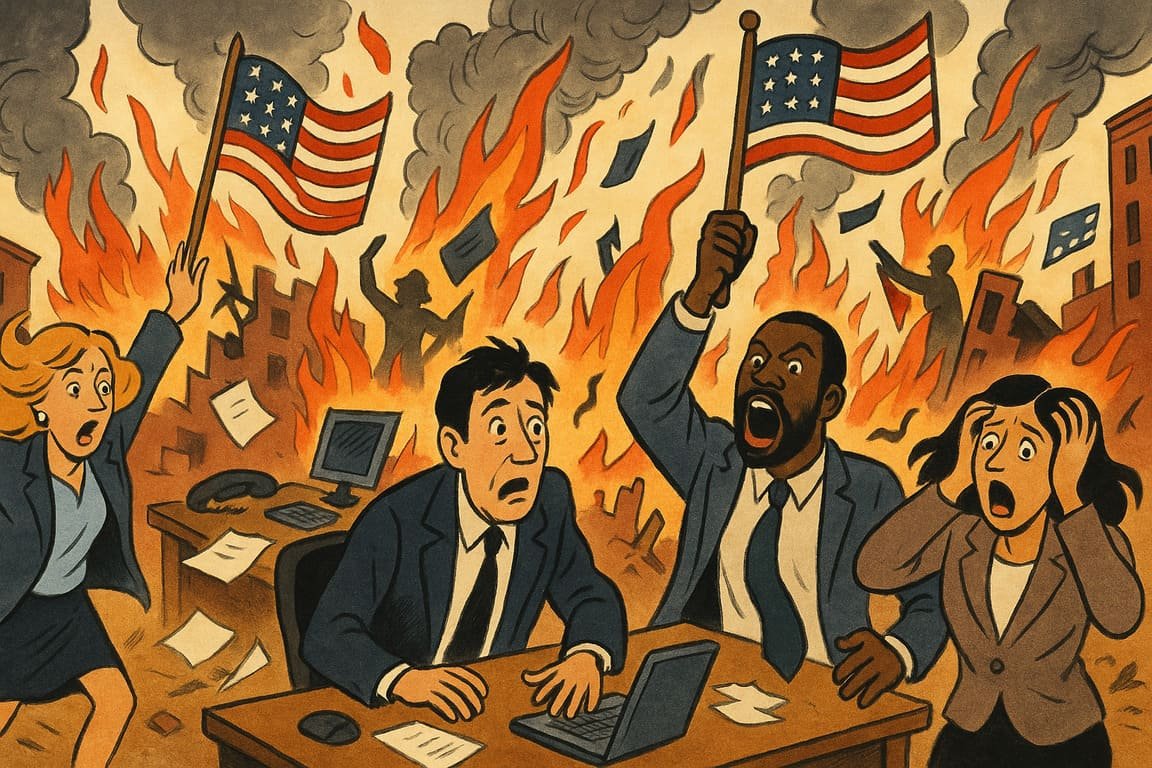
Order is a luxury that businesses often assume will last forever. Then the rules change overnight. A parliament collapses, protests flood city streets, currencies stumble, and carefully polished business plans suddenly feel as useful as umbrellas in a hurricane. Markets dislike uncertainty, yet history keeps proving that political instability is not merely a government problem. It becomes a boardroom problem. Every executive, entrepreneur, and investor eventually discovers that politics can rewrite the future of an industry long before customers notice the shift.
Political anarchy rarely begins with dramatic headlines. It often starts with small cracks that organizations ignore because quarterly profits still look healthy. New regulations create confusion. Trade relationships weaken. Public trust erodes. Leadership changes direction every election cycle. Businesses that depend on yesterday’s assumptions slowly lose their footing while more adaptive competitors quietly redesign supply chains, rethink investments, and prepare for a world where certainty has become the rarest commodity. Stability, once taken for granted, suddenly becomes a competitive advantage.
History offers powerful reminders. During the uncertainty surrounding the United Kingdom’s decision to leave the European Union, countless businesses faced difficult questions about regulations, talent, logistics, and investment. Some organizations delayed action and paid the price through costly disruptions. Others treated uncertainty as a strategic planning exercise rather than a political debate. They diversified suppliers, established new regional operations, and strengthened risk management. The companies that prepared for multiple futures often emerged stronger because they accepted that flexibility mattered more than perfect predictions.
The same lesson echoes across emerging markets where political transitions reshape commercial landscapes. Businesses operating in regions affected by policy shifts frequently discover that resilience depends less on optimism and more on preparation. Consider a manufacturing company that relied heavily on imported materials. When sudden trade restrictions interrupted shipments, production nearly stopped. Instead of waiting for governments to restore normal conditions, management developed local supplier networks and redesigned products using available resources. What began as survival eventually became a lasting competitive strength that competitors struggled to copy.
Political uncertainty also tests leadership character. Employees watch carefully when uncertainty rises. Customers pay attention as well. Panic spreads faster than confidence. Leaders who communicate honestly while acknowledging difficult realities often strengthen organizational trust. Those who hide behind polished presentations or empty promises usually deepen anxiety. Crisis leadership is not about pretending everything is under control. It is about helping people move forward despite uncertainty. Calm decisions become contagious, just as fear can spread through an organization with astonishing speed.
Risk management deserves a permanent seat in every boardroom because political disruption rarely arrives with advance notice. Strong businesses build scenarios instead of predictions. They maintain financial flexibility, diversify markets, develop local partnerships, and monitor geopolitical trends as carefully as financial statements. Companies that survive prolonged instability rarely possess supernatural forecasting abilities. They simply accept uncertainty as part of modern business rather than treating it as an unlikely exception. Preparation transforms unpredictable events into manageable challenges.
There is another uncomfortable truth. Political chaos often creates extraordinary opportunities alongside genuine danger. While weaker competitors freeze, disciplined organizations continue investing, hiring talented people, and acquiring valuable assets at favorable prices. History shows that several successful companies expanded during periods when fear dominated public conversation. They understood that markets reward thoughtful courage, not reckless optimism. Strategic patience becomes remarkably valuable when everyone else is distracted by panic and speculation.
The business world has never existed outside politics, no matter how much executives wish it could. Every regulation, election, diplomatic conflict, or institutional reform quietly shapes the environment where companies compete and grow. Organizations that recognize this reality stop reacting emotionally and start preparing strategically. They understand that resilience is built long before disruption arrives. The next political storm will eventually appear. The lasting question is simple: will it expose fragile assumptions, or reveal a business that was prepared long before the clouds gathered?
