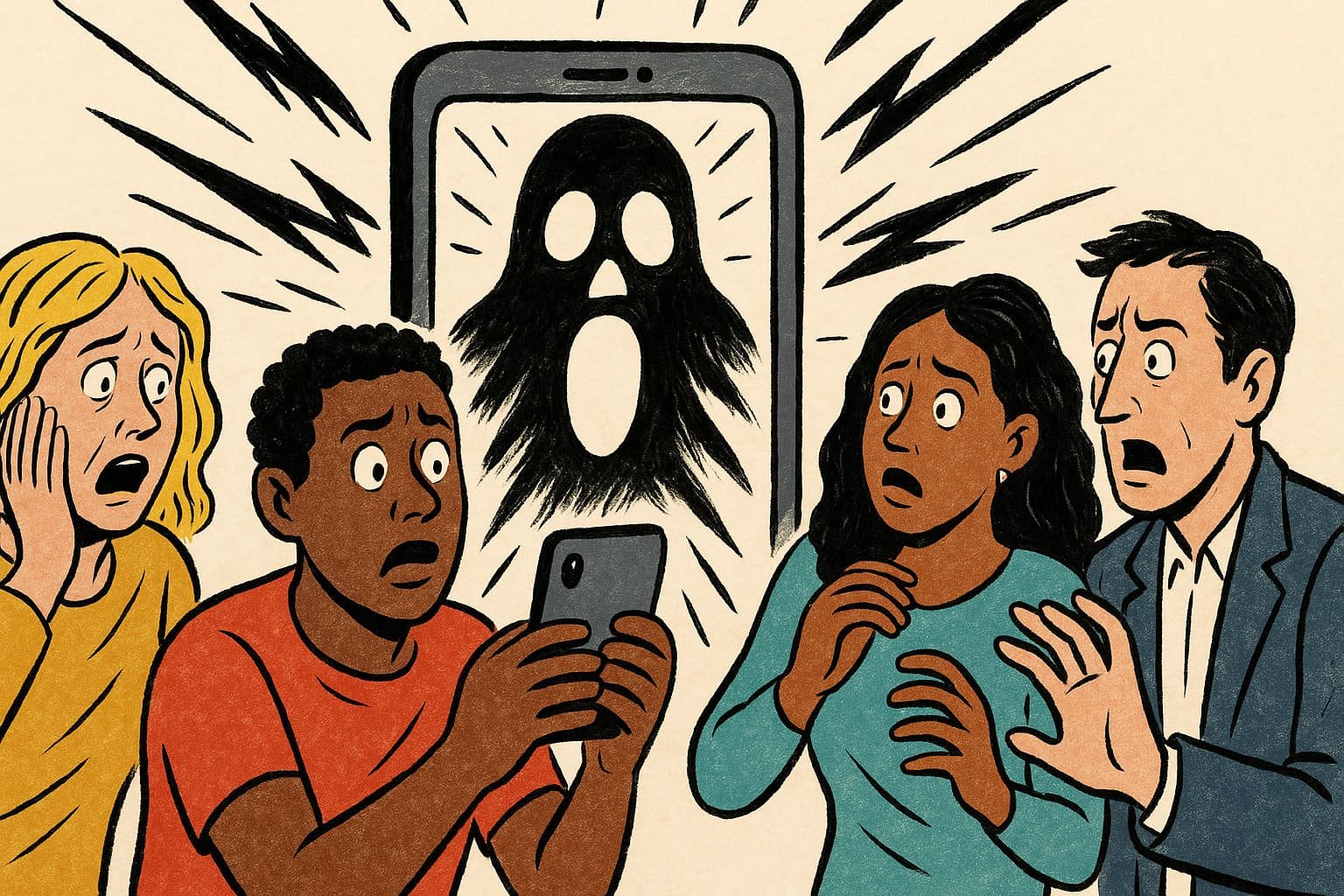
A chill hung over the glass lobby as sunlight scattered across polished floors, dancing in quick, sharp bursts, just out of reach. People shuffled through with nervous glances, clutching sleek rectangles that pulsed and glowed in their hands. Security cameras blinked above, silent witnesses to a thousand micro-decisions, each one shaped not by comfort, but by a quiet sense of threat. In this space, every gesture felt calculated: eyes darting to notifications, thumbs hovering over buttons as if defusing bombs. A digital stage set for anxiety, where the actors never remove their masks and the audience is trapped in a feedback loop of their own making.
Below the hum of conversation and the gentle clatter of designer shoes, another reality simmered: the battle for attention. Every interface, every notification, every haptic nudge whispered a warning; don’t miss out, don’t let go, don’t fall behind. The fear wasn’t just in the air; it seeped through pixels and code, quietly guiding decisions. People believed they were choosing, but each swipe and tap was the product of deliberate, sometimes ruthless, manipulation by unseen designers.
Somewhere on the 27th floor, an interface designer named Tara sat with her team, mapping out a new sign-up process for an app promising to revolutionize wellness. The design brief sounded harmless: increase engagement, reduce drop-off, keep users returning. But the language in the room was surgical. “Let’s trigger a sense of urgency at step three,” Tara suggested, recalling the last campaign where a red badge doubled click-through rates. Nobody questioned why users needed a sense of panic to complete a form. The numbers were all that mattered, and fear was the lever.
Long ago, branding meant painting optimism across billboards and broadcast screens. Now, the true currency of design is fear: fear of missing out, of being judged, of choosing wrong, of being forgotten. It has become the quiet artist behind every sleek interface, smoothing rough edges while sharpening hidden hooks. Through colors, copy, and cleverly placed micro-interactions, the architecture of anxiety pulls users deeper, blending security with suspense in a dance as old as commerce.
Yet for all the power this gives creators, the cost is invisible and immense. The world’s most beloved apps seduce with convenience but bind with uncertainty. They don’t shout at you; they whisper your secret worries back, reflected in every option and every alert. It’s not a conspiracy, but a series of small choices each one justified by a metric, each one sharpening the edges of our collective experience. Fear, it turns out, is the most profitable UX designer of all.
Quick Notes
- Fear Sells More Than Features: Every tap, scroll, and click is often powered by subtle dread; losing access, falling behind, missing out. App designers know you act faster when you’re scared you’ll lose something, not just when you want to gain.
- Designs Play on Insecurity: Those gentle nudges, the red badges, and the pop-up warnings are rarely accidental. Designers build uncertainty into every step because it keeps you coming back for reassurance.
- Your Brain’s Panic Button: Interfaces rely on your fight-or-flight response, not just logic. A forgotten password, a ticking countdown, or a surprise “Are you sure?” prompt each one is crafted to keep you on edge and engaged.
- Real People, Real Traps: Even big brands like Netflix or TikTok use fear to keep viewers glued; think of the “Next Episode” countdown or the endless scroll. Small businesses and startups do the same, often without realizing how manipulative it can become.
- You Can Break the Loop: Recognizing these fear-driven patterns can help you take control. Awareness is your superpower; the more you see the tricks, the easier it gets to make choices for yourself; not just for the metrics.
Panic by Design: When Anxiety Becomes the Architect
You live in a world meticulously shaped by invisible hands. Every interface you touch; banking apps, news sites, dating platforms leans on unease to spark action. This isn’t an accident; it’s a strategy polished over decades, honed by teams who know that urgency drives engagement better than delight. The red notification bubble isn’t red by chance; it’s an ancient trigger repackaged for modern consumption. Designers don’t see themselves as villains, but metrics demand results, and nothing spikes clicks quite like a hint of looming loss.
Consider the story of Khalil, a product manager for a startup’s fitness app. When engagement numbers dipped, he didn’t ask how to bring joy back to users. Instead, he wondered what they feared losing. His team added “Streaks” if users skipped a day, the app shamed them with a broken chain and a gloomy icon. Engagement soared, but so did stress. “We built accountability,” Khalil claimed, but behind the scenes, even his designers joked about inventing “healthy guilt.” Real people became loyal, not through love, but through anxiety.
This quiet obsession with anxiety explains why so many apps feel sticky but unsatisfying. The best designers understand that delight fades, but discomfort lingers. Each time you pause before clicking “Delete Account,” or double-check before pressing “Send,” you’re not encountering bugs; you’re meeting design at its most psychological. It’s an open secret in user experience circles: fear creates retention, and retention is revenue.
The science isn’t new. Studies in behavioral economics, from Nobel laureates to everyday marketers, have shown that people are risk-averse. You hate losing what you already have far more than you enjoy gaining something new. This principle, called loss aversion, now powers everything from pop-up ads to security warnings. The most viral designs borrow from casinos, not classrooms, blending anticipation with tension so you can never quite relax.
If you want a vivid example, look at the rise of the “dark pattern” a sly design trick that nudges you into decisions you might not have made if you felt safe. From pre-ticked boxes that sign you up for emails, to deceptive “unsubscribe” buttons, these patterns prey on confusion and urgency. One UX consultant, Lila Zhou, tells her students to “never underestimate the power of a deadline or a missing option.” The interface is never neutral; it’s always playing chess with your mind.
The Anxiety Algorithm: Coding For Your Worries
Your favorite apps are powered by algorithms that know your habits better than your closest friend. They watch how quickly you respond to alerts, how often you check your messages, and even how long you linger over that “Are you sure?” warning. It’s not just tracking; it’s prediction, designed to keep you moving from uncertainty to reassurance; never letting you get too comfortable.
Consider Saanvi, a UI engineer at a major messaging app. Her team once noticed that users were abandoning chats if the read receipt arrived too soon. Instead of fixing the feature, they added a subtle delay. That short window of “Did they see my message?” kept people glued, checking and rechecking, trapped in a cycle of social doubt. “We want people to feel heard,” Saanvi insisted, but the real goal was to keep you returning, driven by a microdose of fear.
These algorithms do more than just respond to behavior; they actively shape it. Each time you get a late-night notification or see your battery draining at a critical moment, you’re experiencing a carefully crafted anxiety spike. The result? You become a more reliable user, less likely to abandon the platform, more likely to recommend it to friends. Fear becomes a self-fulfilling prophecy, written in code and delivered straight to your nerves.
On a larger scale, entire companies are built around managing digital fear. Cybersecurity brands thrive on paranoia, selling peace of mind one warning at a time. Productivity platforms automate reminders, not because you’re forgetful, but because your fear of falling behind is their best retention tool. Even wellness apps, promising serenity, send alerts that amplify worry about missing your meditation streak or breaking a promise to yourself.
The consequences are real. Anxiety-driven design doesn’t just impact how you use tech; it reshapes how you think, plan, and even rest. Studies on digital well-being show that people feel less satisfied with tools that manipulate their insecurities, even if those tools make them more productive. The catch? Most people can’t look away. You become addicted to the comfort that only the next notification can bring.
So who profits from your panic? Not just the tech giants. Small startups, indie designers, and even your local gym’s app developer know the score. The new currency of digital design isn’t happiness; it’s the predictable churn of your worries, spun into engagement gold.
Pop Culture Fear: Viral Interfaces and the Myth of Choice
Every cultural icon from Hollywood thrillers to reality TV understands the value of suspense. Today, that same logic powers viral app design, where the illusion of choice masks the real agenda: keeping you hooked through subtle anxiety. It’s no accident that dating apps swipe like casino slots, or that your favorite news feed never really ends. Pop culture gave us cliffhangers; interface designers turned them into habit.
The story of Freya, a mid-level designer at a music streaming service, drives this point home. Her team faced a common dilemma: users skipped ads, leading to revenue drops. Their solution? Insert unskippable ads but give users a countdown timer, paired with the message “Don’t miss the next big hit.” The timer, more than the ad, drove anxiety and users waited, hypnotized by the ticking clock, fearful of missing out on the next song.
Hollywood has long understood the dopamine rush of fear. Streaming platforms now auto-play the next episode, so you never confront the empty silence after a show ends. You stay up too late, not out of pleasure, but because pausing feels riskier than pushing forward. TikTok and Instagram Reels trap you in endless scrolls, borrowing the language of suspense and turning every swipe into a tiny cliffhanger.
Even outside entertainment, “fear of missing out” (FOMO) is now a core feature of interface design. You’re reminded of friends’ achievements, warned about sales expiring soon, or shown who’s online; always nudging you to act now or regret it later. Every social app is a stage, and the show never stops. The audience? Everyone who fears being left out of the story.
Researchers in behavioral design have compared these patterns to classic conditioning. The reward isn’t just the content; it’s the relief you feel when uncertainty ends. But the next cycle starts immediately, pulling you back in before you can even reflect. Choice becomes illusion; freedom turns into a maze built on subtle panic.
Still, the myth of control persists. Designers flood their interfaces with settings, toggles, and “preferences” panels, all while steering your path with carefully hidden nudges. The real drama isn’t on screen; it’s inside your mind, as you weigh each choice against a fear you can’t quite name.
Case Study Carousel: Everyday Fear in Unexpected Places
Even the smallest companies harness the logic of fear to shape experience. Take the story of Jason, who ran a modest e-commerce site selling specialty teas. When sales plateaued, he added a pop-up warning: “Limited stock! Only three left—act now!” Conversions jumped overnight, and soon every product page was painted in a brushstroke of scarcity. The scarcity wasn’t always true, but the urgency worked. Customers later admitted feeling uneasy if they didn’t buy immediately, afraid they’d miss out.
At a regional hospital, nurses noticed families anxiously refreshing their patient status dashboards. The interface flashed updates in bold red, and any delay triggered calls to the front desk. A designer named Priya, brought in to improve workflow, realized the color scheme wasn’t helping. She switched to calmer blues and added a “You’re up-to-date” message. Anxiety dropped, and families called less often. Fear can build loyalty, but it can also breed distrust and exhaustion if left unchecked.
The ride-sharing industry offers another lesson. Apps frequently send “surge pricing” alerts, pressuring you to accept higher fares. Behind the scenes, teams debate how much fear is ethical to bake in. “If riders never see the price go up, they never learn to book early,” explained one anonymous engineer. Yet drivers also fear being left without fares if they decline rides; everyone in the ecosystem dances to the rhythm of algorithmic anxiety.
Education platforms, especially those serving test-prep markets, perfect the art of countdowns. Reminders that “Only two days left to ace your exam” or “Don’t fall behind” turn learning into a race against panic. Students know the stress, but many credit the pressure for keeping them on track; fear, it seems, is a double-edged sword.
If you peel back the layers, the secret is always the same: fear drives faster action than hope, and design teams across industries aren’t shy about using that knowledge. The twist is that fear-driven design often works until it doesn’t. When users catch on, trust erodes, loyalty fades, and brands scramble to replace lost confidence. The pendulum swings between panic and peace, each side leaving a trace in the interfaces you use every day.
Reclaiming Calm in a World Built on Worry
Despite the seductive power of fear-based design, a quiet rebellion is brewing. Some founders are daring to break the cycle, building interfaces that favor calm over chaos. The story of Lucia, a wellness app creator, marks a turning point. Tired of using streaks and panic-inducing prompts, she redesigned her product to encourage gentle reminders and forgiving feedback. Retention dipped at first, but user reviews soared. “People need space to fail without being punished,” Lucia explained. The result? Loyal fans who stayed for the comfort, not the panic.
Mindful design isn’t just a feel-good trend; it’s a competitive edge. Products like Duolingo, which once relied on streak anxiety, now offer “rest days” and second chances. Users report greater satisfaction and less burnout. The lesson: relief can be as addictive as suspense if you design for dignity, not dread.
Across tech conferences and UX panels, the question of ethics is gaining ground. Designers debate how to balance business goals with psychological health. It’s no longer enough to drive metrics at any cost. Case studies from companies like Slack, which prioritized gentle, non-urgent notifications, show that respect builds trust. When users feel safe, they return out of habit not fear.
The most radical shift comes from small teams willing to experiment with transparency. Startups like Calmly, a project management tool, proudly share their algorithm’s logic. They invite users to turn off alerts or set their own pace. Instead of competing on panic, they compete on peace of mind. In a noisy world, tranquility becomes a selling point.
If you crave more control, start with awareness. Notice which apps make you anxious, and ask why. When you see a countdown timer, a flashing alert, or a last-chance warning, pause. Remember: behind every anxiety spike is a choice, and sometimes, the bravest move is to opt out. The future of design could be built on calm, not chaos if you demand it.
Haunted by Design: Where Shadows Shape the Light
In a silent boardroom high above the city, floor-to-ceiling screens flickered with dashboards glowing red and green, each one a heartbeat in the digital theater. A single designer watched, tracing the arc of engagement through graphs that danced like marionettes; metrics as lifelines, fears as invisible threads. Outside, rain tapped at the windows, washing streaks of neon across the glass, blurring the border between safety and suspense. Even in this cathedral of data, the cost of control trembled just beneath the surface, waiting for someone to name it.
Past midnight, a tired developer stared at her screen, caught in a feedback loop of warnings and updates, her reflection framed by the ghostly light. She wondered about the thousands whose hearts skipped when they saw her pop-ups, whose evenings twisted on a single alert. The weight of that power pressed cold against her chest, making every design choice feel like a confession. Trust, once broken by panic, rarely returns the same.
Across town, a founder stood on her balcony, phone in hand, watching the city breathe below. She knew her app could manipulate, could frighten, could win with worry if she wished. But she also saw the emptiness in loyalty born from fear. The secret, she realized, wasn’t in building bigger traps; it was in learning to set people free.
Designers, executives, and users; each caught in the same dance, each haunted by the question: is there more profit in comfort, or in chaos? The final answer flickers between screens, as ephemeral as a heartbeat, as permanent as regret. If silence could speak, it would ask:
What would you build if you weren’t afraid? This story doesn’t end here. It waits for the next touch, the next choice, the next designer brave enough to break the spell. So now, ask yourself: Which feeling shapes the screen you see and whose secret are you living out, with every swipe?
