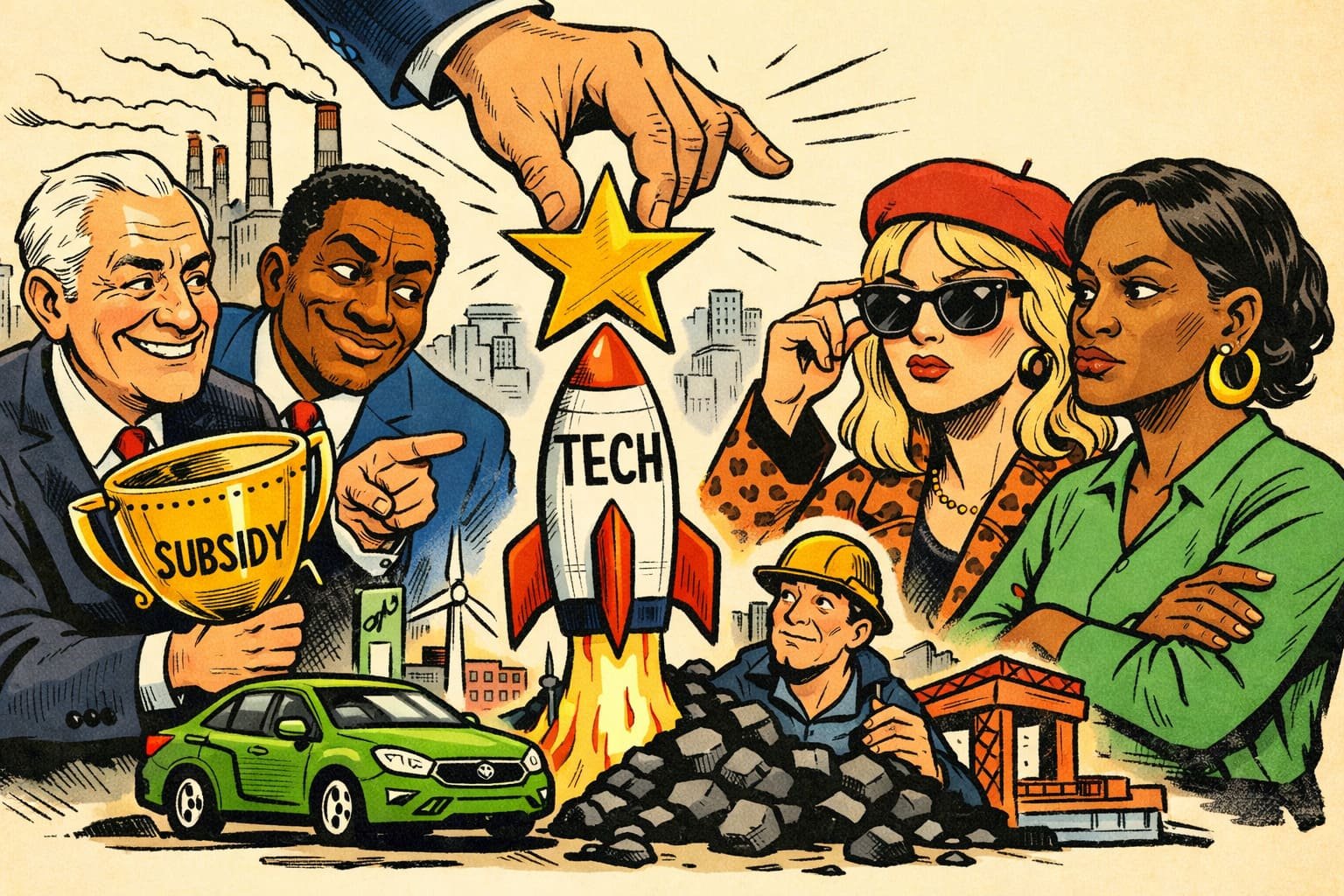
A factory siren cuts through damp air while sparks leap from fresh steel, yet every echo carries a quieter question. Which company deserves tomorrow, and who gets left behind? That question has returned to cabinet rooms across the world as governments once again decide which industries deserve subsidies, tax incentives, and protection. Industrial policy has stepped back into the spotlight, not as an old economic relic, but as a powerful force reshaping investment, competition, jobs, and national ambition.
Supporters argue that markets alone rarely build strategic industries quickly enough. Critics answer with equal force, warning that politicians often mistake influence for insight. Both sides have history to defend. Japan’s industrial rise benefited from coordinated industrial planning, while South Korea nurtured globally competitive manufacturers through deliberate public support. Yet history also remembers costly failures where governments backed weak businesses that survived on subsidies instead of innovation. Success has never depended on spending alone. Judgment matters even more.
Money tells an unusually revealing story. When governments announce generous incentives for semiconductor manufacturing, battery production, or renewable energy, investors immediately recalculate future profits. Banks revise lending decisions. Accountants reassess long-term asset values. Entire supply chains begin shifting before a single factory produces anything. Intel’s investment plans across the United States illustrate how public incentives can accelerate private capital. Taiwan Semiconductor Manufacturing Company also expanded production abroad partly because governments competed aggressively to attract advanced manufacturing. Public policy became financial strategy almost overnight.
Consider Maya, who managed a medium-sized supplier producing industrial sensors. Her company spent years serving automobile manufacturers with predictable orders and modest margins. Then new incentives encouraged electric vehicle investment across several regions, and customers suddenly demanded redesigned components built for unfamiliar technologies. Maya’s team faced painful choices, retrained engineers, borrowed capital, and transformed production before competitors reacted. Survival came from adaptation rather than comfort. Industrial policy rarely changes only large corporations. Smaller businesses often experience the deepest disruption because every financing decision suddenly carries higher stakes.
This explains why industrial policy reaches far beyond politics. Financial markets constantly evaluate whether government support creates durable economic value or temporary excitement. Companies enjoying generous incentives still need strong management, disciplined accounting, productive employees, and customers willing to buy their products after subsidies fade. History repeatedly shows that protected businesses eventually face market discipline. Boeing, Airbus, and countless renewable energy firms demonstrate that public support can accelerate capability, but long-term competitiveness still depends on execution, operational excellence, and relentless improvement instead of permanent protection.
Rain begins falling across another industrial skyline while cranes continue moving without hesitation, lifting steel toward uncertain horizons. Every beam rising into place reflects a decision made long before construction ever began, often inside quiet government offices where budgets, priorities, and national strategy intersect. Those choices shape investment for decades, influencing families, entrepreneurs, manufacturers, and financial markets alike. Industrial policy never simply picks corporate favorites. It quietly decides which economic stories receive their opening chapter, leaving everyone else to write a different ending.
