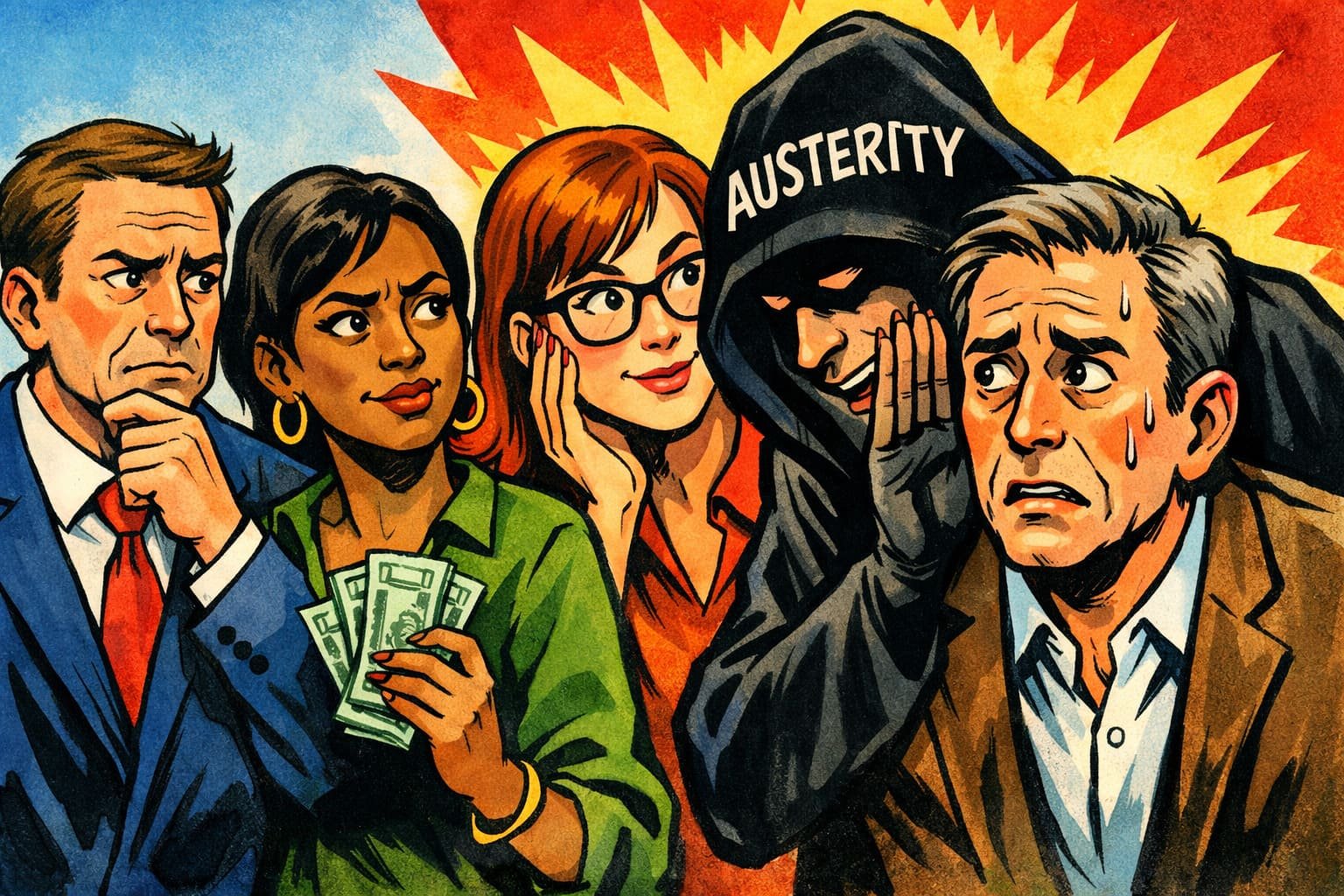
The word returns softly at first, almost embarrassed to be seen in public. No minister wants to stride out and declare a new age of austerity with a grin and a fresh logo. The language comes disguised. Efficiency. Restraint. Hard choices. Better targeting. Spending discipline. Value for money. Soon enough the message becomes clear: the state is running out of easy options, and somebody will have to feel it. That is when austerity whispers return, and voters, with the instincts of people who have been burned before, start smelling trouble long before the official memo lands.
Austerity is one of those ideas that arrives wearing two costumes at once. To supporters, it looks like overdue adulthood, the painful but necessary correction after years of excess. To critics, it looks like economic self-harm dressed as virtue, a grim ritual where public services are starved so spreadsheets can look morally upright. Both pictures contain fragments of truth. A government can absolutely lose market trust by ignoring debt, deficits, and spending realities. It can also damage growth, cohesion, and institutional competence by cutting too hard, too fast, or too blindly.
That tension is why austerity debates are never merely technical. They are about what kind of state a country believes it can afford, and what kind of pain it is willing to call responsible. After the global financial crisis, many governments embraced sharp consolidation. The results were mixed and often bitter. Some public finances stabilized. Many citizens felt abandoned. Weak investment, strained local services, and distrust in institutions became part of the political inheritance. Voters do not need a policy seminar to remember that era. They remember the library hours cut, the clinic stretched, the bus route gone.
The whisper is back now because the pressures are back. Debt service is higher. Ageing pushes up pension and healthcare costs. Defense demands have grown sharper. Climate adaptation is no longer a future hobby. Governments that once spent heavily through crisis years are discovering that markets do not share the emotional attachment to every emergency-era promise. The fiscal room feels tighter, and when fiscal room tightens, the old austerity grammar begins clearing its throat. Politicians may avoid the word itself, but the budget tables hear it coming.
Voters smell trouble because they know where cuts usually land. Rarely in the speechwriting department. Rarely in the prestige announcement category. The pressure often settles on local councils, maintenance budgets, preventative care, social services, youth programs, and all the low-glamour systems that keep daily life from fraying. These are the parts of the state that do not trend online until they fail. Once they fail, the damage feels strangely intimate. A missed pothole repair is an inconvenience. A deeply hollowed local service network is a slow civic loneliness.
A council worker in a coastal town described the feeling with painful accuracy. There was never a single day when “austerity” arrived. There were just more calls, fewer staff, longer waits, older equipment, and a strange office ritual where every broken thing became normal if it survived one more quarter. Citizens kept asking why everything felt slower. Staff kept inventing cheerful phrases. The budget had not collapsed. The texture of public life had. That is the real austerity effect. Not always spectacular ruin, but accumulated thinning until the ordinary becomes fragile.
There is a contrarian point worth making here. Not every spending restraint is austerity, and not every refusal to spend is cruelty. Governments do waste money. Programs can bloat. Subsidies can become politically immortal long after their purpose fades. Fiscal discipline matters. The problem is that the phrase gets abused in both directions. Some leaders use it as camouflage for ideological shrinking of the state. Some critics use it to reject any attempt at prioritization. The harder and more useful question is whether restraint is strategic or indiscriminate. One protects future capacity. The other quietly liquefies it.
This is where politics becomes theatrical in the worst way. When voters sense the whisper of austerity, they often reach for populists promising protection without trade-offs. Those populists usually offer a different fantasy, not a better ledger. They attack experts, dismiss borrowing constraints, and sell relief as if markets are sentimental creatures that can be shamed into compliance. That only postpones the reckoning. The public ends up trapped between two bad sales pitches: one that treats cuts as purity, and another that treats arithmetic as a conspiracy. No wonder trust wears thin.
The smarter path is difficult, which is precisely why it is so rare. Governments facing real fiscal pressure need honest prioritization, long-term reform, and protection for investment that raises future capacity. Cutting maintenance to preserve theatrically visible spending is foolish. Slashing preventative services to fund short-term calm is expensive in disguise. Freezing systems until they fail is not prudence. It is deferred chaos. A serious state knows how to trim, redesign, and invest at the same time. That sounds less heroic than either austerity sermon or anti-austerity carnival, but it is how durable countries behave.
Austerity whispers become dangerous when the public hears only threat and no design. People can tolerate hardship better than contempt. They can endure difficult choices when those choices feel shared, coherent, and tied to a believable future. They revolt, quietly or loudly, when cuts appear selective, hypocritical, or permanent for the weak but temporary for the powerful. Fiscal consolidation without civic trust is like trying to repair a roof during a storm with one hand while the other hand keeps ripping out floorboards.
Soon the budget language turns colder. Words like reprioritization and streamlining drift across the page like expensive perfume trying to cover a damp smell. Citizens recognize it instantly. Something is about to be taken, delayed, narrowed, or closed. The whisper is enough. They have lived through the sharp version before. That is why the mood changes even before the cuts are fully named. People remember that public life does not collapse only through scandal. Sometimes it is pared back so often that the country wakes up inside a smaller promise.
And that is the trouble hanging over the room now. Austerity never returns as a clean debate between adults at a whiteboard. It comes back as memory, suspicion, and dread, because voters have learned that budget restraint often means someone far from the podium is asked to absorb the bruise. The real challenge for governments is not merely to close gaps. It is to prove they can do it without shrinking the public realm into a place where trust, service, and hope all sound like luxuries no longer carried in stock.
