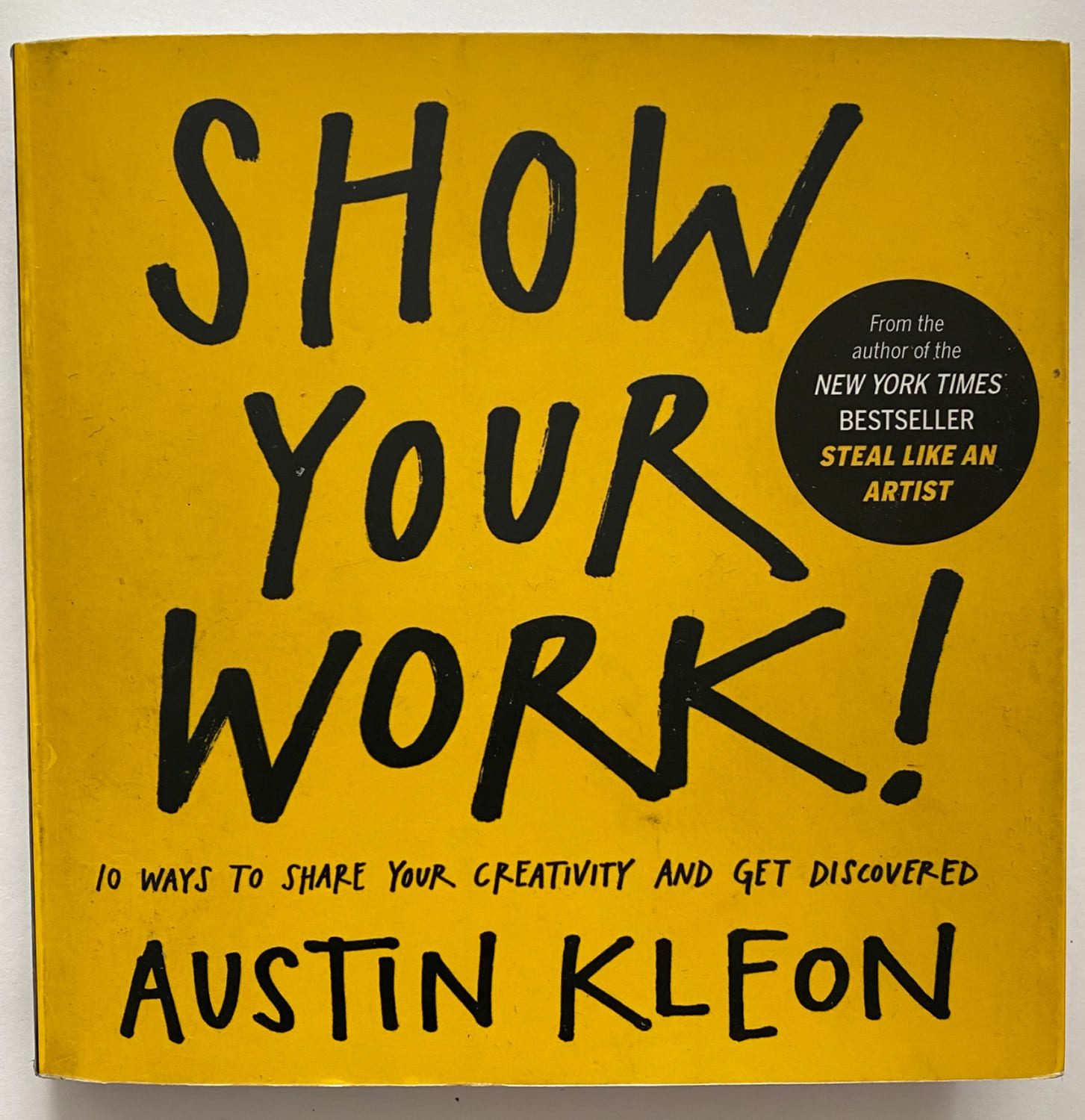
The glow from laptop screens spilled across dark apartments while thousands of creators refreshed analytics dashboards with the nervous intensity of gamblers waiting for roulette wheels to stop spinning. Somewhere, an illustrator hesitated before posting unfinished sketches. A writer deleted drafts nobody would ever read. A filmmaker spent six months perfecting a trailer instead of releasing the actual project. Across the modern internet, talented people quietly disappeared beneath the crushing fear of being seen before feeling fully ready. In Show Your Work!, Austin Kleon tears directly into that paralysis and delivers one of the most important creative survival guides of the digital era. The book is not really about self-promotion. It is about visibility without losing humanity.
Kleon understands something modern culture keeps misunderstanding about creativity. Audiences no longer connect only with finished masterpieces. They connect with process, struggle, experimentation, evolution, personality, and emotional texture. The internet changed artistic gravity permanently. People want to witness becoming, not merely arrival. That shift terrifies many creators because traditional education trained them to hide unfinished work until perfection appeared. Show Your Work! flips that logic entirely. Share the process. Share the questions. Share the tiny discoveries. Let people observe the workshop, not only the museum exhibit. The advice feels deceptively simple until one realizes how psychologically vulnerable it actually is.
A documentary photographer named Elias Navarro once spent nearly three years uploading almost nothing online despite producing breathtaking street photography across Buenos Aires and Lisbon. He obsessed over releasing only “career-defining” work. Meanwhile, less technically skilled creators built loyal communities simply by sharing observations, experiments, failures, and daily visual studies consistently. Frustrated, Elias began posting unfinished contact sheets alongside small reflections about light, loneliness, and urban movement. Something unexpected happened. Audiences connected more deeply to the imperfect fragments than the polished gallery pieces. A publisher eventually approached him not because his work suddenly improved, but because people felt emotionally invited into his creative world. Kleon’s philosophy breathes through stories like that. Visibility compounds trust when the sharing feels human rather than performative.
The brilliance of Show Your Work! lies in how accurately it predicted modern digital culture. Today, personality ecosystems outperform isolated content drops. Newsletters outperform faceless corporate blogs. Behind-the-scenes videos often outperform finished advertisements. Independent creators build stronger loyalty than giant institutions because audiences crave emotional proximity in an internet increasingly flooded with algorithmic emptiness. Kleon recognized early that creators are no longer competing only on talent. They are competing on connection, consistency, and transparency. The future belongs to people willing to document the journey instead of waiting endlessly for permission to appear complete.
There is also a deeply practical business insight hidden beneath the book’s playful tone. Showing work creates discoverability. Search engines, recommendation systems, communities, and collaborations thrive on visible process. Every sketch, essay fragment, notebook observation, reading list, prototype, and experiment becomes a breadcrumb trail leading audiences deeper into a creator’s intellectual universe. Many artists still think promotion begins after the work finishes. Kleon argues promotion begins during creation itself. That changes the relationship between audience and product entirely. Readers, viewers, and listeners become emotionally invested before the final release even arrives.
A product designer named Hana Bekele once joined a startup where executives obsessed over polished launch events while refusing to discuss development publicly. Competitors quietly built communities by sharing design mistakes, testing phases, and evolving concepts openly online. By launch day, the competitors already had emotionally invested users waiting eagerly because people felt included in the process. Hana later admitted the experience permanently altered how she viewed modern branding. Audiences increasingly reward participation over spectacle. Show Your Work! understands this instinctively. In digital culture, secrecy often kills momentum faster than imperfection.
The book also dismantles the exhausting mythology surrounding genius. Many creators secretly believe legitimacy arrives only after some mythical breakthrough moment where society suddenly grants permanent recognition. Kleon rejects that fantasy completely. He encourages sustainable visibility instead of dramatic arrival. Little by little. Day by day. Share something useful. Share what fascinates you. Teach what you know while learning publicly. That philosophy feels emotionally healthier than the modern obsession with virality and instant domination. The internet rewards spectacle temporarily. It rewards authentic continuity much longer.
A writer named Naomi Serrano once spent months crafting elaborate essays nobody read because she published inconsistently and disappeared between releases. Eventually she started posting small fragments daily: notes from books, overheard dialogue, abandoned metaphors, photographs of annotated manuscripts, thoughts about storytelling structure. Her audience grew slowly but intensely loyal. Readers began anticipating her process itself rather than merely consuming finished essays. Naomi later described the shift beautifully: “People stopped seeing me as a vending machine for content and started seeing me as a living mind.” That sentence captures the emotional heart of Kleon’s message. Creativity becomes magnetic when audiences witness consciousness unfolding in real time.
There is another reason the book feels increasingly relevant now. Artificial intelligence is flooding digital platforms with technically competent but emotionally empty material. As a result, human texture is becoming premium. Imperfections matter again. Process matters again. Personality matters again. Audiences crave signs of actual lived experience beneath the content they consume. Show Your Work! almost functions as an antidote to creative sterilization. It encourages creators to remain visible as people rather than reducing themselves into optimized production machines.
Late tonight another exhausted artist still hesitates before pressing publish on something unfinished but honest. Somewhere else, a young designer quietly shares process notes that eventually lead strangers toward unexpected collaboration years later. Coffee cools beside open notebooks. Cursor lights blink patiently against dark screens. Outside, cities hum beneath neon and insomnia while millions of invisible creators wrestle with the terrifying hope that their voice might matter if they finally allow the world to witness it imperfectly. That is where Show Your Work! leaves its readers, standing at the edge of visibility and realizing the real risk was never embarrassment. The real risk was disappearing entirely while waiting forever to become flawless before daring to participate in the conversation of human creativity.
Editorial Disclaimer: Whether a book is a work of fiction, a memoir, or inspired by real events, the ideas, actions, decisions, and behaviors discussed within are not intended to be encouraged, replicated, or endorsed in real-world situations. This review is published solely for educational, analytical, literary, and entertainment purposes, with the aim of examining the book’s themes, storytelling, characters, philosophies, and broader cultural or business insights. Any ethical or unethical viewpoints, practices, or conduct presented in the book do not necessarily reflect the views, values, or endorsements of ESYRITE.
