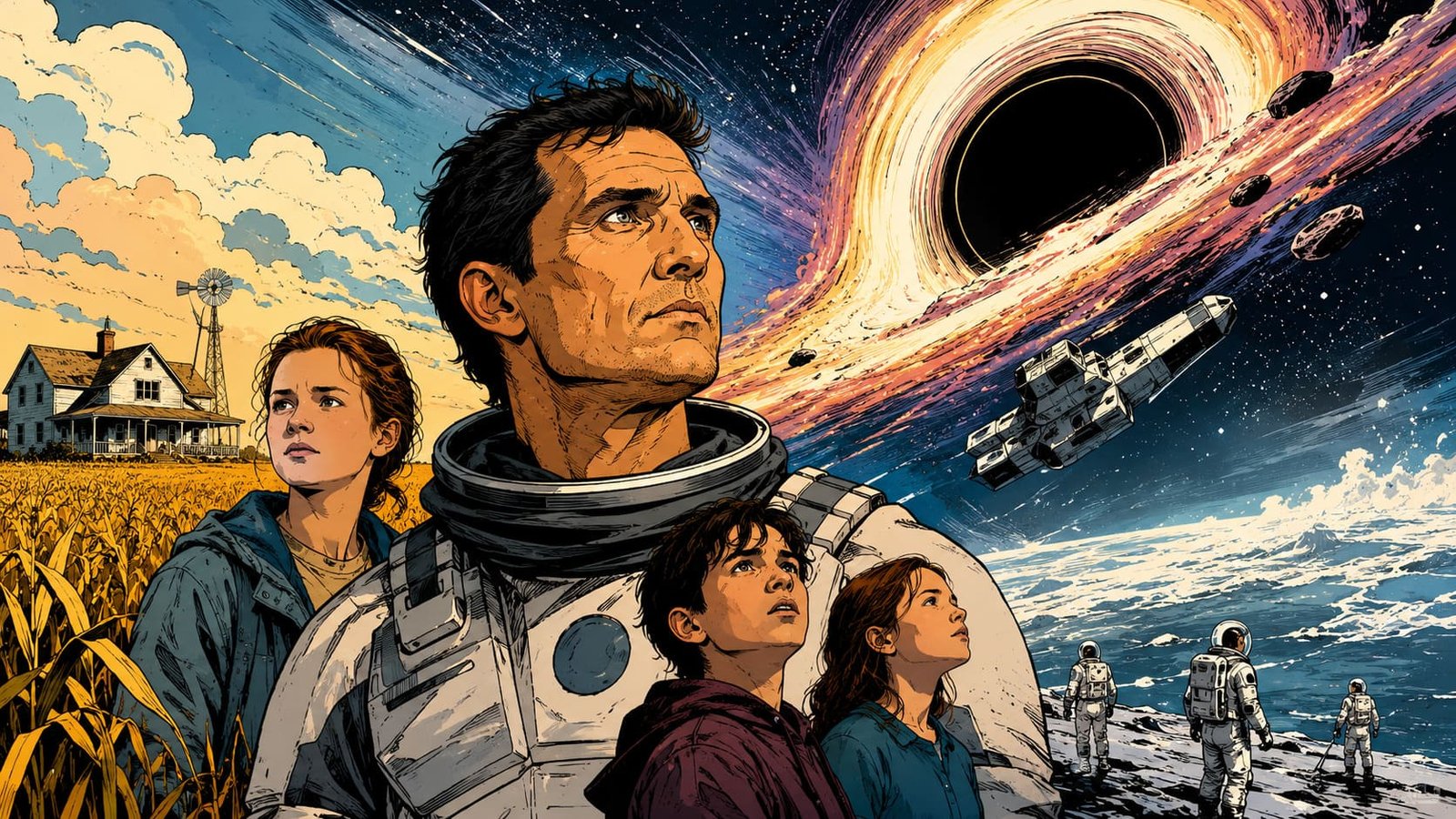
Dust drifted across dying farmland like the ashes of a civilization too distracted to notice its own funeral. Schoolteachers corrected children for believing humanity once walked on the moon. Old machines rusted beside exhausted crops while the planet slowly tightened its grip around human ambition like a fist closing underwater. Interstellar never behaves like ordinary science fiction. Christopher Nolan disguises a deeply emotional meditation on time, sacrifice, and human arrogance beneath wormholes and collapsing galaxies. The movie arrives wrapped in cosmic spectacle, yet its true subject is painfully intimate: what happens when survival becomes so urgent that people forget why survival mattered in the first place. Cooper, played with weathered vulnerability by Matthew McConaughey, is not merely searching for another habitable planet. He is searching for evidence that humanity still deserves a future. That distinction gives the film its haunting gravity. Beneath every equation sits a moral question modern society keeps postponing: can a civilization obsessed with extraction still remember how to protect wonder?
The world of Interstellar feels disturbingly recognizable because its collapse arrives through normalization rather than apocalypse. Nobody screams beneath alien invasion beams. Nobody outruns zombies through flaming cities. Civilization simply shrinks its imagination year after year until survival replaces aspiration. Farmers become the final respectable profession. Scientific curiosity is treated like nostalgia. Public institutions quietly surrender to fear. Nolan captures a pattern visible far beyond fiction. Organizations decay this way too. Great companies rarely implode dramatically at first. They narrow psychologically. Risk disappears. Creativity becomes suspicious. Managers optimize existing systems while forgetting how to build new ones. A robotics founder named Elise once described her former employer as “a place where innovation entered meetings wearing a visitor badge.” That line floats invisibly through Interstellar. Humanity’s greatest danger in the film is not technological failure. It is spiritual contraction masquerading as practicality.
Cooper himself represents a particular kind of modern tragedy. He possesses intelligence, instinct, and emotional depth, yet the world has no meaningful place left for his abilities. Former pilots become farmers because civilization stopped rewarding exploration. That tension cuts deeper now than when the film first released. Entire generations carry skills, ambitions, and creative instincts systems no longer know how to absorb humanely. Brilliant graduates deliver food through apps engineered by billionaires obsessed with “disruption.” Artists optimize social algorithms instead of pursuing craft. Scientists spend years begging institutions for funding while celebrities monetize attention economies built from outrage and distraction. Cooper’s frustration feels universal because it mirrors the emotional claustrophobia of people trapped inside shrinking cultural horizons. The movie asks a brutal question beneath its cosmic elegance: what happens to a species once it stops believing in its own future?
Then the film bends inward emotionally through Murph. Their relationship becomes the gravitational center holding the entire story together. Most science fiction films worship scale. Interstellar worships attachment. Cooper leaves Earth chasing humanity’s survival, yet every discovery deepens his emotional separation from the daughter who understands him most completely. Time itself becomes antagonistic. Minutes transform into decades. Messages age into grief. One sequence aboard the water planet lands with devastating force because it converts abstract physics into emotional violence. Watching years vanish while loved ones grow older elsewhere feels less like fiction and more like modern adulthood accelerated grotesquely. A consultant named Ravi once returned home after years chasing international contracts only to realize his father now moved through the kitchen slowly, cautiously, as though gravity itself had thickened. “Success stole time first,” he admitted later, staring into untouched coffee. Interstellar understands that ache intimately.
Dr. Mann’s betrayal introduces another layer entirely. Matt Damon’s character appears heroic initially, wrapped in the mythology of exploration and sacrifice. Underneath sits terror. Pure survival instinct. His collapse exposes one of the film’s sharpest insights: desperate systems often manufacture performative leadership. Mann was never the best humanity had to offer. He was the best humanity marketed successfully. That distinction matters enormously in modern culture. Public image frequently outruns actual integrity. Corporations build visionary branding around hollow ethics. Leaders become symbols before proving character under pressure. Mann embodies the terrifying possibility that intelligence without moral courage eventually mutates into self-preservation at any cost. His breakdown inside the frozen alien landscape feels horrifying precisely because it feels plausible. Faced with extinction, many institutions abandon principle faster than they abandon quarterly targets.
Nolan’s depiction of artificial intelligence remains strangely elegant because TARS behaves more emotionally mature than many humans onscreen. The robot understands humor, restraint, sacrifice, and trust better than several crew members. That inversion feels increasingly relevant. Modern society fears artificial intelligence becoming too human while simultaneously rewarding humans for behaving mechanically. Endless productivity. Emotional suppression. Transactional relationships. Algorithmic attention spans. TARS operates with calm clarity because it lacks ego. Humans sabotage missions because ego distorts judgment. A startup advisor named Camille once described executive boardrooms as “rooms where intelligent adults compete to become the loudest frightened child.” TARS would probably agree. The film quietly suggests emotional intelligence, not raw intellect, may determine whether civilizations survive long-term.
Visually, Interstellar behaves like sacred architecture. Black holes swirl like divine mysteries beyond language. Frozen clouds stretch across impossible skies. Silence in space feels terrifyingly pure. Hans Zimmer’s organ-heavy score transforms scientific exploration into something almost religious. Yet the movie never abandons grounded human emotion beneath the spectacle. Cooper crying while watching decades of missed messages remains more overwhelming than entire galaxies collapsing nearby. That balance explains the film’s enduring cultural grip. It understands technological progress without emotional maturity creates sophisticated loneliness rather than transcendence. The future cannot save people emotionally if they remain spiritually disconnected from one another. Every breathtaking cosmic image eventually circles back toward love, grief, memory, and human vulnerability.
Near the emotional core of the story sits a dangerous idea many modern systems quietly reject: love may function as a form of intelligence rather than sentimental weakness. Brand’s argument initially sounds irrational beside equations and mission protocols. Yet the film slowly reframes emotional attachment as orientation, almost like gravitational instinct guiding human decisions beyond measurable logic. That proposition irritates hyper-rational cultures obsessed with metrics because it suggests not everything valuable can be quantified cleanly. Families understand this instinctively. Great teachers understand it. So do certain founders who build companies from conviction rather than extraction alone. Interstellar does not argue against science. It argues against reducing humanity to data while ignoring emotional truth. Somewhere between wormholes and dying crops, Nolan smuggles a philosophical rebellion into blockbuster cinema: civilizations collapse spiritually before they collapse physically.
Far beyond dying planets and spinning stations, a lone figure drifted through a constructed dimension where memory hung like lanterns across infinite darkness. A father reached toward fragments of time itself, trying desperately to communicate love through the machinery of physics before existence folded shut around him. The universe in Interstellar never promises fairness. It offers distance, uncertainty, silence, and impossible sacrifice. Yet beneath all the cosmic terror sits one stubborn human conviction refusing extinction: the belief that meaning survives through connection even when worlds fail. That is why the film lingers like a half-remembered dream after midnight. Not because audiences fear black holes, but because they recognize the deeper terror underneath them. A civilization can master galaxies and still lose its soul quietly, one compromise at a time. And somewhere inside the noise of modern ambition, you may already feel the gravity pulling at your own.
Editorial Disclaimer: Whether a film is rooted in fiction or inspired by real events, the actions, decisions, and behaviors portrayed within are not intended to be encouraged, replicated, or endorsed in real-world settings. This review exists solely to analyze the storytelling, characters, themes, and business dynamics presented in the film for educational, analytical, and entertainment purposes. Any ethical or unethical conduct depicted in the film does not reflect the views, values, or endorsements of ESYRITE.
