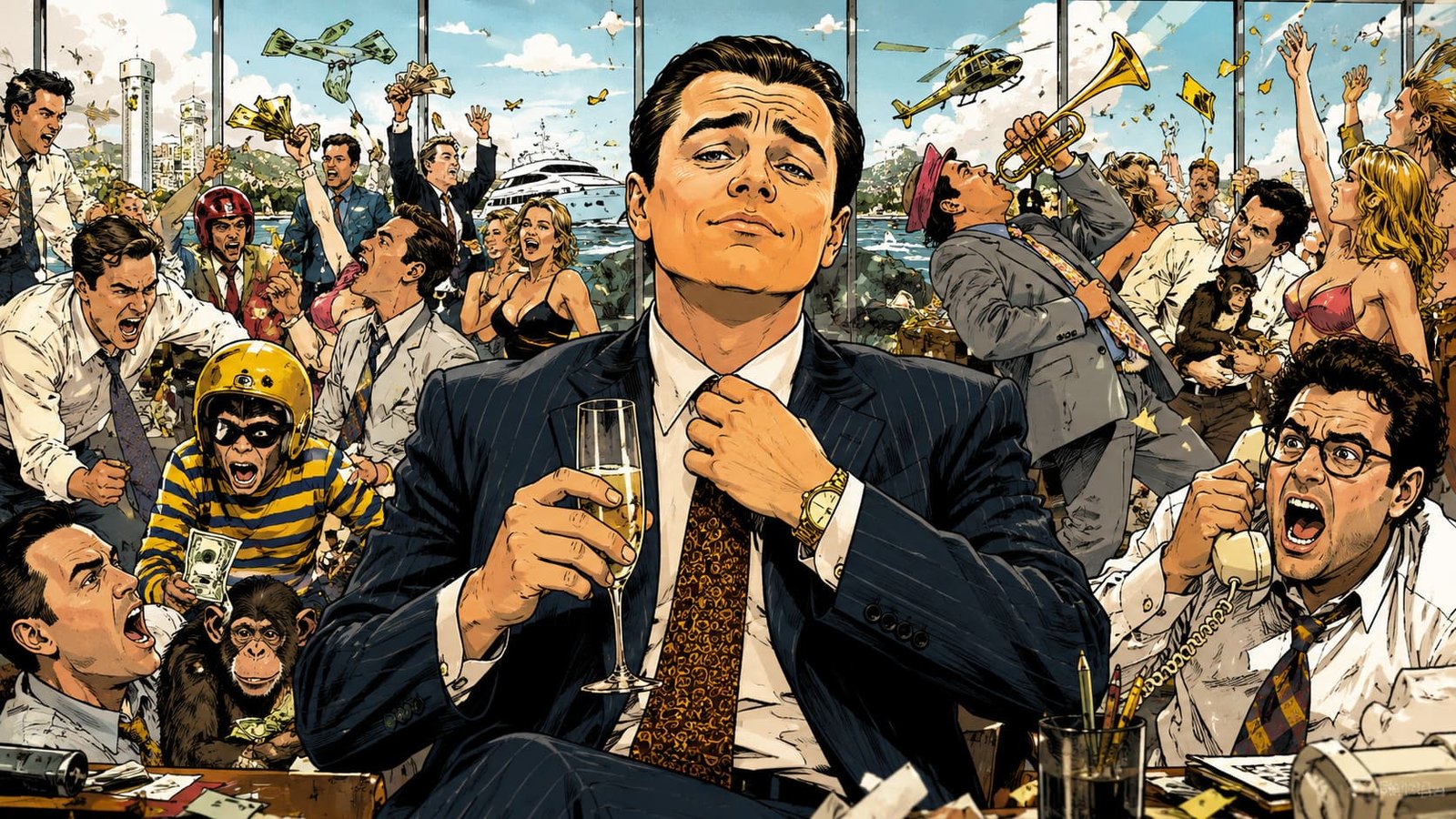
Money rained through the air like confetti at the world’s most expensive nervous breakdown. Strippers danced beside stockbrokers high on chemicals powerful enough to erase consequences temporarily. Phones rang with predatory urgency while young men in tailored suits screamed motivational slogans like cult leaders leading financial warfare beneath fluorescent office lights. Somewhere inside the chaos, morality dissolved completely into entertainment. Jordan Belfort did not simply sell worthless stocks. He sold fantasy itself, packaged with cocaine confidence and the emotional velocity of a casino collapsing at full speed. Leonardo DiCaprio plays Belfort with terrifying charisma because the character understands a dangerous truth modern culture keeps rewarding: people often prefer intoxicating illusion over uncomfortable reality. The Wolf of Wall Street is not truly about finance. It is about appetite unchained from conscience until ambition mutates into spectacle.
Martin Scorsese directs the film like a man documenting civilization during a moral blackout. Every scene vibrates with excess because the world Belfort inhabits requires constant stimulation to avoid confronting emptiness. Drugs, yachts, sex, screaming sales meetings, endless champagne. Nothing ever feels sufficient for long. That emotional restlessness matters more than the criminal schemes themselves. The movie understands addiction broadly, not just chemically. Belfort becomes addicted to status, adrenaline, domination, and attention. Modern capitalism often encourages these addictions quietly while publicly condemning their consequences later. A hedge-fund recruiter named Cassian once described elite sales culture as “giving insecure people million-dollar microphones and watching what breaks first.” The Wolf of Wall Street captures that psychological combustion perfectly.
The early brokerage scenes feel almost anthropological now. Young salesmen learn persuasion techniques resembling emotional manipulation seminars disguised as financial training. Belfort teaches them confidence before ethics, performance before truth. Sell emotion first. Reality later. That philosophy escaped Wall Street long ago and infected nearly every corner of modern commerce. Influencer culture, political branding, startup fundraising, luxury marketing. Entire industries now operate through narrative engineering designed to stimulate desire faster than skepticism can react. Belfort simply removes the polite disguise most systems still attempt maintaining. One startup consultant named Mirek admitted during a late-night networking dinner in Berlin that “half of modern business is convincing exhausted people their insecurity needs a subscription plan.” Jordan would have applauded that sentence enthusiastically.
What makes the film unsettling rather than merely entertaining is how seductive Belfort remains throughout. Scorsese refuses moral distance intentionally. Audiences laugh, admire, recoil, then laugh again. The film implicates viewers directly in the machinery of greed because charisma distorts judgment naturally. Belfort speaks with the energy of someone selling liberation rather than fraud. Employees worship him because he transforms mediocrity into temporary mythology. Young brokers arrive broke and emotionally invisible. Jordan gives them identity, status, belonging. That emotional mechanism explains why toxic leaders survive historically. People rarely follow corruption openly. They follow confidence packaged as salvation. A former advertising executive named Leandro once described manipulative leadership as “making people feel chosen before making them useful.” Belfort weaponizes that instinct constantly.
The relationship between Jordan and Donnie Azoff behaves like a cautionary tale about masculine excess detached from responsibility entirely. Jonah Hill’s performance radiates chaotic insecurity disguised as bravado. Together they operate like overgrown adolescents handed infinite money and zero emotional restraint. The humor lands because it exposes something deeply embarrassing about wealth culture. Many hyper-successful environments emotionally reward regression rather than maturity. Recklessness becomes performance art. Cruelty becomes comedy. Vulnerability disappears beneath performative dominance rituals. The office itself transforms into a giant fraternity house fueled by financial extraction. A private-equity analyst named Renzo once confessed after leaving his firm that “the money got bigger while the emotional intelligence stayed seventeen years old.” That observation belongs spiritually inside every scene of this movie.
Scorsese also understands how systems normalize moral erosion gradually. Belfort does not wake up one morning as a cartoon villain. Small compromises compound. Fraud scales slowly. Rationalization expands alongside wealth. Each success creates emotional insulation from consequence. That progression mirrors countless institutional failures beyond finance. Political corruption, corporate scandals, technological exploitation. Rarely does collapse begin dramatically. People simply stop noticing where the ethical boundary disappeared originally. The FBI agent Patrick Denham becomes fascinating precisely because he exists outside Belfort’s emotional ecosystem. He rides the subway home while Jordan cruises oceans aboard luxury yachts. Yet Denham possesses something Jordan lacks entirely: coherence. The film quietly suggests integrity may look less glamorous externally while producing far greater internal stability.
The famous Quaalude sequence reveals another layer beneath the comedy and chaos. Jordan’s body eventually betrays the illusion of invincibility his lifestyle requires constantly performing. He crawls desperately across floors while hallucinating control he no longer possesses. The scene feels grotesquely funny until one recognizes its symbolic weight. Excess eventually humiliates the people worshipping it most aggressively. Systems built entirely around appetite consume themselves eventually because no external achievement can regulate internal emptiness sustainably. The luxury becomes repetitive. The stimulation loses potency. More intensity becomes necessary just to feel emotionally awake again. A restaurateur named Camille once described ultra-wealthy clients in Monaco as “people ordering increasingly expensive experiences while looking spiritually jet-lagged.” The Wolf of Wall Street understands that emotional exhaustion intimately.
There is also something strangely prophetic about the film’s ending. Jordan survives. He loses money, status, freedom temporarily, yet reemerges teaching sales psychology to audiences still eager for shortcuts toward power and wealth. That final irony lands like acid. Society condemns excess publicly while remaining hypnotized by it privately. Belfort becomes motivational product instead of permanent cautionary tale because modern culture confuses attention with redemption constantly. The audience staring at him during the final seminar looks hungry, not horrified. They want the secret. The technique. The magic sentence capable of transforming ordinary life into extraordinary status. Scorsese ends the film there intentionally because the real danger was never Jordan alone. It was the civilization endlessly rewarding people like him.
Beneath stage lights and hotel ballroom chandeliers, a disgraced salesman stood before strangers clutching notebooks like desperate pilgrims searching for financial salvation from a man who once turned greed into national theater. Outside, cities still pulsed with advertisements promising reinvention through consumption while exhausted people chased versions of success sold to them by louder, richer voices. That is the lasting sting of The Wolf of Wall Street. The film recognizes that modern ambition often behaves less like disciplined aspiration and more like collective intoxication disguised as opportunity. Somewhere between the yachts, stock pitches, and roaring applause, an entire culture stopped asking whether wealth could satisfy the soul and started asking only how quickly the next hit could arrive. And deep down, that question still echoes through boardrooms, podcasts, trading floors, and glowing phone screens everywhere.
Editorial Disclaimer: Whether a film is rooted in fiction or inspired by real events, the actions, decisions, and behaviors portrayed within are not intended to be encouraged, replicated, or endorsed in real-world settings. This review exists solely to analyze the storytelling, characters, themes, and business dynamics presented in the film for educational, analytical, and entertainment purposes. Any ethical or unethical conduct depicted in the film does not reflect the views, values, or endorsements of ESYRITE.
