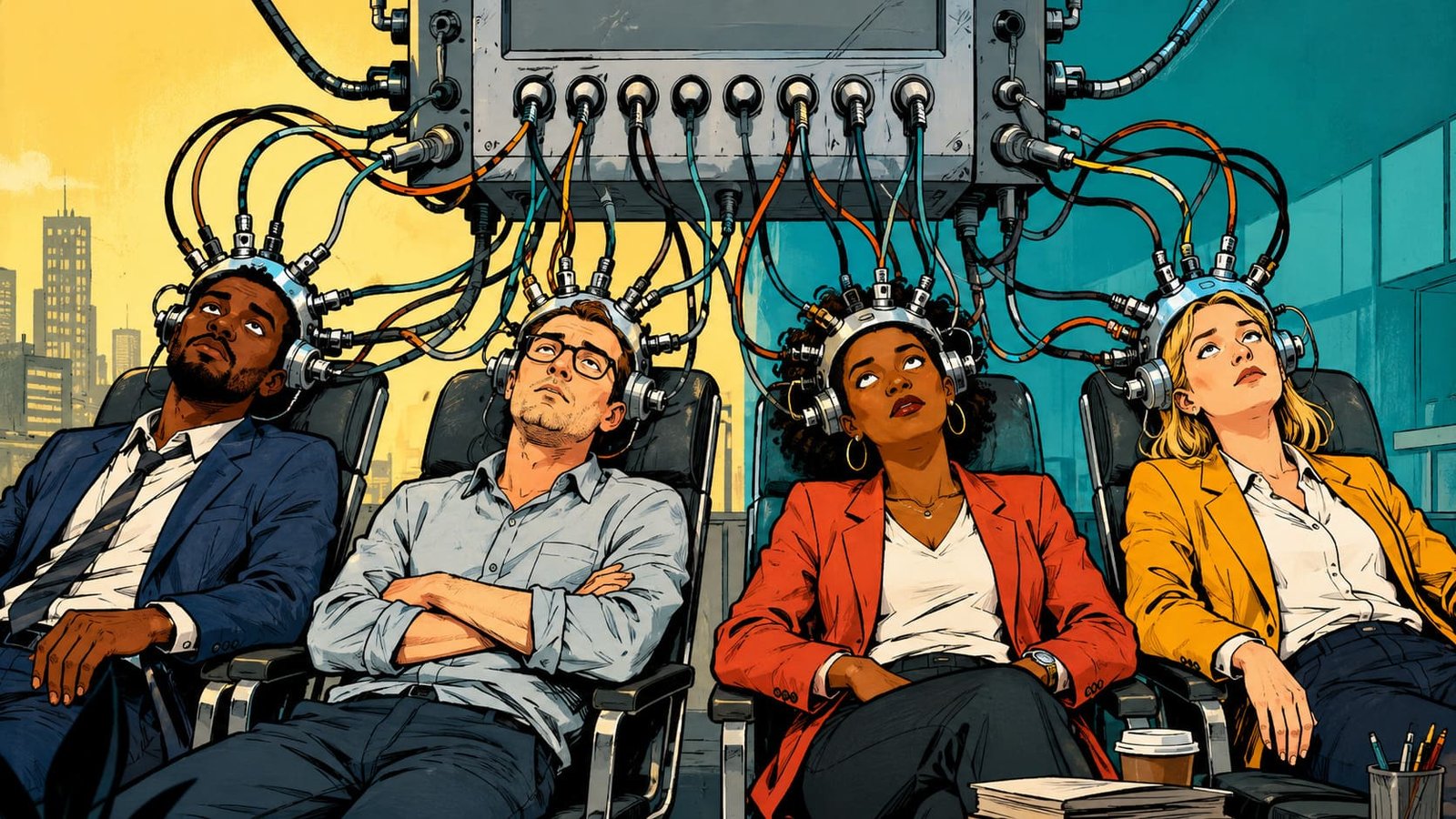
A software engineer opens a laptop and finds a curious new colleague already waiting inside it. The machine has no desk, no coffee, no opinions about the weather, yet it can draft code, explain errors, search documentation, and produce a first version before a human has finished deciding where to begin. Nothing about the office looks revolutionary. That is precisely what makes the transformation unsettling. Technology workers are not simply being asked to learn another tool, they are being pushed into a different definition of expertise, where knowing how to make something increasingly competes with knowing what deserves to be made.
For years, technical careers rewarded accumulation. Learn a language, master a framework, understand an infrastructure stack, become the person everyone calls when production catches fire. AI changes that bargain because knowledge once locked inside experience can now be summoned through a prompt, a search, or an automated agent. Recent labour research shows that AI is increasing demand for judgment, creativity, leadership, data interpretation, and other human capabilities even as technical tasks become easier to automate. A strange inversion is forming: the more powerful the machine becomes, the less impressive mere machine fluency looks.
Consider a developer named Anton who spent years becoming the fastest person on his team at solving familiar bugs. Then an AI coding assistant arrived and began producing fixes almost instantly. His advantage did not vanish, but its location moved. Suddenly the valuable question was not “Can Anton write the function?” but “Can Anton tell whether the function should exist, whether the proposed solution is safe, and what happens six months after deployment?” That shift resembles what happened to photographers when digital cameras changed the economics of taking pictures. Technical ability survived, but the definition of professional value moved upstream.
A data analyst faces a similar rewiring. Before breakfast, a machine can clean a dataset, suggest patterns, create a chart, and produce an explanation that sounds remarkably confident. A colleague named Safiya notices one strange result and asks where it came from. Nobody knows. The dashboard looks beautiful, almost suspiciously beautiful. That moment captures a new form of technical maturity: knowing when an impressive answer deserves distrust, a skill increasingly important as organizations adopt systems capable of producing plausible work at extraordinary speed.
Companies that treat this transformation as a software training exercise will miss its deeper economic meaning. PwC’s 2026 AI Jobs Barometer describes a labour market splitting between roles where AI amplifies expertise and roles where AI reduces barriers to performing specialised tasks. For technology workers, that distinction matters enormously. A developer who uses AI to multiply judgment becomes more valuable; a worker whose entire identity rests on producing routine output becomes easier to substitute. The uncomfortable lesson is not that technical people need to become less technical. They need to become technically broader, commercially sharper, and much harder to fool.
A peculiar career ladder is taking shape, with several old rungs replaced by questions nobody was trained to answer. Who understands the customer? Who can challenge an elegant but dangerous solution? Who knows which shortcut will become tomorrow’s disaster? Technology workers who survive this rewiring will not necessarily be those who type fastest, memorize the most commands, or collect the largest pile of certificates. They will be the people capable of moving between machine capability and human consequence without losing sight of either. When every worker gets augmented, the rarest skill may be knowing what should remain unmistakably human.
