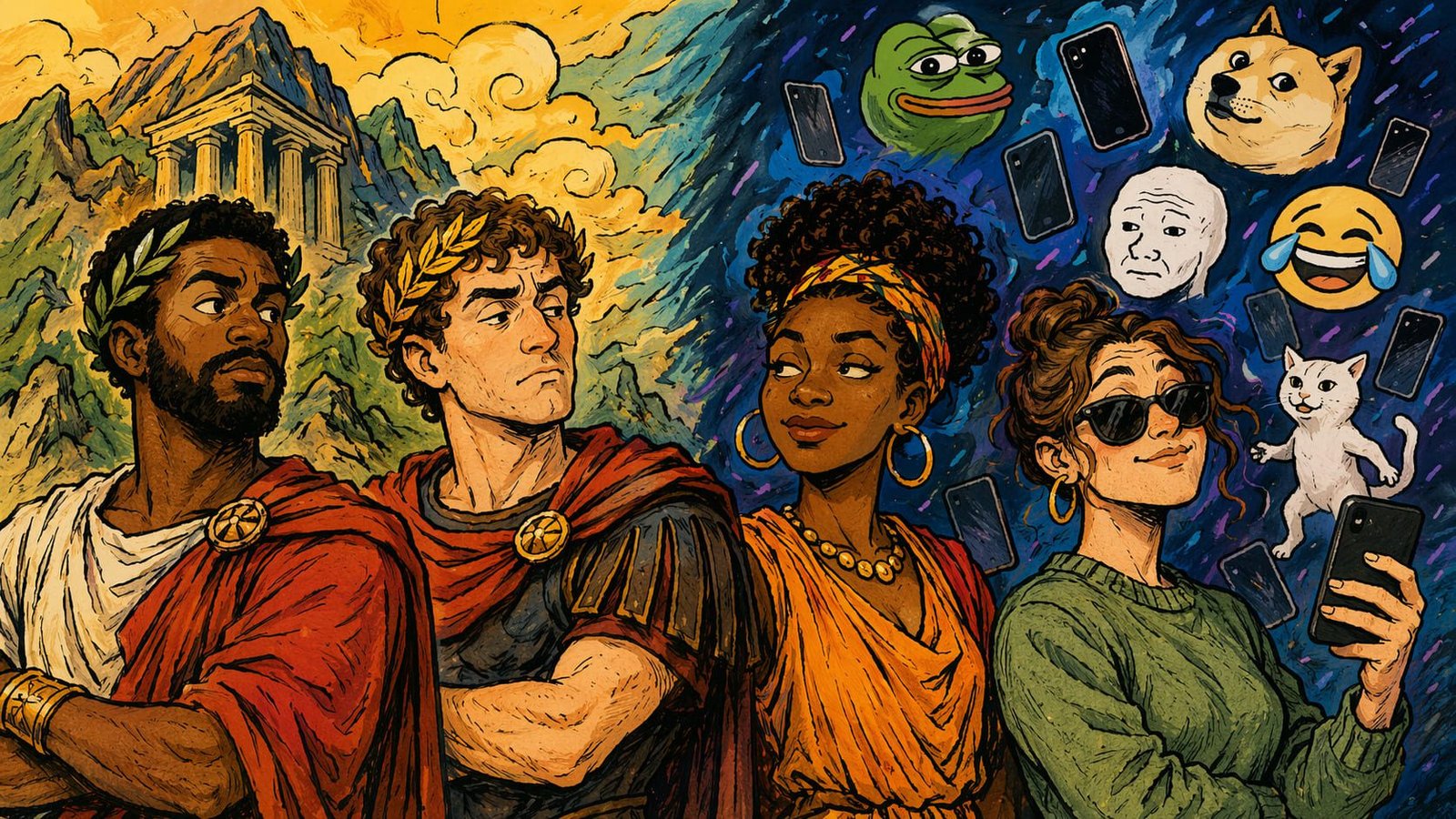
A phone lights up in the dark, a thumb scrolls, and something ancient flickers beneath the noise. A looping image, a short caption, a familiar format reshaped again. It feels new, disposable, almost forgettable. Yet the reaction it triggers is strangely old. Recognition arrives before understanding. The joke lands because it echoes something deeper than humor, something that has been told before in different forms, across different times, wearing different faces.
Myths never disappeared. They changed their costume. Where once they traveled through oral traditions and sacred texts, they now move through timelines and feeds. The structure remains intact. There is still the hero, the trickster, the outsider, the ruler. The difference lies in speed and scale. Memes compress these archetypes into fragments that can be shared instantly, allowing ancient patterns to circulate in modern forms.
A digital strategist named Kofi once traced the lifecycle of a popular meme that depicted a character caught between two choices. At first glance, it was simple humor. As variations spread, the meme began to represent broader dilemmas, career versus passion, stability versus risk, belonging versus independence. Kofi realized that the meme had become a modern expression of an age-old narrative. The archetype of the divided self had found a new medium.
This continuity reveals something important about human cognition. People are drawn to patterns that feel familiar, even if they cannot immediately explain why. Archetypes provide that familiarity. They offer a framework for understanding complex experiences. When these patterns appear in memes, they carry the same resonance, even in compressed form. The humor becomes a gateway to something deeper.
A small creative agency experienced this dynamic during a campaign for a lifestyle brand. The team, led by Amira, used meme formats that subtly referenced well-known archetypes. The rebel, the mentor, the underdog. The campaign resonated strongly, not because the audience consciously identified the patterns, but because the narratives felt intuitive. Amira later reflected that the success was less about originality and more about tapping into something timeless.
Psychologists often refer to these recurring patterns as collective symbols, shapes of meaning that appear across cultures and generations. They help individuals make sense of their experiences by connecting them to broader narratives. Memes, in their rapid and adaptable form, act as carriers for these symbols. They allow archetypes to evolve, to reflect current contexts while maintaining their core structure.
A content creator named Sofia once built a series around the archetype of the outsider. Each meme portrayed a character navigating systems that felt indifferent or hostile. The tone was humorous, yet the underlying theme resonated deeply with her audience. Comments filled with personal stories, reflections, shared experiences. The meme had become more than a joke. It had become a space for recognition, a modern echo of an ancient narrative.
There is a subtle power in this transformation. Memes do not just reflect archetypes. They reshape them. By placing these patterns in contemporary contexts, they update their meaning. The hero may no longer wield a sword, but navigate a corporate hierarchy. The trickster may not be a mythical figure, but a viral persona disrupting expectations. The essence remains, but the expression evolves.
A media researcher named Daniel once described this as “compressed mythology.” He argued that memes function as fragments of larger stories, each carrying enough meaning to resonate, but flexible enough to adapt. This flexibility allows them to spread rapidly, but also to shift in meaning as they move. The same meme can represent different ideas in different contexts, reflecting the fluid nature of modern culture.
The tension lies in the balance between depth and speed. Traditional myths unfolded over time, allowing for reflection and interpretation. Memes operate in bursts, often consumed quickly and forgotten just as fast. Yet their impact accumulates. Repeated exposure to certain patterns reinforces them, shaping perception in subtle ways. The depth is not lost. It is distributed across many small moments.
A startup founder named Leandro once noticed this while building a community around his product. He used meme culture to communicate values, embedding archetypal narratives into short, shareable content. The approach created a sense of belonging, a shared language that connected users. Leandro realized that he was not just marketing a product. He was participating in the construction of a modern myth, one that his audience could recognize and contribute to.
Somewhere, a new meme is taking shape. It will draw from familiar patterns, even if those patterns are not immediately visible. It will be shared, adapted, reinterpreted. Each iteration will carry a fragment of something older, something that has traveled through time in different forms. The audience will engage, laugh, reflect, often without realizing the depth beneath the surface.
These fragments continue to circulate, weaving ancient structures into modern expression, a question lingers beneath the humor and repetition: are you just sharing a joke, or participating in a story that has been shaping human thought for centuries?
