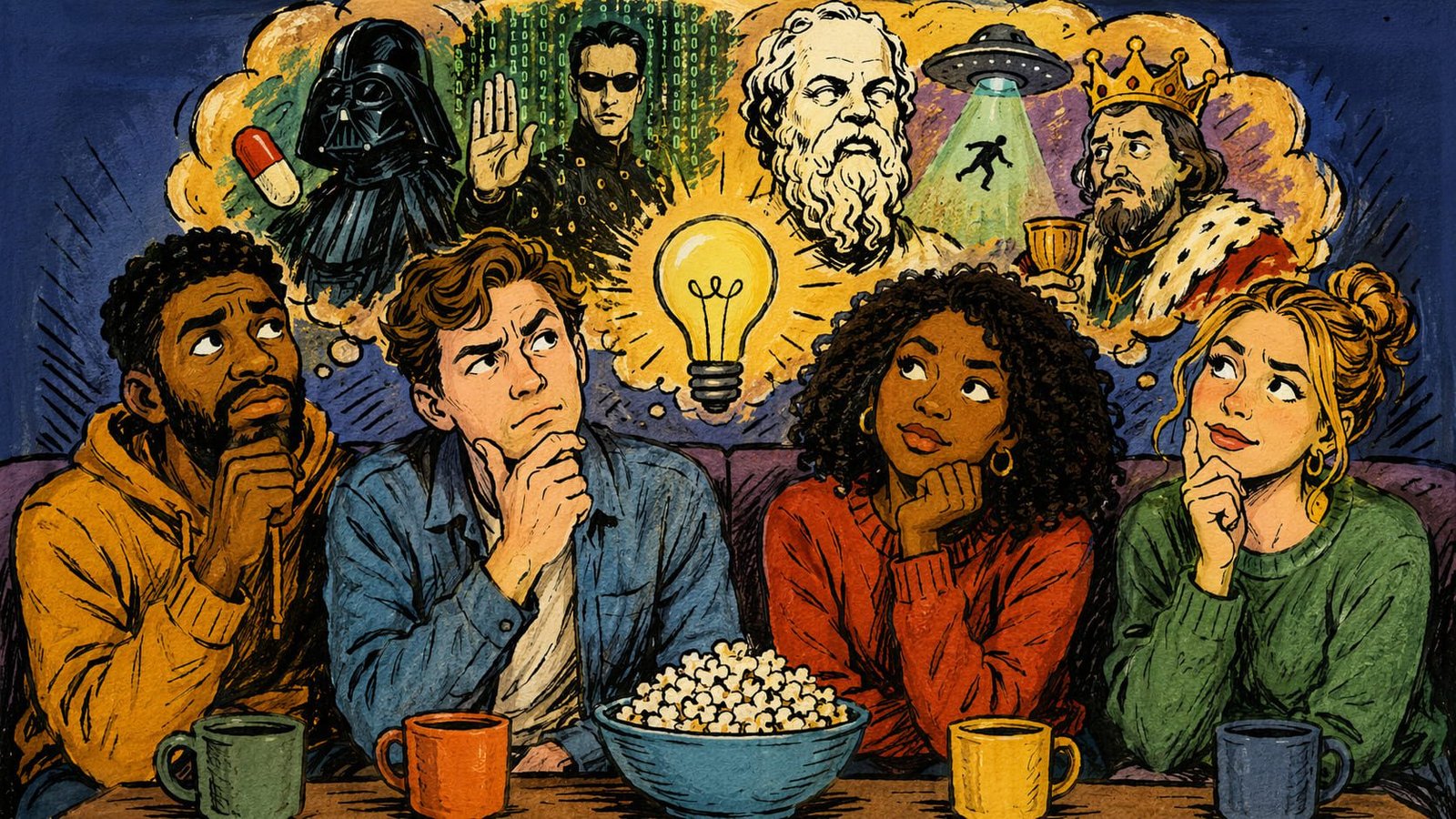
A crowded subway car hums with the low rhythm of motion, faces lit by small glowing rectangles. A line from a show repeats in someone’s mind. A lyric lingers, half-understood but emotionally precise. No one pauses to label it as philosophy, yet something has already taken root. The lesson does not arrive as a lecture. It arrives as a feeling that makes sense before it can be explained. By the time language catches up, the idea has already settled into place.
Pop culture rarely introduces itself as thought. It prefers to disguise its depth behind entertainment, humor, spectacle. That disguise makes it more effective. When ideas come dressed as pleasure, they bypass resistance. A character’s decision becomes a moral argument. A storyline becomes a framework for understanding risk, loyalty, ambition. These narratives do not ask to be studied. They ask to be felt. That is how they slip past analysis and land somewhere more durable.
A young analyst named Jerome once found himself quoting a line from a series during a negotiation. He had not planned to. It simply surfaced, perfectly timed, shaping how he framed the deal. Later, he realized the line had influenced not just his words, but his thinking. The show had presented a worldview where boldness was rewarded and hesitation punished. Jerome had internalized that pattern. The moment felt spontaneous. It was anything but.
This is how philosophy travels now. Not through dense texts or formal debates, but through narratives that carry ideas in compressed form. A single scene can hold a theory about power. A conversation between characters can reveal assumptions about trust. The audience absorbs these patterns, often without naming them. Over time, they become default settings, shaping how situations are interpreted and decisions are made.
Consider how modern storytelling has shifted toward complexity. Characters are rarely purely good or purely bad. They operate in gray areas, making choices that feel both justified and troubling. This mirrors a broader cultural movement toward nuance. The popularity of such narratives suggests a collective appetite for understanding contradictions. It also normalizes a certain kind of moral flexibility, one that feels realistic but can blur boundaries.
A creative director named Lila once noticed her team referencing different shows to justify conflicting strategies. One group leaned on a narrative that celebrated disruption at any cost. Another cited a story that emphasized patience and long-term vision. Both believed they were making rational decisions. In reality, they were drawing from different philosophical frameworks embedded in the content they consumed. The disagreement was not just strategic. It was philosophical, shaped by stories rather than explicit theories.
Pop culture also acts as a testing ground for ideas that might feel risky in real life. Through fiction, audiences can explore scenarios without consequences. They can watch characters take extreme actions, experience the outcomes, and carry those lessons forward. This creates a kind of simulated experience, a rehearsal space for thinking. The insights gained feel personal, even though they are borrowed.
A small independent filmmaker named Ravi once described his work as “building emotional laboratories.” He crafted stories that placed characters in moral dilemmas, allowing viewers to experience the tension without direct involvement. After one screening, a viewer approached him and said the film had changed how she thought about loyalty in her own life. Ravi had not given advice. He had created a scenario that allowed the audience to arrive at their own conclusion. The philosophy was not delivered. It was discovered.
This process is amplified by repetition. Certain themes appear again and again across different forms of media. The idea that success requires sacrifice. The notion that authenticity is the highest virtue. The belief that systems are inherently flawed and must be challenged. Each repetition reinforces the concept, making it feel more like truth than interpretation. Over time, these ideas form a network, a kind of informal philosophy that guides perception.
There is a subtle shift that happens when these ideas become internalized. They begin to influence not just what people think, but how they think. The structure of reasoning changes. The questions that feel worth asking change. The boundaries of what feels possible expand or contract. This is where pop culture moves beyond entertainment and into the realm of cognition. It does not just provide answers. It shapes the process of asking.
A professor once challenged a group of students to trace their beliefs about success back to their sources. Many cited personal experiences, family influences, education. Yet when pressed further, they began to recognize patterns drawn from films, music, and online content. The realization was uncomfortable. It suggested that their most personal beliefs were, at least in part, inherited from shared narratives. The boundary between individual thought and cultural influence blurred.
This does not mean that pop culture dictates thinking in a rigid way. It offers frameworks, not commands. People interpret, adapt, resist. Yet the frameworks themselves set the stage. They define the range of possibilities that feel intuitive. They influence what feels obvious, what feels questionable, what feels unthinkable. In that sense, they act as invisible architecture for thought.
Somewhere in a writer’s room, a new script is taking shape. Characters are being shaped, conflicts designed, resolutions crafted. The creators may focus on plot and pacing, on dialogue and visual impact. Yet beneath those elements, a deeper layer forms. Assumptions about human nature, about society, about meaning. These assumptions will travel with the story, reaching audiences who may never notice them consciously.
As those ideas settle into the background of everyday thinking, one question lingers, quiet but persistent: are you forming your own philosophy, or living inside one that was written for you?
