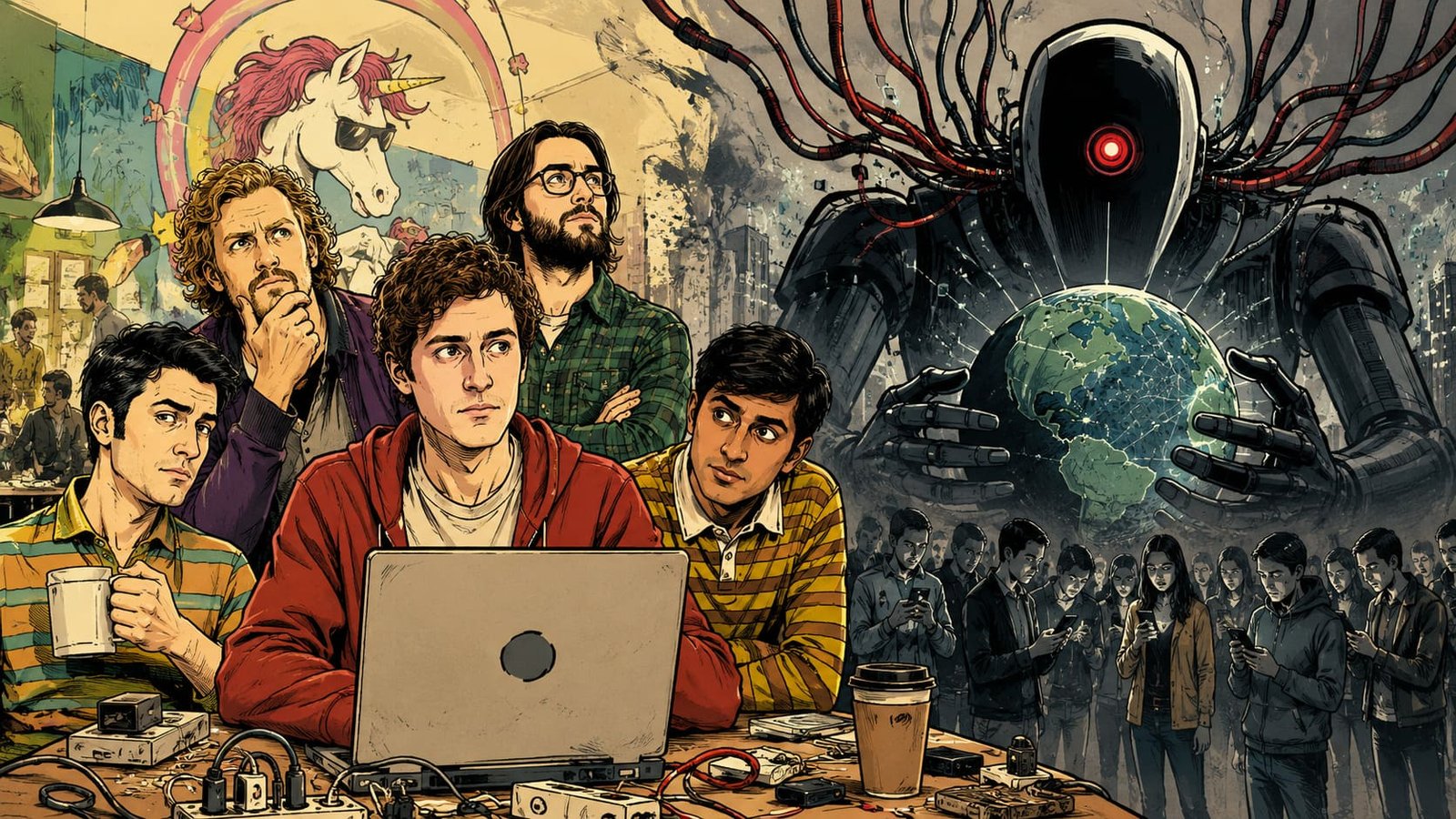
The conference room smelled faintly of burnt coffee, cold ambition, and overpriced deodorant. Young founders in expensive sneakers pitched “world-changing platforms” beneath glowing screens while investors nodded with the solemn intensity of medieval priests blessing a new religion. Outside, self-driving cars drifted silently through California sunlight. Inside Silicon Valley, the future looked less like human progress and more like a nervous breakdown disguised as innovation. The series understood something most technology culture desperately tries to hide: the modern startup ecosystem is often powered by people brilliant enough to change civilization yet emotionally unprepared for ordinary human life.
Richard Hendricks enters the story carrying the awkward fragility of a man who accidentally invents something powerful before fully understanding himself. Pied Piper begins as a compression algorithm and slowly mutates into a psychological experiment about ego, ethics, and the corrosive gravity of scale. Around Richard orbit engineers, investors, opportunists, and dreamers who all speak with the strange confidence of people convinced history belongs to coders. The show’s genius sits inside its ability to expose the absurdity beneath technological utopianism without ever becoming cynical about intelligence itself. These characters genuinely believe they are building the future. That belief makes the comedy sharper because audiences recognize traces of truth behind every ridiculous pitch deck and existential meltdown.
Erlich Bachman remains one of television’s great monuments to startup delusion. Loud, manipulative, occasionally insightful, he behaves like a man who read half of Sun Tzu during a cannabis binge and decided he understood venture capitalism better than everyone else. Yet beneath the satire sits a recognizable archetype. Every innovation boom creates personalities who confuse proximity to genius with genius itself. During the dot-com era it was executives buying domain names like lottery tickets. During the crypto surge it became influencers promising liberation through monkey JPEGs and decentralized fantasies. Silicon Valley captures that recurring human weakness beautifully. Technology changes rapidly. Ego stays prehistoric.
A robotics engineer named Haruto Sakamoto once spent eighteen months building an artificial intelligence tool designed to optimize food distribution networks across Southeast Asia. Investors initially ignored him because his presentations lacked charisma. During one disastrous demo, his software malfunctioned while a rival founder delivered polished nonsense about “redefining human synergy.” The rival raised millions. Haruto nearly quit. Months later his system quietly helped stabilize supply logistics after severe flooding disrupted transportation routes. The flashy competitor vanished. Haruto later admitted the experience taught him a brutal lesson about modern business culture: visibility often outruns value. That tension powers Silicon Valley. The loudest people in the room frequently understand the least, while the quietest carry ideas capable of reshaping industries.
The series becomes especially dangerous when it examines ethics. Most television about technology settles for simple warnings about machines replacing humans. Silicon Valley digs deeper into the psychology of builders themselves. The real threat is not artificial intelligence becoming evil. It is ambitious humans rationalizing harm because growth metrics reward it. Gavin Belson embodies this contradiction perfectly. He speaks in spiritual corporate riddles while crushing competitors with the cold efficiency of an empire protecting territory. Watching him perform enlightened leadership while behaving like a monopolistic warlord feels painfully familiar in an age where technology CEOs quote philosophy books moments before harvesting user attention like industrial farmers harvesting wheat.
There is also something deeply sad beneath the comedy. These characters spend enormous portions of their lives optimizing systems while failing to understand intimacy, trust, or emotional stability. One late-night coding sprint can suddenly reveal crushing loneliness beneath the humor. Dinesh and Gilfoyle insult each other relentlessly, yet their strange companionship often feels more authentic than the performative networking surrounding them. The show quietly argues that modern professional culture has turned intelligence into theater. Everyone must signal brilliance constantly. Everyone must appear visionary. Even failure gets rebranded as “iterative growth.” Somewhere along the way, actual human connection becomes secondary to valuation.
A product manager named Celeste Durham once described attending a startup retreat in Northern California where founders discussed “changing humanity” while screaming at catering staff because the oat milk arrived late. Nobody noticed the contradiction. That detail could have walked directly into Silicon Valley. The show excels at exposing the surreal gap between technological idealism and ordinary human behavior. Its world runs on presentations about community while employees quietly burn out behind glowing screens. It laughs at optimization culture because optimization never ends. One success only creates pressure for larger success. One innovation becomes obsolete before the applause fully fades. The result is an industry permanently trapped between messianic ambition and emotional exhaustion.
Far beyond the polished campuses and investor parties, server farms continue humming in isolated deserts while exhausted programmers stare into blue-lit monitors searching for the next breakthrough capable of making them unforgettable. Somewhere, another founder rehearses a revolutionary pitch while quietly fearing irrelevance more than failure itself. That lingering anxiety is the hidden operating system beneath Silicon Valley. The series does not merely mock startup culture. It reveals how modern society transformed innovation into a spiritual identity, a moral performance, and sometimes a substitute for meaning itself. Beneath every algorithm sits an ancient human desire to matter before time runs out. The terrifying part is how often civilization rewards the people least equipped to carry that responsibility.
Editorial Disclaimer: Whether a TV Show is rooted in fiction or inspired by real events, the actions, decisions, and behaviors portrayed within are not intended to be encouraged, replicated, or endorsed in real-world settings. This review exists solely to analyze the storytelling, characters, themes, and business dynamics presented in the TV Show for educational, analytical, and entertainment purposes. Any ethical or unethical conduct depicted in the TV Show does not reflect the views, values, or endorsements of ESYRITE.
