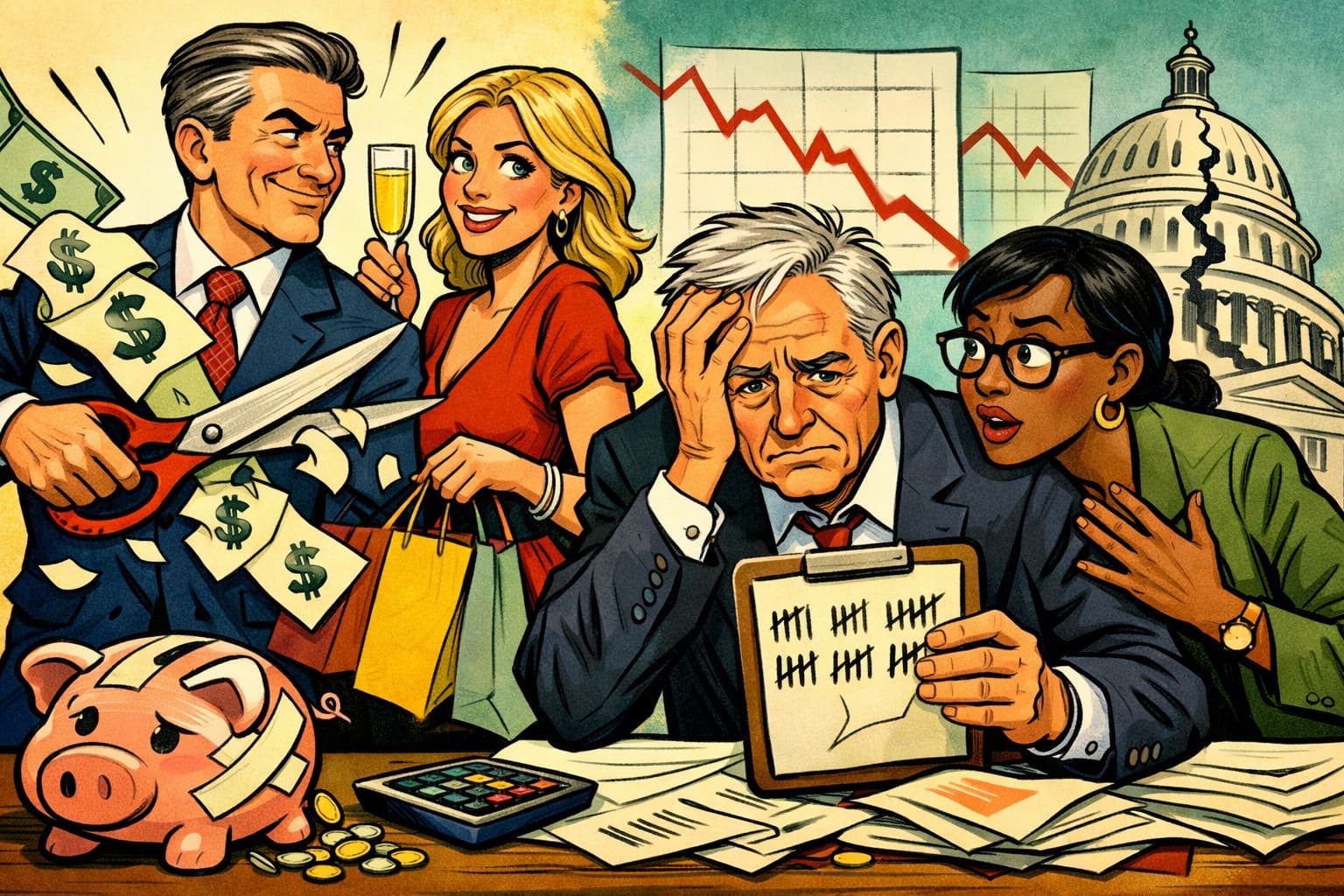
Tax cuts enter politics dressed like movie stars. They are photogenic, easy to chant, and capable of making even tired campaigns look young for a week. Who does not enjoy hearing that life will get lighter, work will pay more, and government will retreat from the wallet with newfound humility? Then the treasury opens the ledger and discovers that a tax cut is not a press release. It is a subtraction with consequences. That is when the seduction ends and the scar tissue begins.
The case for cutting taxes is not nonsense. High tax burdens can discourage work at the margin, distort investment choices, and punish enterprise when badly designed. Pro-growth reform can absolutely matter. The trouble starts when politicians sell tax cuts as if they exist outside the ecosystem of public finance. Revenue lost today either requires faster growth, spending restraint, more borrowing, or higher taxes elsewhere later. There is no secret fifth option hiding in a ministerial drawer next to the patriotic lapel pins. Someone pays, sometime. The only debate is over timing, visibility, and honesty.
That is why markets react so differently to tax cuts that look superficially similar. A reduction paired with credible offsets and institutional trust may be absorbed calmly. A reduction announced with swagger, vague optimism, and borrowed wishful thinking can trigger alarm. Britain’s 2022 mini-budget became the textbook warning. Large unfunded tax cuts were read as a sign that political ambition had detached from fiscal discipline, and borrowing costs rose sharply as credibility cracked.
The deeper problem is psychological. Tax cuts feel personal. Spending cuts feel abstract until they land. That asymmetry makes bad policy politically efficient. A household notices a smaller tax bill fast. It takes longer to notice the road resurfacing delayed, the clinic overstretched, the school building repair postponed, or the housing backlog thickening like wet concrete. By the time the public connects the dots, the political authors of the cut may be touring studios, insisting that growth just needs “a little more time.” Time, in this genre, behaves like a getaway car.
There is also a moral vanity to certain tax-cut arguments. They imply that government has been overeating and that taxpayers are heroic prisoners breaking out of a bloated state. Sometimes that picture is fair. Sometimes it is adolescent cosplay in a tailored suit. Public goods cost money. Courts cost money. Ports cost money. Sewer systems, disease surveillance, public safety, regulators, and digital infrastructure all cost money. A treasury counting scars is often counting the aftermath of leaders who wanted the applause of tax cuts without the discipline of redesigning what the state can realistically afford.
A midsize manufacturer once cheered a local tax cut that lowered business levies just enough to make the quarterly board deck sparkle. Six months later, a freight corridor upgrade was delayed because the regional budget had weakened, and delivery times worsened. The chief executive got a minor cash win and a major logistics headache. That story captures the problem beautifully. Tax cuts can feel like freedom on Monday and bottleneck on Friday. Revenue is not abstract when its absence shows up as friction, decay, and lost reliability across the systems commerce quietly depends on.
This is where ideology can become almost comic. On one side sit the tax-cut evangelists, promising that almost every reduction will pay for itself through growth. On the other side sit the reflexive statists, acting as though every tax increase is morally enlightened. Both camps flatten a hard problem into a costume drama. The better question is not whether taxes should rise or fall in the abstract. It is whether the tax system raises needed revenue with the least economic distortion and the greatest political legitimacy. That is a serious design problem, not a bumper sticker.
The OECD’s work on bracket creep in countries that do not fully index tax thresholds shows how governments sometimes avoid visible tax rises while quietly pulling more revenue from households as wages move up through nominal tax bands. Periodic tax cuts then get marketed as relief from a burden government partly allowed to build in the first place. It is a fiscal soap opera with remarkably good wardrobe and terrible emotional honesty.
The phrase “treasury counts scars” matters because public finance has memory even when politics does not. A tax cut that widens deficits may push future governments into uglier repairs. Those repairs often come through stealthier taxes, weaker services, spending squeezes, or extra borrowing at worse rates. The original cut still gets remembered fondly. The cleanup gets blamed on whoever inherits the mess. That is one of democracy’s nastier accounting tricks. The political reward arrives early. The fiscal bruise ripens later, often in someone else’s hands.
Good tax reform is much less glamorous. It broadens bases, closes distortions, simplifies compliance, and targets incentives where behavior actually changes. It does not need a drumroll every five minutes. It also respects an awkward truth: sometimes the state needs more revenue, not less, especially when ageing, healthcare pressure, defense demands, or debt service are all climbing at once. Pretending otherwise may be emotionally satisfying. It is not strategy. A government that wants Scandinavian services and libertarian tax ratios is not pursuing bold reform. It is dating fantasy.
The most durable leaders in fiscal history understand that tax cuts are tools, not love languages. Used well, they can improve productivity and strengthen confidence. Used badly, they become sugar poured into the engine. For a while the machine sounds lively. Then comes the repair bill, and it always seems to arrive on a week when nobody wants cameras. That is the real treasury instinct. It is not anti-growth or anti-aspiration. It is simply aware that arithmetic keeps records while politics keeps playlists.
Somewhere between the campaign chant and the budget annex sits the country itself, waiting to learn whether relief was real or rented. The scars accumulate quietly, in missed upgrades, higher refinancing costs, thinner resilience, and citizens who start hearing every tax promise as either a trick or a dare. In the end, the most responsible government is not the one that cuts taxes most dramatically. It is the one that can look the public in the eye and explain, without costume or fog, what the nation can keep, what it can build, and what any shiny cut will truly cost when the applause is gone.
