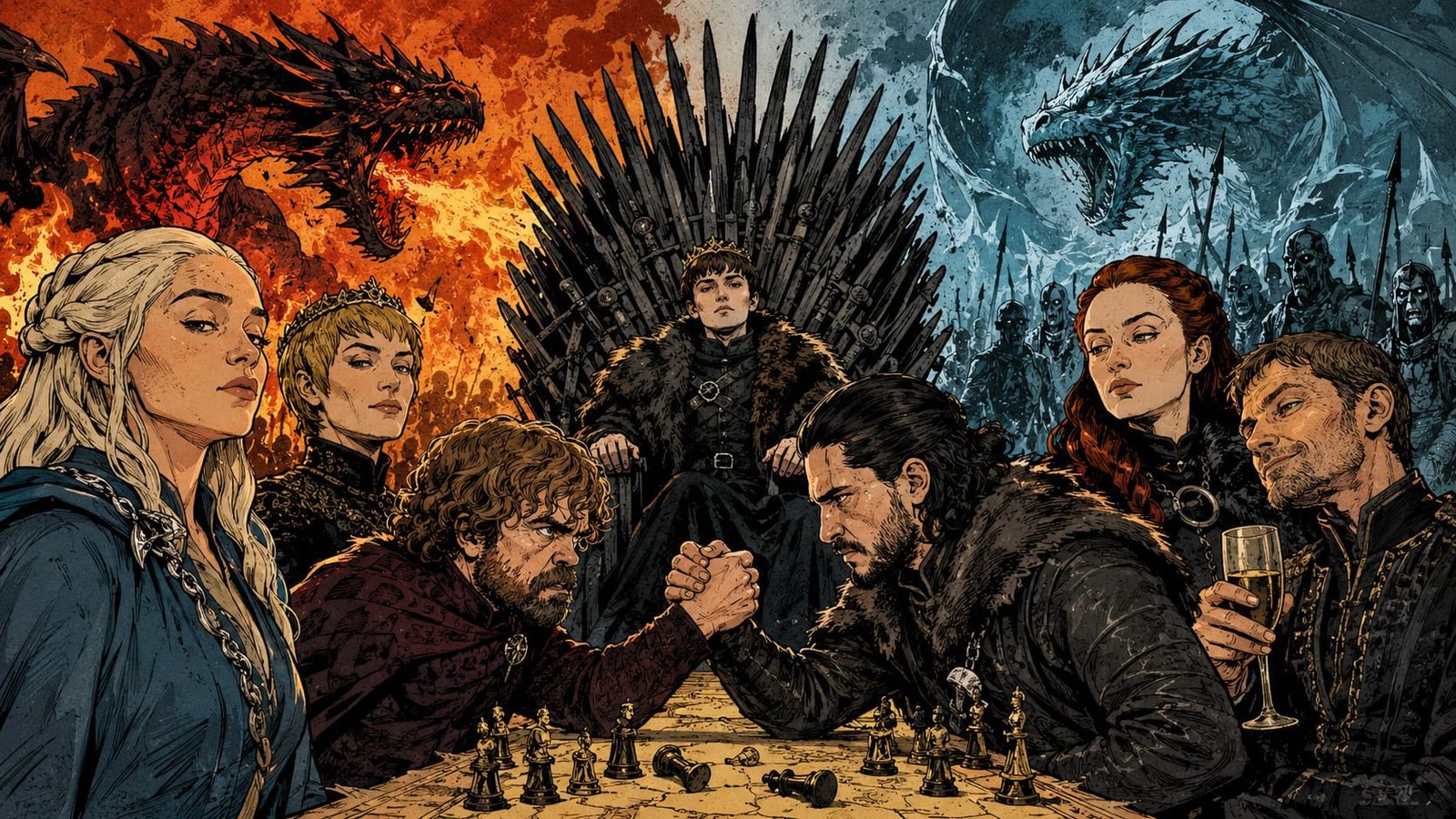
Snow drifted across abandoned battlements while ravens cut through a sky heavy with prophecy and violence. Far below the frozen North, gold goblets clashed inside crowded halls where smiling nobles rehearsed betrayal beneath chandeliers and silk banners. Game of Thrones arrived disguised as fantasy entertainment, yet what it truly delivered was a ruthless anatomy of civilization itself. Kingdoms rise. Institutions decay. Families cannibalize themselves for relevance. Leaders confuse fear with strength. Crowds cheer for saviors until survival becomes inconvenient. The series understood something deeply uncomfortable about human history: societies rarely collapse because evil suddenly appears. They collapse because ambition slowly normalizes cruelty until violence begins sounding reasonable.
The political architecture of Westeros feels terrifyingly real because every faction operates through recognizable human instincts. House Stark believes honor can survive inside systems built on manipulation. House Lannister weaponizes wealth and perception with the cold precision of multinational corporations protecting market dominance. Daenerys Targaryen begins as a symbol of liberation before drifting toward ideological absolutism. Each storyline becomes a meditation on leadership under pressure. The show refuses simplistic morality because real power rarely offers clean choices. A ruler protecting stability may become monstrous. A revolutionary promising justice may become intoxicated by worship. The audience watches characters transform beneath pressure and quietly recognizes pieces of modern politics, boardroom culture, and social behavior staring back at them.
Ned Stark’s execution remains one of television’s defining psychological ruptures because it shattered the comforting fantasy that integrity guarantees survival. Audiences expected moral logic. Instead the show delivered institutional realism. Good intentions without strategic awareness become liabilities inside predatory systems. That lesson echoes far beyond fantasy storytelling. Organizations regularly consume ethical people who mistake competence for protection. One executive follows principles while another studies incentives. Guess who survives the merger. Game of Thrones became culturally explosive because it mirrored anxieties modern audiences already carried but rarely articulated openly.
A shipping magnate named Elias Verhoeven once inherited a logistics empire after his father suffered a stroke. Elias believed transparency and fairness would modernize the company culture. Senior executives publicly praised his vision while quietly forming alliances against him. One trusted advisor leaked confidential negotiations to competitors during a restructuring deal. Another executive manipulated regional managers through fear campaigns disguised as loyalty tests. Within two years Elias realized leadership was not merely about values. It required understanding incentives, ego, tribalism, and institutional memory. He later admitted the most dangerous people were rarely the loudest. They were the calm strategists smiling during private dinners. That realization could have been lifted directly from King’s Landing.
Tyrion Lannister embodies one of the show’s most fascinating contradictions. Intelligence grants him insight yet never fully protects him from prejudice or emotional isolation. He survives partly because he understands narrative. He reads rooms. He recognizes vanity before others notice danger. That skill resembles the emotional intelligence often ignored inside modern management culture. Organizations celebrate technical brilliance while underestimating the strategic value of psychological awareness. Tyrion succeeds because he understands people’s hidden motivations better than most warriors understand battle tactics. Watching him maneuver through political chaos feels strangely educational in an age where leadership increasingly depends on reading emotional currents invisible on spreadsheets.
The series also explores how fear mutates collective behavior. Entire populations shift allegiances depending on security, spectacle, and narrative framing. One ruler burns enemies publicly to project strength. Another distributes food to gain legitimacy. The mechanics resemble modern media ecosystems more than medieval kingdoms. Public opinion becomes volatile. Outrage spreads rapidly. Symbolism matters almost as much as policy. Cersei Lannister understands this instinctively. She weaponizes perception with terrifying precision because she recognizes something timeless about human societies: many people prefer certainty wrapped in cruelty over uncertainty wrapped in compassion. That observation lands with frightening force in the modern political era.
A crisis consultant named Priya Raman once described managing communications during a corporate scandal involving a celebrated consumer brand. Internally, executives panicked like cornered aristocrats while publicly performing calm professionalism. Teams monitored social media sentiment hour by hour as if tracking troop movements during wartime. One board member privately argued that perception mattered more than truth because “memory is shorter than outrage.” Priya later admitted the experience felt less like public relations and more like surviving a siege. Game of Thrones captures that atmosphere perfectly. Institutions under pressure stop behaving ideally and start revealing what they truly worship.
Far beyond the throne rooms and battlefields, winter continues advancing with silent inevitability while rulers remain distracted by status games and inherited grudges. Torches flicker against ancient stone. Horses breathe clouds into frozen air. Somewhere, another ambitious soul mistakes temporary victory for permanent control. That lingering tension is why Game of Thrones endured far beyond dragons and spectacle. It exposed a brutal pattern buried inside human civilization itself: people repeatedly build systems powerful enough to dominate the world while remaining emotionally unequipped to govern themselves. The swords change. The banners change. The technologies evolve. Yet the same ancient hunger keeps returning, whispering that power will finally make human beings feel safe, adored, immortal. History keeps answering with ashes.
Editorial Disclaimer: Whether a TV Show is rooted in fiction or inspired by real events, the actions, decisions, and behaviors portrayed within are not intended to be encouraged, replicated, or endorsed in real-world settings. This review exists solely to analyze the storytelling, characters, themes, and business dynamics presented in the TV Show for educational, analytical, and entertainment purposes. Any ethical or unethical conduct depicted in the TV Show does not reflect the views, values, or endorsements of ESYRITE.
